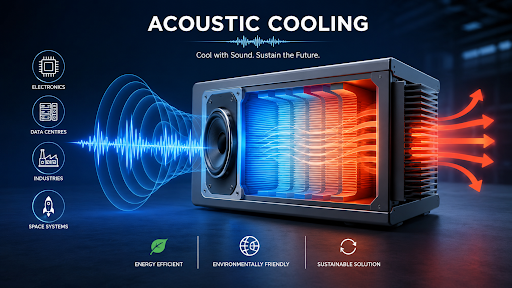
Acoustic Cooling uses sound waves and thermodynamic principles to transfer heat without conventional refrigerants. The technology offers energy-efficient, environmentally friendly cooling for electronics, data centres, industries, and space systems, making it a promising sustainable alternative to traditional refrigeration.
Why In News?
Thermoacoustic cooling research at the Institute of Nano Science and Technology (INST), Mohali, has demonstrated highly efficient sound-driven refrigeration systems.
What is Acoustic Cooling?
Acoustic Cooling or Thermoacoustic Refrigeration uses sound waves to transfer heat and create cooling without conventional compressors or harmful refrigerants.
It combines the principles of acoustics, thermodynamics, and heat transfer.
The technology converts acoustic energy into a cooling effect through pressure oscillations inside a gas-filled chamber.
Researchers consider it a promising alternative to conventional refrigeration because it uses environmentally safe working gases such as helium, nitrogen, or air.
Principle Behind the Technology
Sound Waves and Thermodynamics
Pressure Oscillations
Heat Transfer Mechanism
Key Findings of Recent Research
Energy-Efficient Cooling
Reduced Electricity Consumption
Sustainable Thermal Management
Advantages of Acoustic Cooling
Lower Energy Demand
Environment-Friendly Technology
Reduced Carbon Emissions
Minimal Maintenance
Conclusion
Acoustic cooling represents a next-generation sustainable refrigeration technology that uses sound waves to deliver energy-efficient and refrigerant-free cooling.
Source: pib
|
PRACTICE QUESTION Q. Consider the following statements regarding Acoustic Cooling:
Which of the statements given above are correct? A. 1 only B. 1 and 3 only C. 2 and 3 only D. 1, 2 and 3 Answer: B Explanation: Statement 1 is correct: Acoustic cooling (or thermoacoustic refrigeration) uses high-amplitude sound waves to alternately compress and expand a gas, which drives the transfer of heat from one area to another to produce a cooling effect. Statement 2 is incorrect: Acoustic cooling systems do not require chlorofluorocarbons (CFCs) or any other ozone-depleting and environmentally hazardous chemicals. Instead, they typically use safe, inert gases like helium, argon, or even normal air. Statement 3 is correct: The technology relies on the principles of thermoacoustics, which explores the interaction between thermodynamics and acoustic waves. It converts acoustic energy into heat differentials or vice versa. |






© 2026 iasgyan. All right reserved