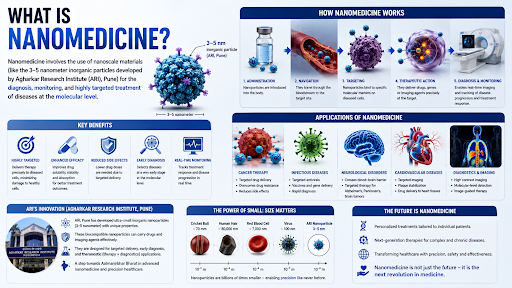
Nanomedicine utilizes nanoparticles to deliver drugs directly to diseased cells, minimizing damage to healthy tissue. Key applications include targeted cancer therapy, precision imaging, and regenerative medicine, revolutionizing treatments by operating at the molecular and atomic levels.
Why In News?
Indian institutes like IIT-BHU and Agharkar Research Institute (ARI), Pune advanced nanomedicine with targeted therapies for breast cancer and antimicrobial resistance.
What Is Nanomedicine?
Nanomedicine leverages nanoscale materials to directly target diseases at the molecular level, offering solutions to global health crises like cancer and Antimicrobial Resistance (AMR).
Core Characteristics of Nanomedicine
Optimal Particle Size: Scientists engineer nanomedicines using particles sized precisely between 3 to 5 nanometers.
Robust Composition: Researchers build these advanced medicines using inorganic compounds or biodegradable mesoporous silica nanoparticles, which feature a high payload capacity and tunable surface chemistry.
High Thermal Stability: These nanoscale inorganic particles remain completely stable at extreme temperatures up to 200 degrees Celsius.
Cost-Effective Production: Manufacturers produce these agents at a very low cost, making advanced precision treatments highly affordable for economically disadvantaged patients.
Major Advantages Over Conventional Therapies
Reduces Systemic Toxicity: Nanomedicine minimizes the severe side effects of traditional chemotherapy by ensuring precise tumor targeting and reducing off-target effects.
Improves Drug Solubility: Nanotechnological tools effectively enhance the solubility and uptake of poorly soluble chemodrugs.
Enables Bedside Fabrication: Medical staff fabricate therapies like the nanotherapeutic clotting implant using minimal, accessible equipment, such as handheld homogenizers and centrifuges, improving healthcare access.
Source: PIB
|
PRACTICE QUESTION Q. The term "Nanomicelles" has recently been in the news. With reference to nanomedicine, what are they? (a) Microscopic organisms used for the biological synthesis of metallic nanoparticles. (b) Synthetic, sub-microscopic structures that group together to transport and deliver poorly soluble drugs. (c) Nanobots programmed to perform localized surgeries on human blood vessels. (d) Polymeric networks used exclusively in orthopedic implants to prevent immune rejection. Answer: (b) Explanation: Nanomicelles are aggregates of amphiphilic molecules (containing both hydrophobic and hydrophilic parts) that assemble into a spherical structure in water. They are highly effective in nanomedicine as targeted drug delivery systems, especially for carrying poorly soluble anti-cancer or therapeutic drugs across biological membranes. |
Nanomedicine involves the use of nanoscale materials (like the 3-5 nanometer inorganic particles developed by IIT-BHU) for the diagnosis, monitoring, and highly targeted treatment of diseases at the molecular level.
NMS is an indigenous combination treatment that uses a patient's serum protein corona to stabilize drug and metal-based nanomedicine. It is mixed with autologous fibrin to create a localized implant that prevents tumor recurrence post-surgery.
Unlike traditional antibiotics, advanced nanomedicines can specifically target the virulence proteins of aggressive microorganisms, effectively destroying them even when they develop resistance to existing drugs.





© 2026 iasgyan. All right reserved