Indian Railways is launching India’s first indigenous hydrogen train on the Jind-Sonipat route, expanding to 8 heritage lines. Emitting only water, this initiative leverages green hydrogen to drive sustainable mobility and achieve net-zero carbon emissions by 2030.
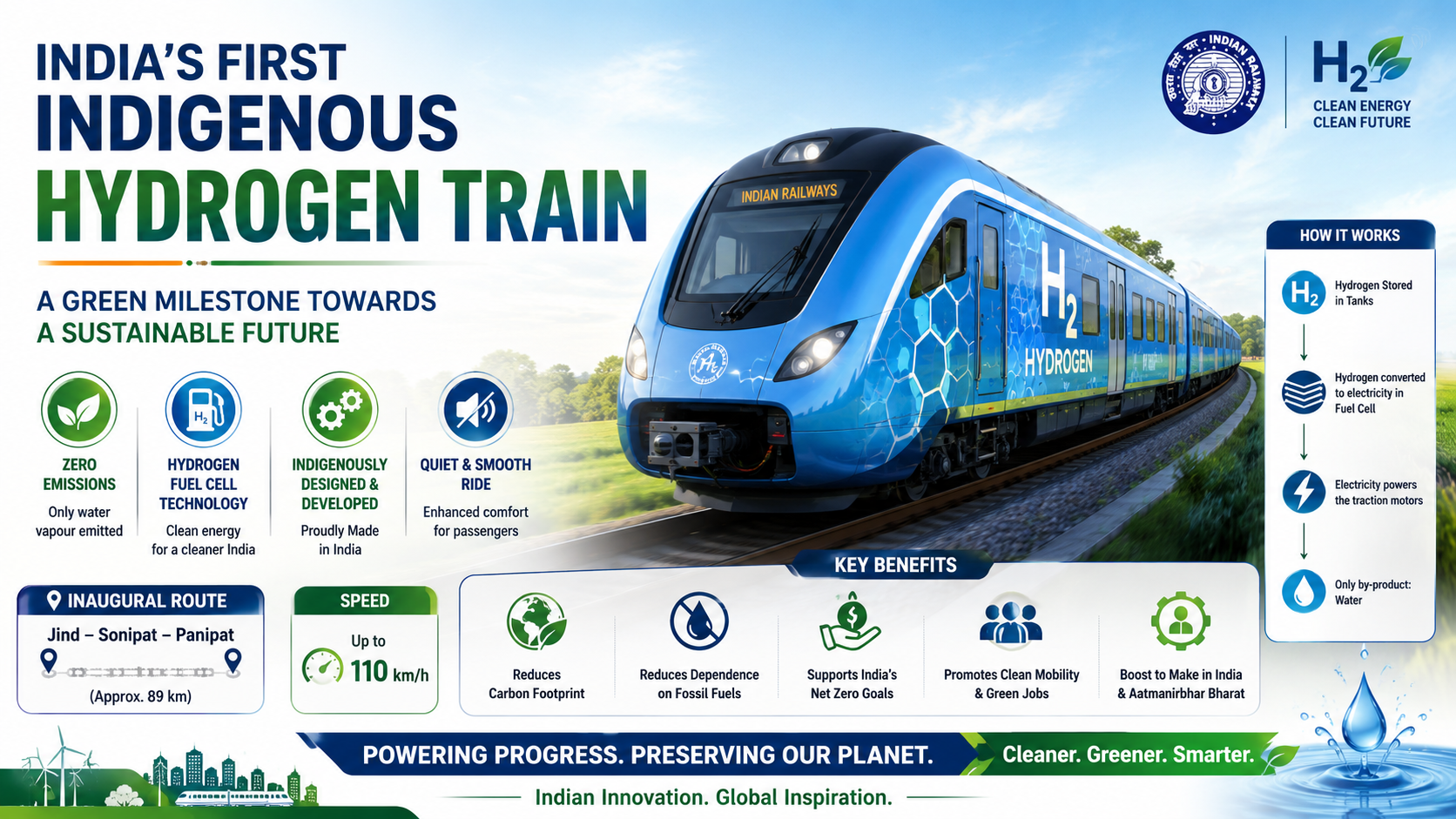
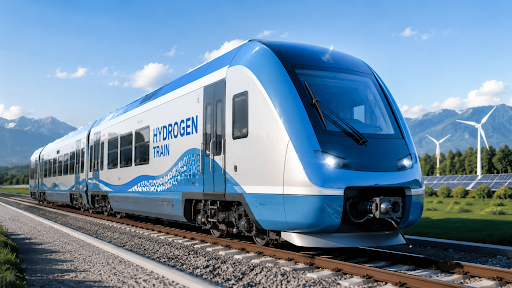
Indian Railways approved India's first indigenous 10-car Hydrogen Fuel Cell-based trainset on the Jind-Sonipat route.
Indian Railways has officially approved the operational rollout of the country's first-ever indigenous 10-car Hydrogen Fuel Cell-based trainset.
Pilot Route: The train will operate on the Jind-Sonipat section of the Northern Railway in Haryana.
Development Body: The Research Designs and Standards Organisation (RDSO), the research arm of Indian Railways, developed the technology.
Train Configuration: The trainset consists of two Driving Power Cars (DPCs) of 1,200 kW each (totaling 2,400 kW) and eight passenger cars, making it the world's longest hydrogen train on a Broad Gauge platform.
Operational Capacity: It features a 1,200 KW propulsion engine designed for consistent passenger transit with a maximum safe operating speed of 75 kmph.
Maintenance Hub: A dedicated maintenance workshop at Shakurbasti supports the trainset under strict RDSO-approved standard operating procedures.
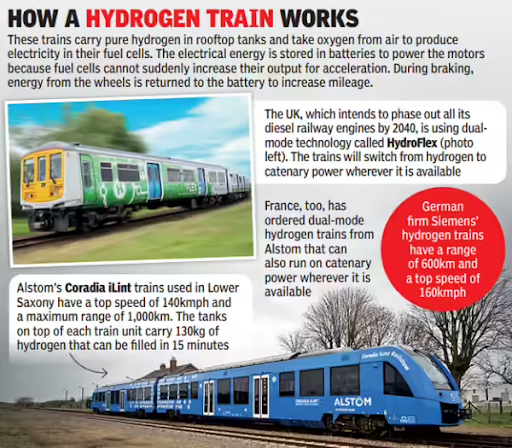
Unlike traditional engines that burn fuel, a hydrogen fuel cell train uses an electrochemical process to generate electricity onboard.
Chemical Power Generation: The system mixes onboard compressed hydrogen gas with oxygen drawn from the outside air inside a specialized fuel cell stack.
Electrochemical Conversion: These gases pass through an internal membrane, triggering an electrochemical reaction that combines hydrogen and oxygen atoms to produce steady electrical energy.
Propulsion System: This electricity routes directly to a heavy-duty propulsion engine to turn the wheels and power all onboard electronics.
Zero-Pollution Discharge: The chemical reaction uses no fossil fuels and produces zero carbon emissions, releasing only clean water vapor and heat as byproducts.
 What Are The Major Advantages Of Hydrogen-Powered Trains?
Decarbonization and Net Zero Goals: Hydrogen trains support India’s mission to achieve Net Zero emissions by 2070. They serve as a zero-emission alternative to diesel engines on non-electrified routes.
Energy Independence: Utilizing domestically produced Green Hydrogen reduces India’s reliance on imported fossil fuels, supporting the goal of becoming energy independent by 2047.
Higher Efficiency: Fuel cells provide higher energy conversion efficiency compared to traditional combustion-based technologies.
Infrastructure Flexibility: Hydrogen-powered locomotives can run on existing railway tracks, requiring lower infrastructure modifications than full-line electrification.
Quiet Operation: Fuel cells have a minimal number of moving parts, allowing the train to operate much more quietly than diesel combustion engines.
Lifetime Cost Savings: Despite higher initial capital costs, hydrogen trains can offer lifetime cost savings (up to ₹33 crore on specific routes like Kalka-Shimla) due to higher efficiency and falling hydrogen prices. (Source: Center for Study of Science, Technology and Policy)
 Key Initiatives and Strategic Frameworks
The Indian Government has established several frameworks to catalyze the adoption of hydrogen in the rail sector.
|
Initiative |
Core Purpose |
Details |
|
Establish a Green Hydrogen ecosystem; targets 5 MMT production per annum by 2030. |
Initial outlay of ₹19,744 crore; includes the SIGHT program for incentives. |
|
|
Hydrogen for Heritage |
Deploy hydrogen trains on environmentally sensitive and tourist-heavy heritage hill tracks. |
Plans for 35 hydrogen trains; estimated cost of ₹80 crore per train and ₹70 crore ground infra per route. |
|
Provide financial incentives for electrolyzer manufacturing and green hydrogen production. |
Outlay of ₹17,490 crore to de-risk first movers and increase uptake. |
Selected Heritage Routes for Hydrogen Deployment:
Infrastructure Deficiencies: A major obstacle remains the lack of specialized ground infrastructure. For example, the Jind plant requires 4,000 liters of water daily to generate hydrogen, but adequate supply systems are often missing.
High Initial Capital Expenditure (CAPEX): The initial cost of hydrogen trainsets is higher than diesel locomotives.
Safety Concerns: Hydrogen is highly flammable. Ensuring safety requires advanced multi-tier grids featuring hydrogen leak detectors, flame detectors, and automated alarm systems to handle potential explosions or fires.
Water Availability: The production of green hydrogen through electrolysis demands massive amounts of water, which is a constraint in regions with poor water infrastructure.
Nascent Production Scale: India currently lacks the capability to produce green hydrogen at a commercial scale, leading to high fuel costs in the initial phase.
Technical Integration: Questions remain regarding how to effectively integrate hydrogen-powered trains with existing electrified tracks and ensure the safety of personnel who currently lack specialized safety gear for hydrogen handling.
Focus on Low-Frequency Routes: Identify railway routes where electrification is not economically viable (e.g., hilly terrain or industrial shunting yards) for hydrogen conversion.
Build Backward Linkages: Develop robust infrastructure for hydrogen storage, refueling, and pipelines/trucks to ensure a steady fuel supply.
Aggregated Ordering: Indian Railways should aggregate orders for hydrogen components to drive down capital costs through economies of scale.
Phased R&D: Implement a phased Research and Development roadmap focusing on indigenizing the value chain, specifically for fuel cells and electrolyzers.
Safety Standardization: Establish a robust ecosystem of regulations, codes, and safety standards aligned with international norms to build public and operational trust.
Establishment of Hydrogen Hubs: Develop large-scale Hydrogen Hubs where production and utilization are geographically proximate to minimize transportation challenges.
India's indigenous hydrogen train represents a technological leap toward green transportation, balancing high initial costs with long-term environmental sustainability and energy security.
Source: ndtv
|
PRACTICE QUESTION Q. Consider the following statements regarding India's first indigenous hydrogen train:
Which of the statements given above are correct? (a) 1 and 2 only (b) 2 and 3 only (c) 1 and 3 only (d) 1, 2, and 3 Answer: (c) Explanation: Statement 1 is correct: The Indian Railways approved the operation of a 10-car hydrogen fuel cell-based trainset on the Jind-Sonipat section of the Northern Railway in Haryana as a pilot project. Statement 2 is incorrect: Hydrogen fuel cell technology does not burn hydrogen gas in a combustion engine. Instead, it generates electricity through an electrochemical reaction that combines hydrogen and oxygen within a fuel cell, producing only water vapor and electricity with zero harmful emissions. Statement 3 is correct: Under the "Hydrogen for Heritage" scheme (mission), Indian Railways plans to deploy 35 such eco-friendly trains across various hilly and heritage routes to reduce diesel dependence and carbon emissions. |
It is an eco-friendly train powered by an onboard hydrogen fuel cell propulsion system. It mixes compressed hydrogen gas with oxygen from the air to generate continuous electricity, emitting only clean water vapor and heat as byproducts, thereby replacing conventional diesel engines.
India's first indigenous 10-car hydrogen trainset will operate on the dedicated Jind-Sonipat section in Haryana as a pilot route, running at a maximum speed of 75 kmph.
Key challenges include the nascent stage of commercial green hydrogen production, lack of robust storage and transportation infrastructure, scarcity of critical minerals for manufacturing electrolysers, and safety concerns regarding highly explosive compressed hydrogen gas.



© 2026 iasgyan. All right reserved