Scientists from the Zoological Survey of India discovered a new cascade-dwelling frog, Amolops kamal, in Nagaland’s Kiphire district.
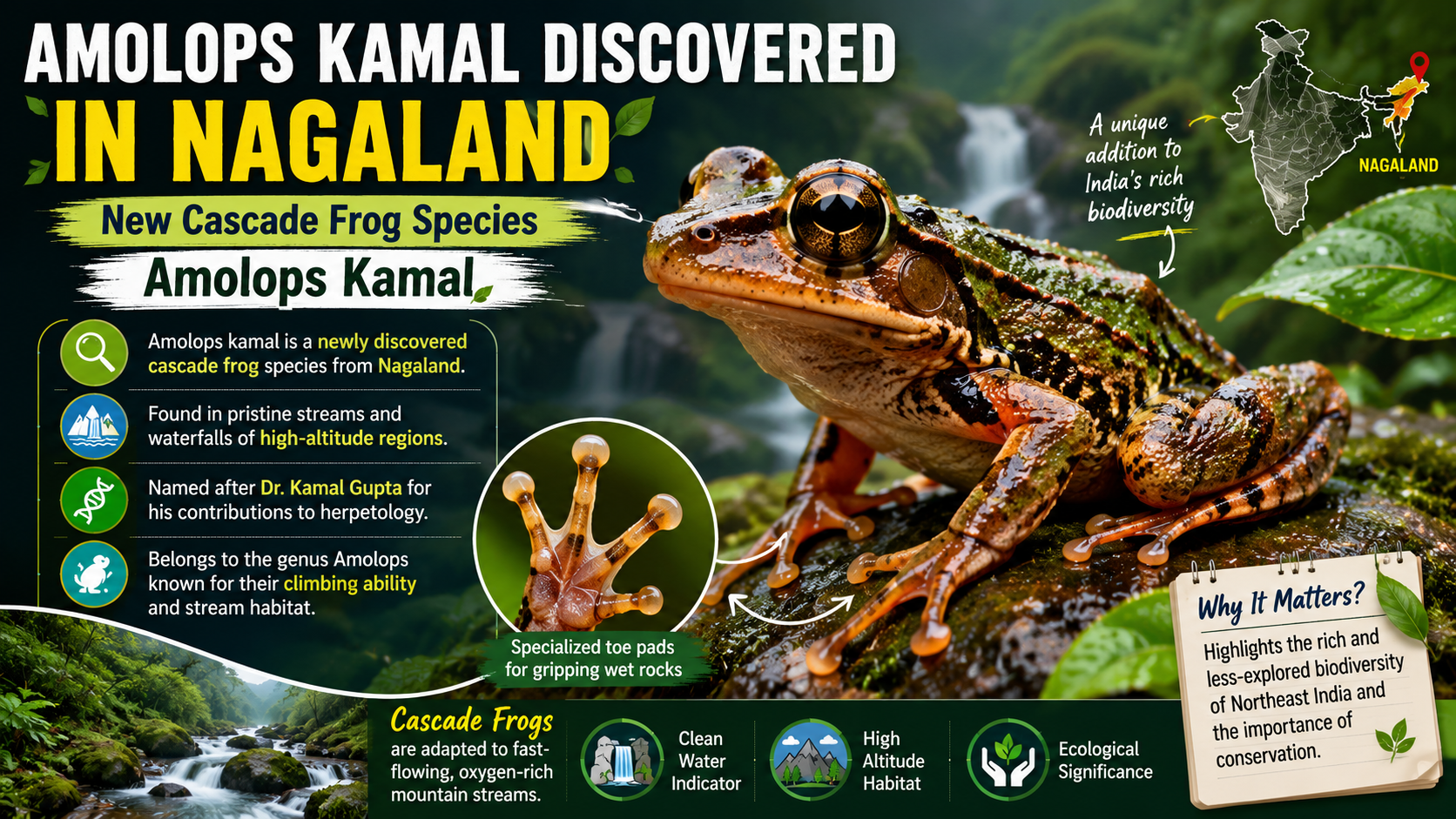
Scientists from the Zoological Survey of India (ZSI) discovered a new species of cascade-dwelling frog, named Amolops kamal.
A team of scientists from the Zoological Survey of India (ZSI) discovers a new-to-science amphibian species named Amolops kamal.
The research team formally names the species in honor of Dr. Kamal Choudhury, a late zoologist and former professor at B. Barooah College, Guwahati, to recognize his mentorship and contributions to regional biodiversity studies.
The scientific findings published in the journal Records of the Zoological Survey of India.
Taxonomists classify the genus Amolops as cascade frogs or sucker frogs. Globally, the genus contains about 90 recognized species, with 20 of these species reported in India.
Habitat
The species exclusively inhabits rugged, isolated hill-stream ecosystems and thrives near turbulent, fast-flowing mountain waterfalls.
Researchers trace the frog's origin to the remote Singrep village located in the Kiphire district of Nagaland, which shares a mountainous border with Myanmar.
The habitat falls within the Eastern Himalayan and Indo-Burma biodiversity hotspot, an area celebrated for its unique microclimates, forested hills, and rich amphibian life.
Characteristics
Cryptic Species: The frog exhibits extreme morphological mimicry. It represents a cryptic species, meaning it looks nearly identical to related frogs to the naked eye but remains entirely genetically distinct.
Physical Adaptations: It possesses strong limbs, extensive foot webbing, and large digital discs (adhesive toe pads) that allow it to effectively grip slick, wet rocks against rushing water currents.
Ecological Significance
The cascade frog acts as a vital bio-indicator of stream health, forest quality, and local climate stability because it easily falls victim to minor ecological disturbances.
Frogs like Amolops kamal maintain local ecological balance by controlling insect populations and serving as an essential prey base for regional birds and reptiles.
Source: THE HINDU
|
PRACTICE QUESTION Q. Consider the following statements regarding the newly discovered Amolops kamal:
Which of the statements given above is/are correct? (a) 1 only (b) 2 only (c) Both 1 and 2 (d) Neither 1 nor 2 Answer: c Explanation: Statement 1 is correct: Scientists from the Zoological Survey of India (ZSI) discovered a new-to-science species of cascade-dwelling frog from the hill-stream habitats of Nagaland's Kiphire district. It has been named Amolops kamal (Nagaland cascade frog). Statement 2 is correct: Integrative taxonomic analyses, which included molecular phylogenetic studies, confirmed that the frog belongs to the Amolops indoburmanensis cryptic species complex. Statement 3 is incorrect: Because cascade frogs share intense morphological similarities and often exist as cryptic species, distinct evolutionary lineages cannot be confirmed solely through traditional body measurements. Researchers relied on an integrative taxonomic approach that required molecular phylogenetic studies (DNA sequencing) alongside physical morphological examinations to validate the discovery. |
Amolops kamal, commonly known as the Nagaland cascade frog, is a newly discovered amphibian species belonging to the family Ranidae that is highly adapted to fast-flowing hill streams.
It was discovered in the rugged hill-stream ecosystems near Singrep village in the Kiphire district of Nagaland, a region that borders Myanmar.
The species was named in honour of the late Dr. Kamal Choudhury, a zoologist and former head of the zoology department at B. Barooah College, Guwahati, as a tribute to his mentorship of the study's lead author.






© 2026 iasgyan. All right reserved