TRAI's proposed C-V2X regulatory framework, backed by NFAP-2025 spectrum allocations, aims to revolutionize India's Intelligent Transport Systems. This technology enables real-time vehicle-to-infrastructure communication, dramatically improving road safety, reducing emergency response times, and strengthening international tech collaborations.
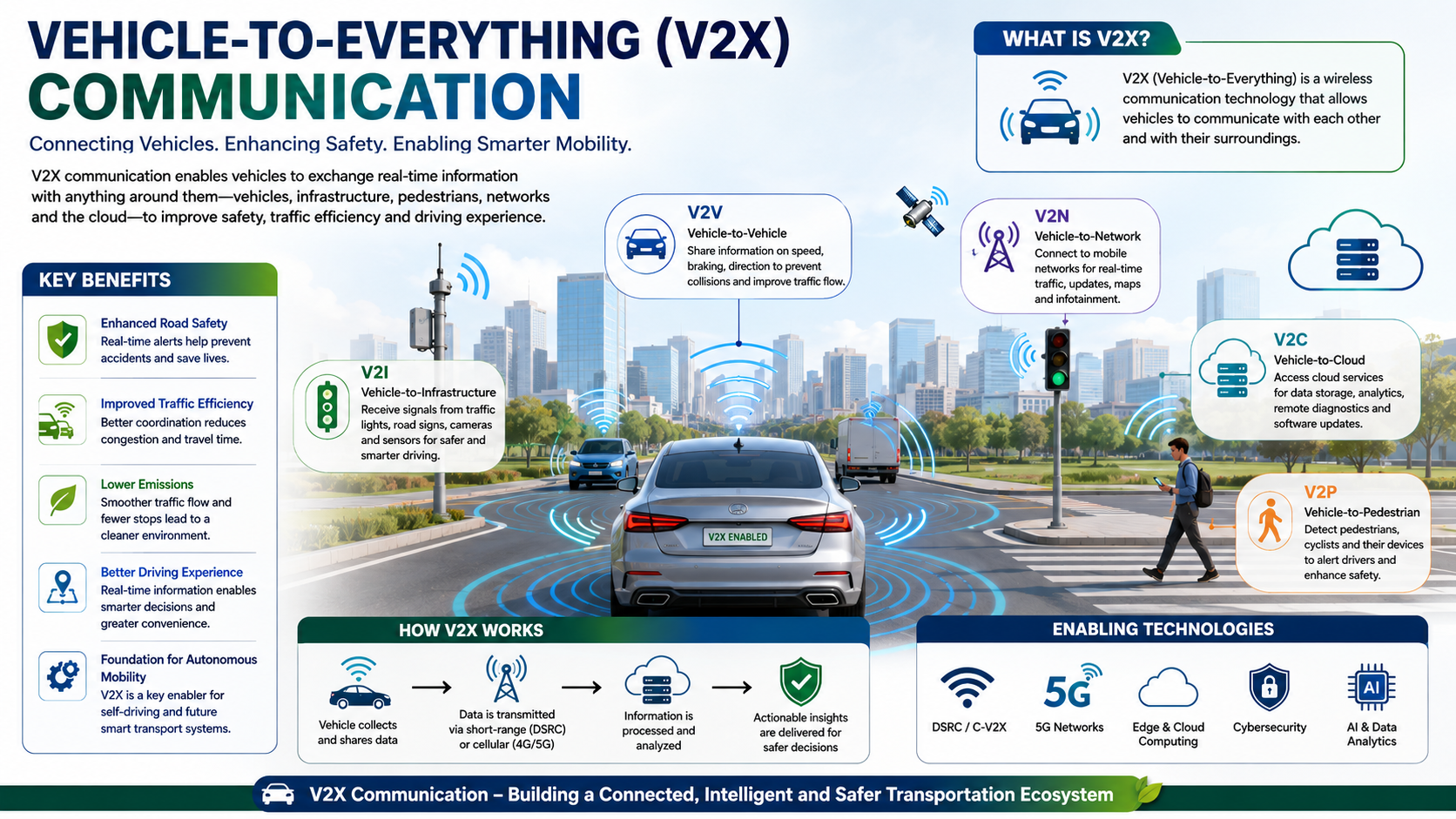
The Telecom Regulatory Authority of India (TRAI) has issued a consultation paper on the regulatory framework for Vehicle-to-Everything (V2X) communication.
Definition: V2X is an interoperable wireless platform that allows a vehicle to exchange data with any entity that may affect it.
360-Degree Awareness: It functions as a virtual sensor, providing Non-Line-of-Sight (NLOS) awareness. This allows vehicles to detect hidden hazards, such as cars around corners or pedestrians at blind intersections.
Data Exchange: Vehicles continuously share information regarding relative speed, geographic position, and direction.
Standards: Global development focuses on two primary technologies: Cellular V2X (C-V2X) and Dedicated Short-Range Communication (DSRC). India has identified C-V2X as the likely harmonized standard due to its scalability and 5G integration.
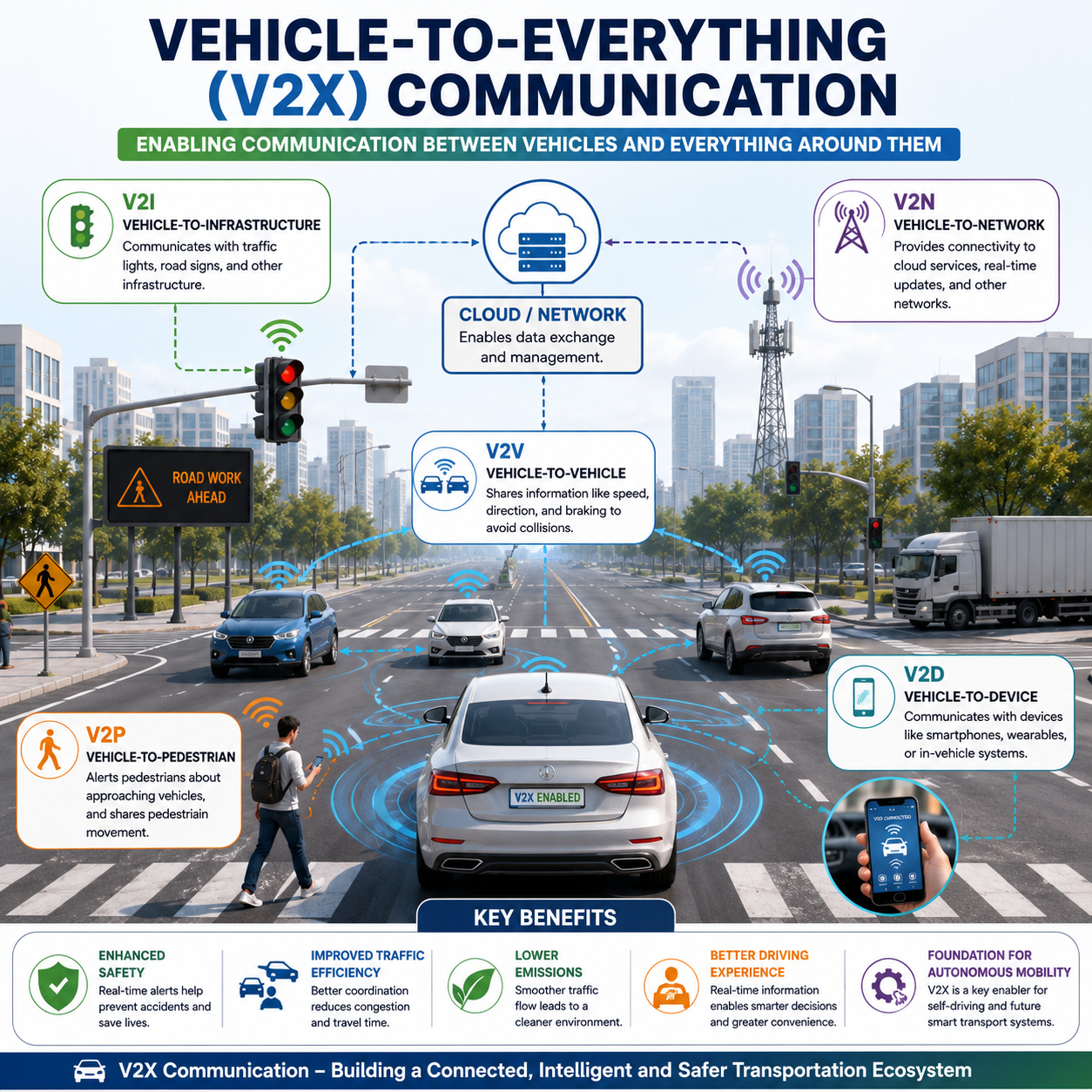 How Does V2X Communication Work?
V2X operates through a distributed architecture that facilitates both short-range direct links and long-range cellular network communication.
On-Board Units (OBUs): Hardware installed inside vehicles that transmits and receives safety alerts.
Roadside Units (RSUs): Static nodes installed at traffic lights, highways, and toll plazas that communicate with vehicles and the central road network.
Communication Layers:
Ultra-Low Latency: The system requires swift message transfers (<100ms in DSRC and as low as 10-20ms in 5G) to trigger automated emergency braking or signal pre-emption.
Security Frameworks: Employs Public Key Infrastructure (PKI) and pseudonym certificates to verify data packets, preventing hackers from spoofing location or braking coordinates while maintaining driver privacy.
|
Mode |
Communication Link |
Primary Function & Impact |
|
Vehicle-to-Vehicle (V2V) |
Vehicle ↔ Vehicle |
Shares speed and braking data to prevent multi-car accidents and provide collision warnings. |
|
Vehicle-to-Infrastructure (V2I) |
Vehicle ↔ Roadside Units |
Links with traffic lights and smart signs to optimize flow and enable emergency vehicle priority. |
|
Vehicle-to-Pedestrian (V2P) |
Vehicle ↔ Smartphones/Wearables |
Protects vulnerable road users (cyclists, pedestrians) by alerting drivers to their presence in blind spots. |
|
Vehicle-to-Network (V2N) |
Vehicle ↔ Cloud/Cellular |
Connects to long-range services for real-time navigation, weather updates, and fleet analytics. |
|
Vehicle-to-Device (V2D) |
Vehicle ↔ Personal Hardware |
Enables broader interactions, such as links to smart home systems or local user hardware. |
Reduction in Road Fatalities: NCRB reported 1.73 lakh deaths and 4.63 lakh injuries in 2023. More than 90% of accidents stem from human error, V2X acts as a digital safety net to prevent misjudgments.
Emergency Vehicle Prioritization (EVP): V2X allows ambulances and fire trucks to "talk" to traffic signals, triggering a "green wave" that can reduce response times.
Traffic and Fuel Efficiency: By reducing "stop-and-go" traffic through systems like Green Light Optimized Speed Advisory (GLOSA), fuel consumption and CO2 emissions can be reduced.
Economic Impact: The automotive industry contributes 7.1% to India's GDP. Connected mobility fosters new opportunities for telecom operators, automakers, and tech providers.
Public Health Gains: Safeguarding the "golden hour" in medical emergencies significantly improves survival rates for trauma, cardiac, and stroke patients.
High Initial Costs: On-Board Units (OBUs) currently cost an estimated ₹5,000–₹7,000 per vehicle, which may be passed on to price-sensitive consumers.
Infrastructure Gaps: Nationwide rollout requires massive investment in Roadside Units (RSUs) and the upgrade of legacy traffic controllers to Adaptive Traffic Control Systems (ATCS).
Technical Obstacles: Physical structures like metro pillars create "shadow zones" that interfere with signals, necessitating higher RSU density.
Regulatory Complexity: Determining whether RSUs require specific authorizations under the Telecommunications Act, 2023, and managing spectrum fees for public safety vs. commercial services remains a challenge.
Interoperability: Ensuring that cars from different manufacturers can communicate seamlessly with varying roadside hardware requires strict adherence to open global standards.
Mandatory Adoption: India should mandate OBU installation in all emergency fleets (EMRI-108), fire brigades, and police vehicles by 2027.
Institutional Coordination: Establish a National Task Force involving MoHUA, MoRTH, and MeitY to define uniform standards and cybersecurity requirements.
Pilot Expansion: Leverage the TiHAN testbed at IIT Hyderabad—India's first multi-modal connected and autonomous vehicle testbed—to simulate complex urban scenarios.
Public-Private Partnerships (PPP): Encourage models involving telecom operators, smart city SPVs, and private hospitals to fund and maintain the digital infrastructure layer.
State-Level Strategies: Development of a "V2X Strategy 2030" (e.g., in Telangana) can serve as a blueprint for other states, focusing on high-congestion medical corridors.
V2X communication is a vital national priority, evolving India's digital infrastructure to enhance urban mobility and save lives through smart, low-latency connectivity.
Source: PIB
|
PRACTICE QUESTION Q. With reference to Vehicle-to-Everything (V2X) technology and its regulatory framework in India, consider the following statements:
Which of the statements given above is/are correct? A) 1 and 2 only B) 2 and 3 only C) 1 and 3 only D) 1, 2, and 3 Answer: A Explanation: Statement 1 is correct. The National Frequency Allocation Plan 2025 (NFAP-2025), released by the Department of Telecommunications (DoT), has earmarked 50 MHz in the frequency range of 5875–5925 MHz specifically for Intelligent Transport Systems (ITS) and Vehicle-to-Everything (V2X) technologies. Statement 2 is correct. V2X technology communicates via radio signals (such as C-V2X), allowing it to "see" around corners and through obstacles. Unlike traditional sensors like cameras and radars, which typically require a direct line of sight, V2X alerts remain effective even when hazards are obscured by traffic, road curves, fog, or other blind spots. Statement 3 is incorrect. Under the framework proposed by the Telecom Regulatory Authority of India (TRAI) and envisaged by the DoT, On-Board Units (OBUs) installed in vehicles are recommended to be license-exempt under defined technical conditions. This exemption is intended to facilitate widespread adoption and easy installation for end-users. In contrast, Roadside Units (RSUs) may require specific authorization |
C-V2X is an advanced wireless communication standard that allows vehicles to exchange real-time data with other vehicles (V2V), infrastructure (V2I), pedestrians (V2P), and cellular networks (V2N). It provides a 360-degree digital safety net to prevent collisions and optimize traffic flow.
By equipping ambulances with On-Board Units (OBUs) and traffic signals with Road-Side Units (RSUs), C-V2X allows ambulances to securely communicate with traffic systems to preempt red lights. This creates automated green corridors, significantly reducing emergency response times during the critical "golden hour".
The DoT proposes allocating 50 MHz in the 5.9 GHz band (5875–5925 MHz) for V2X and Intelligent Transport Systems (ITS) under the National Frequency Allocation Plan 2025 (NFAP-2025).


© 2026 iasgyan. All right reserved