The Chandrayaan-3 'hop' maneuver blew away the top layer of lunar dust, allowing the ChaSTE instrument to reveal a complex two-layer regolith structure. These discoveries about the Moon's thermophysical properties will guide future lunar habitat construction.
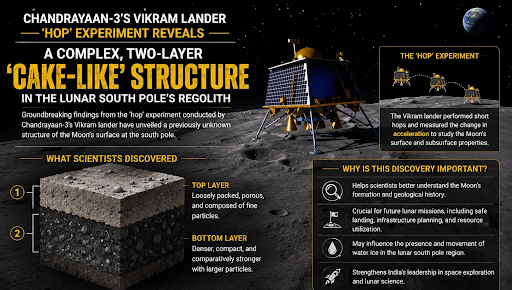
A team of scientists from the Indian Space Research Organisation (ISRO) shared a report of the findings of the ‘Hop’ experiment conducted by the Vikram Lander of Chandrayaan-3.
|
Read all about: Chandrayaan-3: Key Findings & Achievements l Chandrayaan-3 |
Chandrayaan-3 is India's third lunar exploration mission, which successfully achieved soft landing near the Moon's south pole on August 23, 2023.
This success made India the first country to land in the south polar region and the fourth country overall to soft-land on the Moon.
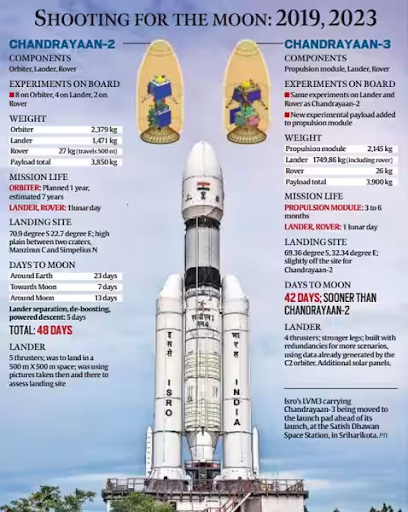
Core Mission Components
The spacecraft had a total mass of 3,900 kg and was divided into distinct functional systems:
Significant Scientific Discoveries
Two-Layered Soil Structure: A controlled "hop experiment" performed by the Vikram lander stripped away the top 3 cm of loose dust.
Buried Ancient Crater: Geological mapping from rover paths and orbital imagery proved that the Statio Shiv Shakti landing site sits within a massive, degraded 160-km wide buried impact crater.
Chemical Profile: The Pragyan rover confirmed the definitive presence of Sulphur (S) on the surface, alongside key metallic elements like Aluminum, Calcium, Iron, and Titanium.
Seismic and Plasma Activity: Payloads recorded localized high-latitude moonquakes and documented sharp twilight thermal drops.
ISRO's Vikram lander executed a "hop" experiment near the lunar south pole (Shiv Shakti point).
The lander reignites its engines, lifts itself approximately 40 to 50 cm above the lunar surface, and safely lands 30 to 50 cm away using residual propellant.
The engine exhaust plume acts as a powerful blower and strips away the top 3 cm of loose lunar dust (fluff layer), exposing older, untouched material beneath.
Key Discoveries: Two-Layer 'Cake-Like' Structure
The 'hop' experiment disproves the assumption of uniform lunar dust, revealing a distinct two-layer 'cake-like' structure within the top few centimeters.
Top Layer (2 to 6 cm): The surface dust proves highly cohesive (sticky) and hyper-porous. It acts as a thermal blanket, which plays a critical role in trapping and storing water-ice molecules in the subsurface.
Subsurface Layer (below 6.5 cm): The regolith suddenly becomes twice as dense and five times more cohesive (bulk density jumps from 750 to 1600 kg m⁻³).
Astronauts walking on this surface would experience the top layer as loose dry flour, while the subsurface feels like damp, stiff clay.
Extreme thermal gradients; surface temperatures record higher than expected (330K), while the soil just 10 cm below remains approximately 60°C cooler.
Source: NEWINDIANEXPRESS
|
PRACTICE QUESTION Q. The recent analysis of the Chandrayaan-3 'hop' experiment revealed a "two-layer cake-like" structure on the Moon's surface. In this context, what is the significance of the uppermost hyper-porous layer of the lunar regolith? (A) It acts as a highly conductive medium transferring heat rapidly to the lunar core. (B) It acts as a thermal blanket that plays a crucial role in storing water-ice molecules in the subsurface. (C) It provides a dense, solid foundation necessary for landing heavy spacecraft. (D) It generates internal heat during the long lunar night. Answer: B Explanation: Analysis of data from the Chandrayaan-3 'hop' experiment revealed that the top 2-6 cm of lunar regolith is a highly cohesive and hyper-porous layer that acts as a thermal blanket. This insulating layer plays a crucial role in maintaining subsurface temperatures, which is critical for trapping and storing water-ice molecules. |
The 'hop' experiment was a maneuver where the Vikram lander reignited its engines, lifted about 50 cm off the ground, and safely landed 30-50 cm away.
ChaSTE probed the newly exposed ground, revealing a two-layer "cake-like" regolith structure and recording a sharp temperature drop during the lunar twilight.
Lunar regolith is the layer of shattered rock, consisting of tiny, jagged, glass-like shards that cover the Moon's solid bedrock, created by constant micrometeorite bombardment.






© 2026 iasgyan. All right reserved