Paramphistomiasis (rumen fluke disease) is a highly fatal parasitic infection affecting Indian livestock. Spread via intermediate aquatic snail hosts, its immature larvae cause severe intestinal necrosis and "bottle jaw". It spikes during monsoons and requires targeted oxyclozanide therapy.
Why In News?
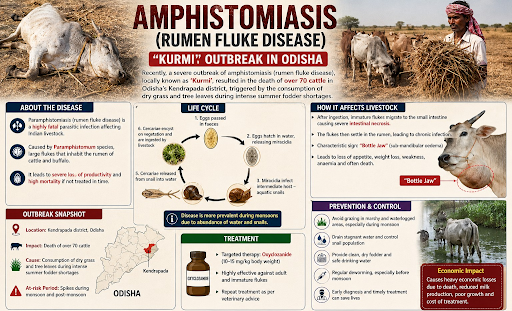
Recently, a severe outbreak of rumen fluke disease, locally known as 'Kurmi', resulted in the death of over 70 cattle in Odisha's Kendrapada district.
About Rumen Fluke
Rumen flukes (Paramphistomes) are parasitic trematodes infecting ruminants via snail intermediate hosts.
Physical Characteristics: Adult parasites are pear-shaped, pink or red in color, and reach lengths of up to 15 mm.
Location in Host: Adult flukes attach to the lining of the rumen (stomach), while immature forms (1–3 mm long) reside in the small intestine and duodenum.
Causes and Environmental Factors
Intermediate Hosts: The parasites require planorbid, bulinid, or mud snails (Galba truncatula) to complete their life cycle.
Pasture Conditions: High rainfall, poorly drained areas, and heavily irrigated pastures increase the risk of infection.
Seasonal Influence: In India, the highest infection rates occur during the monsoon season, as the weather facilitates snail breeding and larval dispersal.
Summer Risk: During summer grass shortages, cattle graze on dry grass and tree leaves near water sources, making them vulnerable to infection, locally termed 'Kurmi' in some Indian regions.
Transmission and Life Cycle
The transmission of rumen fluke follows a complex indirect life cycle involving an aquatic environment.
Symptoms
Diarrhea, rapid weight loss, "bottle jaw" (submandibular swelling), reduced milk yield, curdling, and major body mass loss despite a normal appetite.
Treatment
Oxyclozanide: This is the only anthelmintic compound effectively proven to kill both mature and immature rumen flukes.
Source: TIMESOFINDIA
|
PRACTICE QUESTION Q. Consider the following statements regarding Rumen Fluke disease frequently mentioned in the news:
Which of the statements given above is/are correct? (a) 1 and 2 only (b) 1 and 3 only (c) 2 and 3 only (d) 1, 2, and 3 Answer: (b) Explanation: Statement 1 is correct: Paramphistomiasis (Rumen Fluke disease) is caused by trematode parasites whose mature stages attach themselves to the lining of the rumen and reticulum of ruminant livestock (such as cattle, sheep, and goats). Statement 2 is incorrect: While adult flukes attach to the rumen (stomach), they are generally harmless and do not cause the most severe clinical disease. The most severe clinical disease, acute hemorrhagic enteritis, and high mortality rates are caused by the immature larval forms as they gather and burrow into the mucosa of the small intestine (duodenum). Statement 3 is correct: The life cycle of the rumen fluke is heteroxenous, meaning it requires an intermediate aquatic snail host (such as Indoplanorbis or Lymnaea) to develop from eggs into infective cercariae. |
It is a severe parasitic infection in ruminants (cattle, sheep, goats) caused by various species of rumen flukes (amphistomes).
Infected animals exhibit severe watery diarrhoea, rapid weight loss, dehydration, anorexia (loss of appetite), and swelling under the jaw, commonly known as a "bottle jaw".
The disease is managed through targeted anthelmintic medicines; currently, oxyclozanide is the only drug documented to effectively kill both immature and mature rumen flukes.





© 2026 iasgyan. All right reserved