The 2026 Ebola outbreak in the DRC’s Ituri province involves the Bundibugyo strain, claiming 65 lives. With no approved vaccine for this variant, the Africa CDC and WHO are leading urgent regional coordination to prevent a cross-border public health crisis.
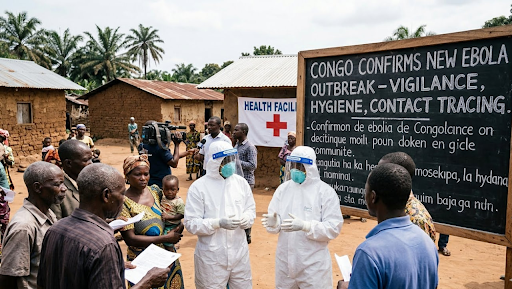
The Democratic Republic of Congo has confirmed a new Ebola outbreak.
The Orthoebolavirus causes Ebola Virus Disease (EVD), a rare, severe, and fatal hemorrhagic illness endemic to African tropical forests.
Scientists identify six distinct species of the virus, with three primary strains driving large outbreaks: Zaire, Sudan, and Bundibugyo.
Fruit bats belonging to the Pteropodidae family serve as the natural hosts for the virus.
The disease carries an average case fatality rate of 50%, though it can reach up to 90% depending on the specific viral strain and outbreak conditions.
Transmission Mechanisms
Infected wildlife (such as bats, chimpanzees, and gorillas) transmit the virus to humans through close contact or consumption of raw meat.
Infected individuals spread the virus to others via direct contact with bodily fluids (including blood, vomit, feces, and semen).
Contaminated objects, surfaces, and unsafe burial ceremonies involving direct contact with deceased bodies heavily drive community transmission.
Symptoms & Diagnosis
The virus exhibits an incubation period of 2 to 21 days before infected individuals show symptoms.
Patients experience sudden fever, fatigue, muscle pain, and sore throat, which rapidly escalate to vomiting, diarrhoea, and impaired kidney/liver function.
Late-stage symptoms include internal and external bleeding, such as bleeding from the gums, nose, or needle puncture sites.
Medical professionals diagnose the disease using specialized tests, primarily the RT-PCR assay and ELISA tests.
Treatments
The World Health Organization (WHO) approves specific monoclonal antibodies (mAb114/ansuvimab and REGN-EB3/Inmazeb) to treat the Zaire strain.
Currently lacks approved vaccines or specific therapeutics for the Bundibugyo and Sudan strains.
Medical workers depend on optimized supportive care, such as rehydration and symptom management, to improve patient survival rates.
Source: BBC
|
PRACTICE QUESTION Q. Consider the following statements about the Ebola Virus Disease:
Which of the statements given above is/are correct? A) 1 only B) 2 only C) Both 1 and 2 D) Neither 1 nor 2 Answer: B Explanation: Statement 1 is incorrect. While the Zaire ebolavirus is the most common cause of Ebola outbreaks in the Democratic Republic of the Congo (DRC) historically, the rare Bundibugyo ebolavirus strain was confirmed to be the primary cause of the outbreak in the region. Statement 2 is correct. Currently, all approved and licensed Ebola vaccines (such as Ervebo and Zabdeno) and therapeutics (such as Inmazeb and Ebanga) are specifically designed and approved for the Zaire ebolavirus strain. There are currently no approved vaccines or specific treatments officially licensed for the Bundibugyo strain. |
It is the 17th recorded Ebola outbreak in the Democratic Republic of the Congo, centered in the Ituri province. By mid-May 2026, it had resulted in at least 65 deaths and 246 suspected cases.
The 2026 outbreak is caused by the Bundibugyo strain. This complicates response efforts because existing approved vaccines and treatments were primarily designed for the Zaire strain, which was responsible for most previous outbreaks.
Ebola spreads through direct contact with the bodily fluids (like blood, vomit, or feces) of infected people or animals, or by touching contaminated objects and surfaces. It is not an airborne disease.



© 2026 iasgyan. All right reserved