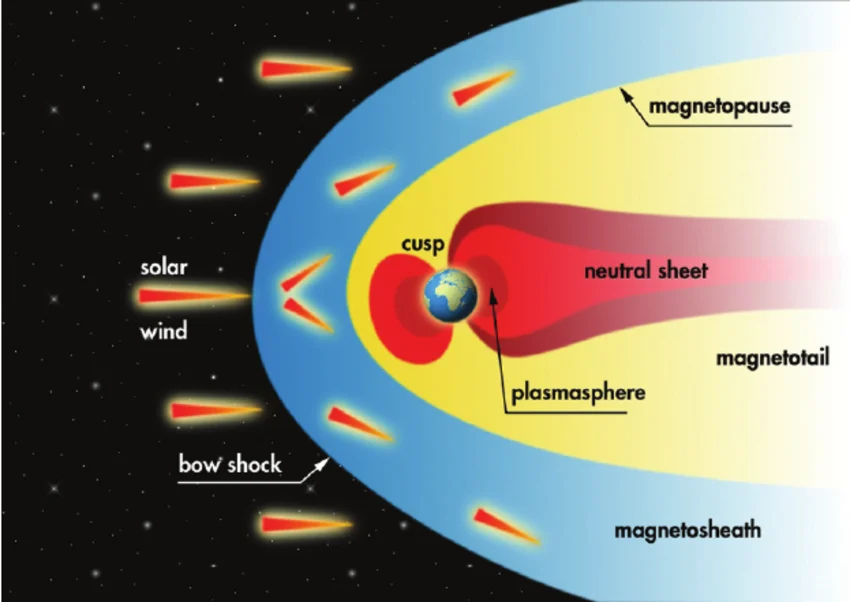
Earth's magnetosphere shields us from severe space weather that threatens modern infrastructure. The joint China-Europe SMILE mission provides unprecedented X-ray imaging of these solar interactions, while proposals like artificial mass-loading offer innovative defenses against devastating geomagnetic storms.
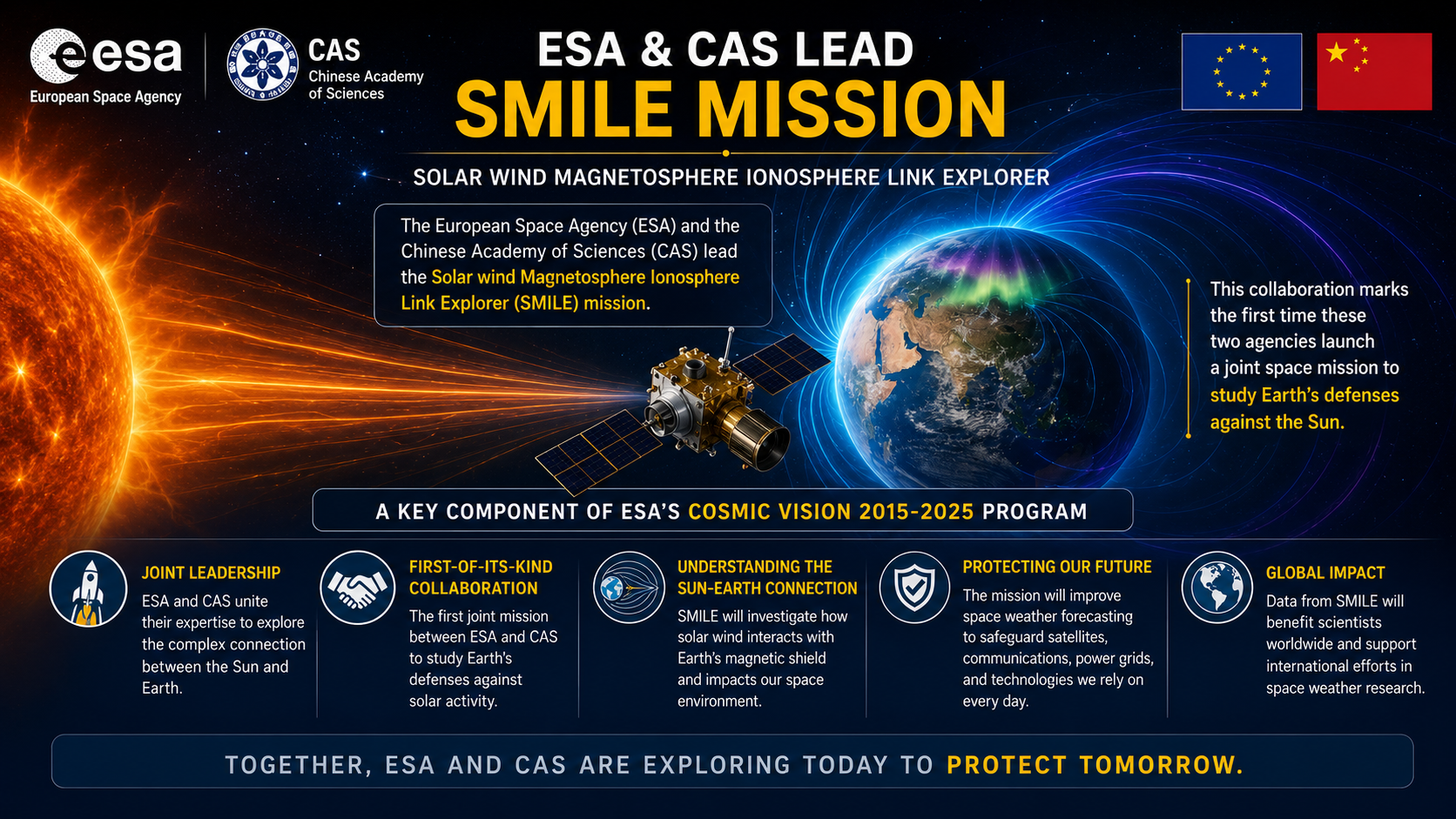
The SMILE mission was launched to study space weather by analyzing how solar winds interact with Earth's protective magnetic shield and dark-side magnetic glitches.
The European Space Agency (ESA) and the Chinese Academy of Sciences (CAS) lead the Solar wind Magnetosphere Ionosphere Link Explorer (SMILE) mission.
This collaboration marks the first time these two agencies launch a joint space mission to study Earth's defenses against the Sun.
The mission operates as a key component of the ESA's Cosmic Vision 2015-2025 program.
 Launch and Technical Specifications
A European Vega-C rocket launched the 2,600 kg spacecraft from Europe's Spaceport in French Guiana.
The spacecraft will enter a Highly Elliptical Orbit (HEO), positioning it approximately 1.21 lakh km above Earth's north pole for a three-year mission life.
SMILE carries four scientific payloads that weigh 70 kg in total and operate on X-ray and ultraviolet wavelengths.
The ESA developed the Soft X-ray Imager (SXI), while the CAS developed the Magnetometer, Light Ion Analyser (LIA), and partnered on the Ultraviolet Aurora Imager (UVI).
Objectives
SMILE builds a complete understanding of the Sun-Earth connection by measuring the dynamic interaction between solar wind and Earth's magnetosphere.
The mission utilizes remote sensing and in situ observations to capture the first-ever global X-ray images of Earth's magnetic shield deflecting harmful solar energies in real-time.
The spacecraft will monitor auroras continuously in ultraviolet and X-ray energy bands for up to 45 hours at a time.
Significance and Applications
SMILE improves physicists' ability to forecast solar storms and space weather.
The mission establishes an early warning system for potent solar ejections like solar flares and coronal mass ejections.
Accurate space weather prediction protects space-based assets (satellites, GPS, navigation systems) and ground-based infrastructure (like electricity grids) from disruptive magnetic glitches.
Unlike previous local missions like Swarm and Cluster, SMILE provides a full global view of the magnetosphere's interactions.
Source: INDIANEXPRESS
|
PRACTICE QUESTION Q. Which space agencies are the primary joint collaborators on the Solar Wind Magnetosphere Ionosphere Link Explorer (SMILE) mission? A) NASA and ESA B) ESA and ISRO C) ESA and the Chinese Academy of Sciences (CAS) D) JAXA and NASA Answer: C Explanation: The SMILE mission is a major, first-of-its-kind collaborative space science project jointly developed and funded by the European Space Agency (ESA) and the Chinese Academy of Sciences (CAS). The Goal: It aims to explore the deep link between Earth's magnetic shield (the magnetosphere) and the streaming solar wind. |
The Solar wind Magnetosphere Ionosphere Link Explorer (SMILE) is a joint mission between the European Space Agency (ESA) and the Chinese Academy of Sciences (CAS) launched to study how the solar wind interacts with Earth's magnetosphere.
SMILE uses a combination of advanced instruments, including a Soft X-ray Imager (SXI) and an Ultraviolet Imager (UVI), to capture the first global X-ray and ultraviolet images of Earth's magnetic shield and the resulting auroras.
It is a proposed active defense mechanism where spacecraft in geosynchronous orbit release chemicals (like lithium or barium) to create a protective plasma shield. This increases the mass density at the dayside magnetopause, heavily reducing the efficiency of magnetic reconnection and effectively weakening a geomagnetic storm.






© 2026 iasgyan. All right reserved