DUAL-USE SATELLITES AND THE BLURRING LINES OF MODERN SPACE WARFARE

Dual-use satellites blur the lines between civilian infrastructure and military targets, shifting modern space warfare toward non-kinetic cyberattacks. This trend challenges existing space treaties and International Humanitarian Law, prompting India to develop a dedicated Military Space Doctrine


Description

Why In News?

Dual-use satellite expansion shifts space warfare from physical attacks to signal disruption, blurring civilian-military lines and rendering current international treaties obsolete.

What are Dual-Use Satellites?

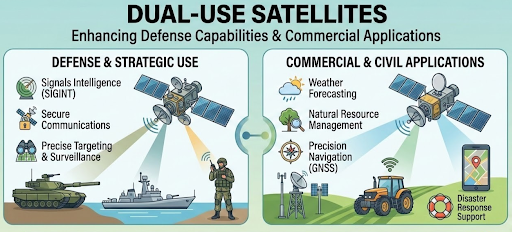
Definition: Dual-use satellites are space systems designed to simultaneously serve civilian/commercial purposes (e.g., broadband internet, GPS, weather forecasting) and military/national security objectives (e.g., high-precision data, encrypted communications, drone targeting).

 Working Mechanism

  • Shared Spectrum: Frequencies are used by both civil aviation and tactical military units.
  • Integrated Data: Satellites provide low-resolution data for civilians and high-resolution data for militaries.
  • Commercial Hosting: Militaries piggyback their sensors on private commercial satellites to save costs.

Modern Space Warfare 

Modern orbital conflict no longer requires physical destruction to paralyse an adversary. It relies on cyberattacks, signal jamming, spoofing, and ground station hacking.

  • Debris Avoidance: Physical attacks create vast clouds of high-velocity debris, triggering the Kessler Syndrome (a chain reaction of collisions) which could render Low Earth Orbit (LEO) unusable for generations.
  • Cost Efficiency & Reversibility: Non-kinetic techniques are cheaper and allow for temporary disruptions instead of permanent destruction.
  • Escalation Control: Keeps conflicts below the threshold of overt war. For example, the 2022 cyberattack on the Viasat KA-SAT network severed communications across Europe without firing a single shot.

Strategic & Legal Challenges 

  1. Collapse of the Civilian-Military Divide & IHL
  • Under International Humanitarian Law (IHL), the "Principle of Distinction" requires warring parties to differentiate between civilian objects and military targets.
  • The "Starlink Precedent": When commercial networks provide "space as a service" for military kill-chains, they lose their protected civilian status, making entire networks legitimate grey-zone targets even if they serve schools or hospitals.

The Attribution Gap

  • Cyber-disruptions in space leave no physical trace and operate through proxy networks and spoofed identities.
  • Without absolute evidentiary proof of the perpetrator, international deterrence fails, encouraging continuous low-intensity attacks.

Legal Blindspots & Treaty Gaps

  • Outer Space Treaty (OST) 1967: Article IV bans the placement of Nuclear Weapons and WMDs in orbit but does not explicitly prohibit dual-use satellites, conventional weapons, or cyber operations.
  • UN Charter Ambiguity: Article 2(4) prohibits the "use of force," but fails to clearly define if bricking a satellite via malicious code constitutes an act of war.

Orbital Dependency & Socio-Economic Risks

  • Global systems rely on satellites. GPS spoofing can misguide ships, and syncing failures can freeze international finance.
  • Jurisdictional Mirage for the Global South: Emerging economies rely on third-party commercial satellites. A silent cyber-strike can paralyse a developing state’s ability to govern, effectively disenfranchising the nation digitally.

India’s Space Security Preparedness

  • Defence Space Agency (DSA) (2019): Established as the central organization for space-related defense operations, consolidating India's space warfare capabilities.
  • Mission Shakti (2019): Proved India's Anti-Satellite (ASAT) kinetic capability.
  • Antariksha Abhyas 2024: India's first comprehensive space defense exercise simulating space warfare scenarios.
  • CERT-In/SIA-India Guidelines (2026): Mandates a "secure-by-design" protocol for all Indian satellites to embed cybersecurity into every stage of a satellite's lifecycle.
  • Military Space Doctrine (Upcoming): Currently in the final stages of formulation, it will aim to integrate space capabilities into national defense, creating deterrence and offensive/defensive capabilities.
  • Project NETRA: India's Space Situational Awareness (SSA) system acts as the "eyes and ears" to track debris and threats.

Way Forward

Adopt "Functional Effects Testing": International law must be updated to recognize that the loss of functionality of a satellite through cyber means is legally equivalent to its physical destruction.

PAROS Treaty: Finalize the legally binding Prevention of an Arms Race in Outer Space (PAROS) treaty to explicitly prohibit any weapons (kinetic and non-kinetic) in orbit.

Cooperative Attribution Mechanisms: Build international intelligence-sharing coalitions to trace and identify cyber-aggressors in space in real-time.

Distributed Constellations: Transition from relying on a few large, expensive satellites to swarms of "many, small" satellites. Destroying a single node in a massive mesh network is strategically useless.

Strengthen Terrestrial Backups: Build resilient ground-based navigation and communication systems to reduce total orbital dependency in times of conflict.

Conclusion

To prevent constant conflict, the world must urgently set digital boundaries for orbital warfare, as signal disruption on dual-use satellites can turn civilian infrastructure into legitimate military targets.

Source: THEHINDU

PRACTICE QUESTION

Q. "The proliferation of dual-use satellites has rendered traditional international space treaties obsolete." Critically analyze. 150 words

Frequently Asked Questions (FAQs)

Dual-use satellites are space assets designed to simultaneously serve civilian/commercial purposes (like internet, weather forecasting, and mapping) and military/national security objectives (such as intelligence gathering, drone targeting, and encrypted communications).

The Outer Space Treaty focuses on prohibiting the placement of Weapons of Mass Destruction (WMDs) in orbit, but it fails to explicitly address cyber operations, non-kinetic disruptions, or the deployment of dual-use commercial satellites.

Kessler Syndrome is a catastrophic scenario where kinetic physical attacks on satellites create vast clouds of high-velocity debris, triggering a chain reaction of collisions that could render Low Earth Orbit (LEO) unusable for generations.


Free access to e-paper and WhatsApp updates

Let's Get In Touch!