The WHO has cleared the first child-friendly Artemether-Lumefantrine formulation for infants (2–5kg). This dual-action ACT therapy ensures precision dosing, eliminating risky manual adjustments and closing a critical treatment gap for the world's most vulnerable newborns.
Why In News?
The World Health Organization prequalified a new dispersible Artemether-Lumefantrine formulation for infants.
What is Artemether-Lumefantrine?
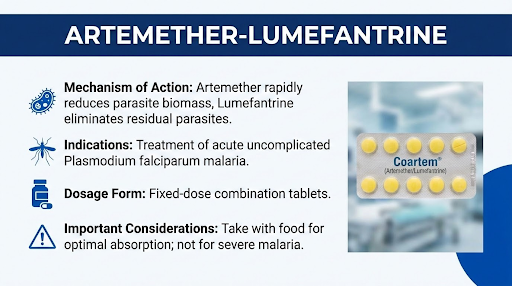
It is the first WHO-prequalified child-friendly version of the standard Artemisinin-based Combination Therapy (ACT), specifically designed for newborns and infants weighing between 2kg and 5kg.
How does it work?
Artemether: A fast-acting component that rapidly reduces the parasite load in the bloodstream during the initial stages of infection.
Lumefantrine: A long-acting component that stays in the body longer to clear any residual parasites, preventing a relapse of the disease.
Significance of the WHO Prequalification
Closing the Treatment Gap: Previously, newborns under 5kg received "off-label" treatments or manually adjusted adult doses, leading to high risks of under-dosing or toxicity.
Global Procurement: Prequalification allows international agencies like UNICEF and The Global Fund to purchase and distribute the drug to high-burden regions.
Vulnerability reduction: Children under 5 account for approximately 80% of all malaria deaths in the WHO African Region; this drug provides a targeted survival tool for the most fragile among them (Source: WHO)
Related Concept: The "R21/Matrix-M" Vaccine
While Artemisinin-based Combination Therapy (ACT) treats active infections, the R21/Matrix-M malaria vaccine (developed by Oxford and Serum Institute of India) focuses on prevention. Together, they form a "Shield and Sword" strategy against malaria.
Source: TIMESOFINDIA
|
PRACTICE QUESTION Q. Consider the following statements regarding Artemether-Lumefantrine:
Which of the statements given above is/are correct? A) 1 only B) 2 only C) Both 1 and 2 D) Neither 1 nor 2 Answer: B Explanation: Statement 1 is incorrect: Artemether-lumefantrine is not a monotherapy; it is a fixed-dose Artemisinin-based Combination Therapy (ACT). Furthermore, it is used for the treatment of acute, uncomplicated malaria, not primarily for prevention. Statement 2 is correct: Artemether acts rapidly to reduce the parasite count, while Lumefantrine has a long half-life to provide long-term clearance of residual parasites. |
WHO Prequalification is a globally recognized stamp of approval certifying that a drug or medical product meets stringent international standards for quality, safety, and efficacy. This status allows major global health agencies, such as UNICEF and Gavi, to legally procure and distribute the medicine at scale.
ART-R is a severe emerging threat where the malaria parasite mutates—specifically via point mutations in the *kelch13* gene—to survive Artemisinin-based Combination Therapies (ACTs). This disrupts treatment efficacy and has complicated elimination efforts in Southeast Asia and Africa.
DAMAN (Durgama Anchalare Malaria Nirakaran) is a successful initiative by the state of Odisha. Instead of waiting for patients to visit hospitals, it deployed mobile health camps into inaccessible tribal hamlets for mass screening and immediate treatment of asymptomatic carriers, drastically reducing the region's malaria burden.





© 2026 iasgyan. All right reserved