The B61 is the primary United States thermonuclear gravity bomb. Recent modernization efforts, including the B61-12 Life Extension Program and the B61-13 variant, enhance weapon accuracy, safety, and security without requiring underground nuclear explosive testing.
The United States is accelerating the development and fielding of the B61-13 nuclear gravity bomb, a high-yield weapon designed to penetrate hardened, deeply buried targets (bunkers).
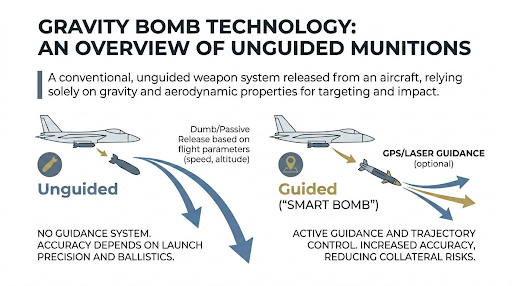
Gravity Bomb (also known as a "free-fall bomb") is a weapon delivered by aircraft that reaches its target solely through the force of gravity after release.
While the concept originated in WWI, technology has radically evolved. Transitioning from unguided munitions to precision-guided nuclear bombs like the B61-12 and B61-13.
The Technology
Modern gravity bomb technology is no longer just about explosive yield; it is about accuracy and versatility.
Strategic Importance in the Nuclear Triad
The Nuclear Triad consists of Land-based missiles (ICBMs), Sea-based missiles (SLBMs), and Strategic Bombers. Gravity bombs are the backbone of the air-leg.
Source: ARMSCONTROL
|
PRACTICE QUESTION Q. Why are militaries increasingly utilizing gravity bombs over standoff missiles for certain operations? A) They provide a longer range of attack. B) They are more expensive but offer higher accuracy. C) They are cheaper and cost-effective for large-scale bombardment. D) They do not require air superiority to be effective. Answer: C) Explanation: A gravity bomb costs roughly $25,000–$30,000, compared to millions for a Tomahawk missile, making them highly economical, though they require air superiority for safe delivery. |
A gravity bomb is an unguided or semi-guided weapon dropped from an aircraft. The B61 nuclear bomb is the primary U.S. thermonuclear gravity bomb and features options for free-fall, retarded free-fall (using a parachute), air burst, and ground burst deliveries
The B61-12 LEP is an initiative to refurbish and extend the service life of the B61 by at least 20 years, consolidating four older variants (Mods 3, 4, 7, 10) while adding a guided tail-kit assembly for greater accuracy.
A nuclear gravity bomb is an unpowered, air-delivered weapon dropped from strategic bombers or fighter aircraft. It relies on gravity and aerodynamics, rather than an internal propulsion system like a missile, to reach its targe






© 2026 iasgyan. All right reserved