

India's low fertilizer use efficiency requires comprehensive policy reforms focusing on balanced nutrient application and sustainable agricultural practices.
|
Read all about: Fertilizer Sector in India: Explained l Fertiliser Sector Crisis & Reforms l Fertilizer Import Dependency in India l Challenges in India's Fertiliser Imports |
Fertilizer is any material of natural or synthetic origin added to soil to provide essential plant nutrients.
Fertilizers are classified into two main types:
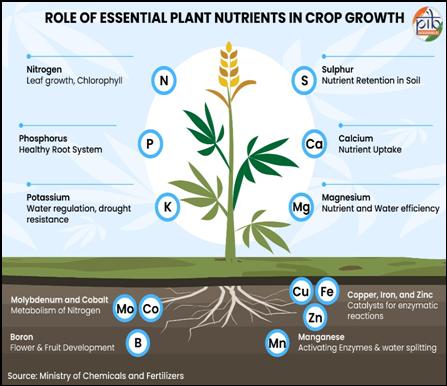 What is Fertilizer Use Efficiency (FUE)?
Fertilizer Use Efficiency (FUE) measures the exact proportion of applied fertilizer nutrients that crops actively absorb and utilize for growth.
Currently, Indian crops absorb only 35% to 40% of the applied nitrogen. (Source: Indian Express)
The environment absorbs the remaining 60% to 65% of nitrogen through harmful processes like leaching, surface runoff, or gaseous volatilization, highlighting a huge input loss.
The Nitrogen Use Efficiency (NUE) of conventional urea remains low, as plants take up only about one-third of the nitrogen applied.
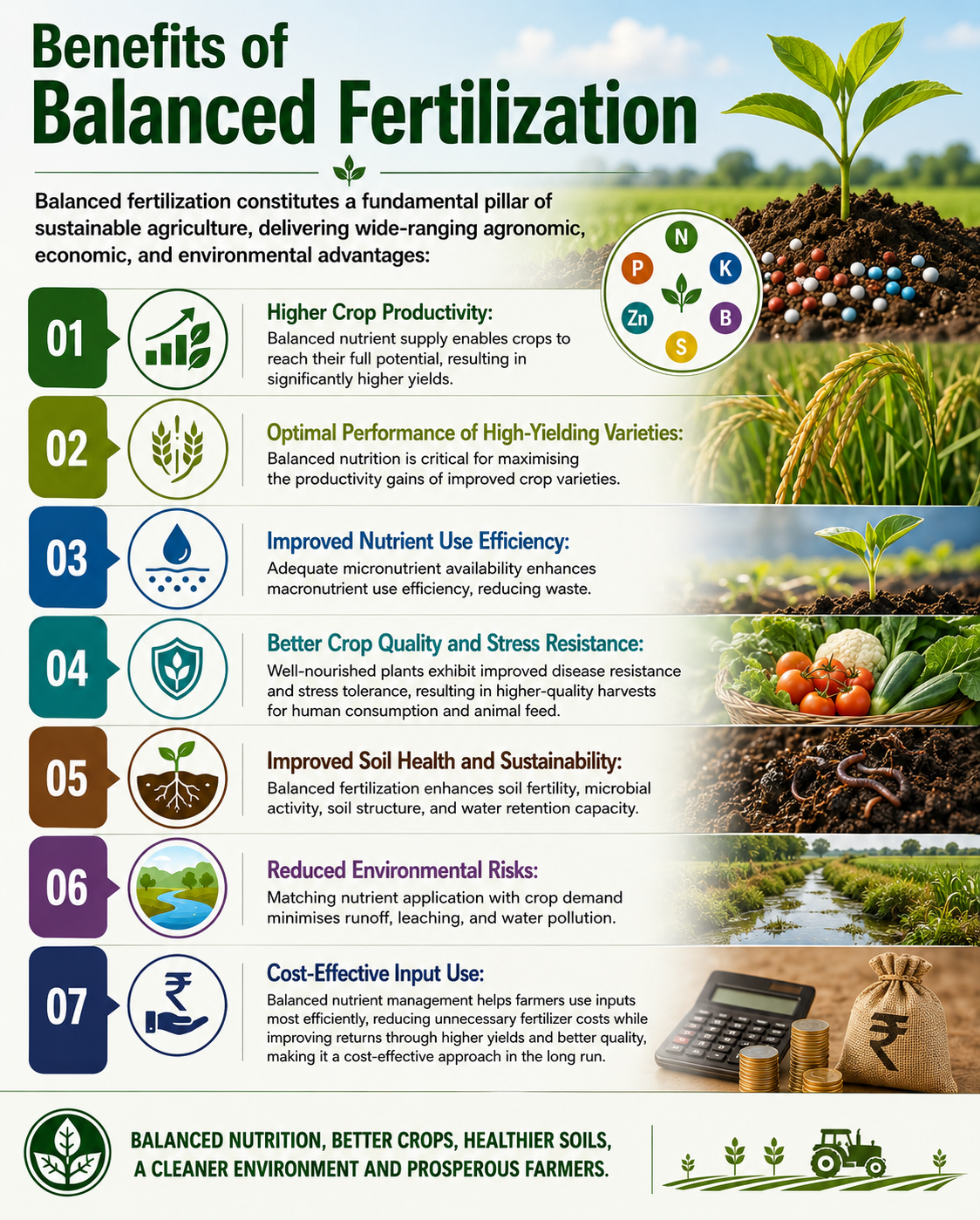 Initiatives Taken by the Government to Support Efficient Fertilizer Use
Nutrient-Based Subsidy (NBS) Scheme
Launched in 2010 to provide farmers with subsidized Phosphatic and Potassic (P&K) fertilizers,
based on their nutrient content (Nitrogen, Phosphorus, Potassium, Sulphur) to incentivize balanced nutrient application.
Mandatory Neem-Coated Urea
Enforces the neem-coating of urea to slow down nitrogen release in the soil. This boosts plant nutrient uptake, reduces run-off, and strictly prevents the illegal diversion of subsidized agricultural urea to industrial sectors.
Direct Benefit Transfer (DBT)
Deploys Point-of-Sale (PoS) machines and Aadhaar authentication across retail points. The system credits subsidies to manufacturing companies only after verifying direct sales to farmers, plugging delivery leakages.
The Union Government rewards states that reduce their consumption of chemical fertilizers. It transfers 50% of the saved subsidy back to the performing states as grants to fund sustainable agriculture infrastructure.
Provide personalized reports to farmers every two years. These cards test 12 key soil parameters (including pH, electrical conductivity, macro, and micro-nutrients) and provide precise, site-specific fertilizer recommendations.
Promotion of Nano-Fertilizers
Encouraging the adoption of Nano Urea and Nano DAP. Farmers spray these ultra-small particles directly onto leaves using drone technologies, achieving a Nutrient Use Efficiency of over 80%.
Integrated Fertilizer Management System (iFMS)
Digital, web-based platform to track fertilizer distribution, movement, imports, and availability in real-time, which eliminates black marketing.
Support for Natural Farming
Encouraging organic farming adoption through targeted schemes like the Paramparagat Krishi Vikas Yojana (PKVY) and Bhartiya Prakritik Kheti Paddhati (BPKP), encouraging farmers to replace chemical fertilizers with bio-fertilizers and organic alternatives.
Urea Price Distortion
Government excludes Urea from the Nutrient-Based Subsidy (NBS) framework. Its artificially low fixed price (₹242/bag) drives farmers to overuse nitrogen.
Heavy Import Dependence
India imports 100% of Potash (MOP), 90% of Phosphates, and 25% of Urea. This deep reliance exposes the domestic agricultural sector to global supply chain vulnerabilities and geopolitical shocks (e.g., Strait of Hormuz disruptions, Russia-Ukraine war).
Curbing the Fiscal Burden: Heavy reliance on imported raw materials strains the national exchequer.
MSP Policy Bias: Minimum Support Price (MSP) procurement policies disproportionately favor fertilizer-intensive and water-intensive crops like rice and wheat.
Weak Soil Health Card (SHC) Linkage: Farmers largely ignore Soil Health Card recommendations due to delayed testing reports, due to inadequate network of Soil Testing Laboratories (STLs), and a lack of skilled lab personnel.
Environmental Degradation: Unabsorbed nitrates leach into aquifers and pollute groundwater.
Bring Urea Under NBS
Integrate Urea into the NBS framework and initiate a gradual decontrol of its pricing, to correct market distortions and restore balanced fertilization.
Implement Direct Benefit Transfer (DBT)
Transition from industry-wide subsidies to direct cash transfers into farmers' bank accounts. An effective DBT model curbs black marketing, prevents industrial diversion, and financially incentivizes judicious fertilizer use.
Scale Up Nano and Bio-Fertilizers
Deploy Nano Urea and Nano DAP using foliar sprays and drones via the Namo Drone Didi Scheme.
Promote Crop Diversification
Enforce and strengthen procurement for pulses under the Dalhan Aatmanirbharta Mission. Integrating leguminous crops into standard crop rotations naturally boosts Biological Nitrogen Fixation, slashing urea requirements.
Adopt Integrated Nutrient Management (INM)
Train farmers to combine organic manure, crop residues, bio-fertilizers, and chemical fertilizers. Strict adherence to 4R Nutrient Stewardship (Right Source, Right Dose, Right Time, Right Place) guarantees maximum Nutrient Use Efficiency (NUE).
Leverage Digital and Precision Agriculture
Utilize the Digital Agriculture Mission, the Krishi Decision Support System (DSS), and GIS-based soil mapping to deliver real-time, site-specific nutrient prescriptions to farmers.
Boost Circular Economy Initiatives
Convert agricultural and cattle waste into Bio-CNG and nutrient-rich Bio-slurry through the GOBARdhan Scheme to secure a high-quality, localized organic nutrient source.
Upgrade Testing Infrastructure
Establish state-of-the-art Soil Testing Labs at every district headquarters, encouraging private labs, and employ professional chemists to guarantee accurate, pre-sowing soil data.
Shifting to tech-backed precision farming simultaneously slashes fiscal subsidy burdens and safeguards ecological health without compromising long-term food production.
Source: THE HINDU
|
PRACTICE QUESTION Q. With reference to the PM-PRANAM scheme, consider the following statements:
Which of the statements given above is/are correct? (a) 1 only (b) 2 only (c) Both 1 and 2 (d) Neither 1 nor 2 Answer: (c) Statement 1 is correct: The primary objective of the PM-PRANAM (Prime Minister Programme for Restoration, Awareness, Nourishment and Amelioration of Mother Earth) scheme is to reduce the consumption of chemical fertilizers and encourage states to promote alternative, organic, and bio-fertilizers. Statement 2 is correct: To incentivize this transition, the scheme grants states an amount equivalent to 50% of the fertilizer subsidy savings they achieve by reducing their reliance on synthetic/chemical fertilizers in a given financial year. |
The PM-PRANAM (Prime Minister's Programme for Restoration, Awareness Building, Nourishment, and Amelioration of Mother Earth) initiative incentivizes states to adopt balanced fertilizer use and reduce chemical fertilizer consumption. States receive a grant equal to 50% of the subsidy they save through this reduction.
Introduced in 2010, the NBS scheme provides a fixed subsidy on Phosphatic and Potassic (P&K) fertilizers based on their nutrient content (Nitrogen, Phosphorus, Potassium, and Sulphur), encouraging balanced nutrient application and healthy soil management.
Launched in 2015, the Soil Health Card scheme assesses 12 key soil parameters (macro and micro-nutrients, pH, EC, etc.) and provides farmers with recommendations on the right amount of fertilizers and organic inputs to use, aiming to improve soil fertility and reduce input costs.
© 2026 iasgyan. All right reserved