PM KUSUM 2.0 transitions farmers from Annadata to Urjadata through solarization and BESS by 2027. Success hinges on resolving financing hurdles, integrating micro-irrigation for groundwater sustainability, and ensuring credit guarantees to harmonize India’s critical water-energy-food nexus.
The Ministry of New and Renewable Energy (MNRE) announced a strategic extension of timelines for select projects till March 31, 2027.
The agricultural sector is a massive consumer of both electricity and groundwater. To address the twin challenges of energy security for farmers and environmental sustainability, the Ministry of New and Renewable Energy (MNRE) launched the PM KUSUM Scheme in 2019.
The scheme introduced a structural shift where the Indian farmer is not just a food producer (Annadata) but also a solar energy producer (Urjadata).
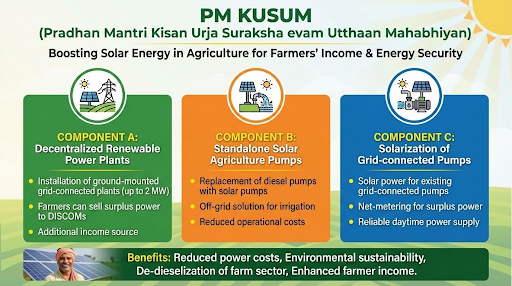
The scheme is divided into three strategic components, each addressing a specific structural gap in the rural energy ecosystem.
|
Component |
Objective |
Target |
Key Features |
|
Component A |
Decentralized Power Generation |
10,000 MW |
• Farmers set up small solar power plants (500 kW to 2 MW) on barren/fallow land. • Power is sold to DISCOMs at a Feed-in-Tariff (FiT). • Benefit: Steady income from uncultivable land. |
|
Component B |
Off-grid Solar Pumps |
14 Lakh Pumps |
• Installation of standalone solar agriculture pumps in areas without grid supply. • Replaces diesel pumps, reducing input costs and pollution. • Target: Small and marginal farmers. |
|
Component C |
Solarisation of Grid-Connected Pumps |
35 Lakh Pumps |
• Individual Pump Solarisation (IPS): Farmers use solar power for irrigation and sell surplus to the grid (Net Metering). • Feeder Level Solarisation (FLS): Solarizing the entire agricultural feeder instead of individual pumps (more efficient). |
Financial Structure and Funding
The scheme operates on a subsidy-sharing model to make solar technology affordable for farmers.
Recent Developments (2026-27 Update)
Extension to 2027: While the general sunset date is March 2026, the MNRE has extended the commissioning deadline to March 31, 2027, for projects where Power Purchase Agreements (PPAs) were signed before December 31, 2025.
PM KUSUM 2.0: A revamped version is under deliberation, focusing on integrating Battery Energy Storage Systems (BESS) to store excess solar power generated during the day and release it during evening peak hours, thereby stabilizing the grid.
De-dieselisation of Agriculture
India has about 8 million diesel pumps. Replacing them with solar pumps reduces diesel imports and cuts carbon emissions. It is estimated to mitigate 32 million tonnes of CO2 annually. [Source: CEEW)
Easing the Subsidy Burden
State DISCOMs incur huge losses supplying highly subsidized electricity to agriculture. By allowing farmers to generate their own power (and sell the surplus), the subsidy burden on states is significantly reduced.
Water Conservation
Component C incentivizes farmers to sell power rather than use it to pump excessive water. If a farmer can earn money by saving electricity (and thus pumping less water), it creates a financial rationale for water conservation.
High Upfront Cost: Even with a 60% subsidy, the 40% farmer share is a significant barrier for small and marginal farmers. Banks are often reluctant to provide the 30% loan component without collateral.
Groundwater Exploitation Risk: In Component B (Standalone Pumps), there is no grid to sell surplus power to. Since solar energy is "free" once installed, farmers might keep pumps running, leading to over-extraction of groundwater.
Domestic Content Requirement (DCR): The mandatory use of indigenous solar cells (ALMM policy) has led to supply shortages and price hikes, slowing down implementation.
Grid Availability: For Component A, finding barren land near electric substations (to minimize transmission cost) is a major logistical hurdle.
Smart Water-Energy Nexus: Linking PM KUSUM beneficiaries with PM Krishi Sinchayee Yojana (Micro-Irrigation) should be mandatory to ensure "Per Drop More Crop."
Innovative Financing: A Credit Guarantee Fund can be established to encourage banks to lend to farmers for the solar pump loans.
Feeder Level Focus: Prioritizing Feeder Level Solarisation (FLS) under Component C is more practical than individual net metering, as it is easier for DISCOMs to manage and maintain.
PM KUSUM is a "Win-Win-Win" for the farmer (income/energy security), the state (reduced subsidy), and the environment (carbon reduction). However, its success depends on addressing the "Water-Energy Paradox"—ensuring that free solar power does not lead to dry aquifers.
Source: ECONOMICTIMES
|
PRACTICE QUESTION Q. "The PM KUSUM scheme aims to address the water-energy-food nexus in India. Discuss the potential benefits of the scheme and the challenges impeding its effective implementation." (150 Words) |
The PM KUSUM scheme aims to transform Indian farmers from traditional food providers (Annadata) into decentralized renewable energy producers (Urjadata). It achieves this by promoting the installation of solar power plants on barren lands and the solarisation of agricultural pumps.
Component A involves setting up decentralized grid-connected solar plants (500 kW to 2 MW) on barren land. Component B provides subsidies for standalone, off-grid solar agriculture pumps. Component C focuses on solarising existing grid-connected agricultural pumps, allowing farmers to sell surplus power to the grid.
Agrivoltaics is an innovative dual-land-use model promoted by the scheme to solve the "food versus fuel" land conflict. It involves installing elevated solar panels over agricultural fields, allowing farmers to grow crops underneath while simultaneously generating solar electricity.


.jpg)


© 2026 iasgyan. All right reserved