PM-AASHA aims to provide tangible price assurance through integrated schemes. Despite record procurements, infrastructure gaps and cartelization remain. Success requires empowering FPOs, enforcing mandi floor prices, and transitioning to direct income support to ensure sustainable agrarian prosperity.
The Government of India expanded procurement operations under the PM-AASHA scheme.
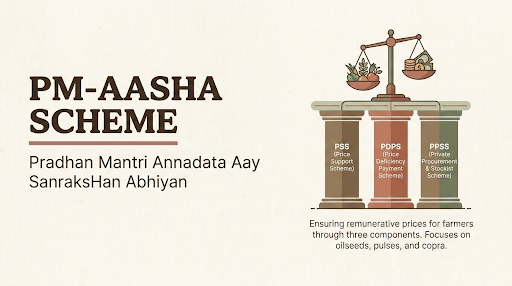
The Pradhan Mantri Annadata Aay SanraksHan Abhiyan (PM-AASHA) is an umbrella scheme launched by the Ministry of Agriculture & Farmers Welfare, in 2018 to ensure that farmers receive the Minimum Support Price (MSP) for their produce.
Price Support Scheme (PSS)
Physical Procurement: Central nodal agencies (like NAFED and NCCF) physically procure pulses, oilseeds, and copra.
Loss Coverage: The Central Government bears the procurement expenditure and losses incurred during the sale of these commodities.
Recent Update: To achieve self-sufficiency, the government has removed the 25% procurement ceiling for Tur, Urad, and Masur, allowing for 100% procurement of these pulses.
Price Deficiency Payment Scheme (PDPS)
Direct Benefit Transfer: This applies to oilseeds. No physical procurement takes place.
The Mechanism: The government pays farmers the difference between the MSP and the actual market price (Modal Price) directly into their bank accounts.
Objective: To provide price protection without the logistical burden of physical storage and handling by the government.
Private Procurement & Stockist Scheme (PPPS)
Private Participation: This is a pilot scheme for oilseeds where private players are invited to procure produce at MSP in selected districts.
Incentives: Private stockists receive a service charge to cover their costs, encouraging competitive market participation.
Market Intervention Scheme (MIS)
Perishable Crops: This component protects farmers of horticultural and perishable commodities (like apples, onions, or potatoes) when market prices crash due to a bumper harvest.
Recent Reform: The government has increased the coverage from 20% to 25% of production and streamlined the fund-sharing pattern to support states more effectively.
Beneficiary Reach: Since 2018, PM-AASHA has benefited 99.3 lakh farmers through the procurement of 195.39 LMT of pulses, oilseeds, and copra, disbursing over ₹1,07,433 crore in MSP value.
Soybean Milestones: A record 5.62 LMT of Soybean was procured in the 2024-25 Kharif season, supporting 2.4 lakh farmers during price crashes.
100% Procurement Policy: For 2024-25, the 25% ceiling for Tur, Urad, and Masur was removed. The government now aims to procure 100% of these pulses to achieve self-sufficiency.
Market Stability: The Price Stabilization Fund (PSF) maintains buffers of onions and pulses to mitigate retail inflation during lean periods.
Procurement "Reach" Deficit: Physical procurement remains low relative to production; for Tur in 2024-25, only 0.15 LMT was procured against a 13.22 LMT target by mid-February 2025, hindered by a lack of remote procurement centers.
Inadequate Infrastructure: NITI Aayog identifies critical shortages in storage, weighing, and drying facilities, leading to crop rejection under strict Fair Average Quality (FAQ) standards due to insufficient farm-gate processing.
State-Level Resistance: The PDPS suffers from low adoption despite its efficiency. States favor physical procurement (PSS) because PDPS requires transparent market data that local mandis currently lack.
Private Sector Disinterest: The Private Procurement & Stockist Scheme (PPSS) pilot has struggled as private entities find government service charges insufficient to offset high market volatility risks.
Structural and Infrastructure
Financial and Operational
Technological and Data Reforms
Awareness and Capacity Building
PM-AASHA reflects India’s transition from price declaration to price realization, but its true success lies in bridging policy design with ground-level delivery.
Source: PIB
|
PRACTICE QUESTION Q. Evaluate the performance of the PM-AASHA in ensuring remunerative prices to Indian farmers. Discuss the structural bottlenecks limiting its success and suggest necessary policy reforms. 250 words |
PM-AASHA (Pradhan Mantri Annadata Aay SanraksHan Abhiyan) is an umbrella scheme launched by the Government of India in 2018. It aims to provide remunerative prices to farmers for their produce, moving from mere "price declaration" to tangible "price assurance," with a focus on pulses, oilseeds, and copra.
Under the PSS, central agencies like NAFED and FCI physically procure crops from farmers at the Minimum Support Price (MSP). Under the PDPS, there is no physical procurement; instead, the government pays farmers the financial difference between the MSP and the lower market price directly into their bank accounts.
The MIS component is designed to protect farmers who grow perishable horticultural crops, such as tomatoes, onions, and apples. The government intervenes to procure these commodities if a sudden bumper harvest causes open market prices to crash by more than 10%.



.jpg)


© 2026 iasgyan. All right reserved