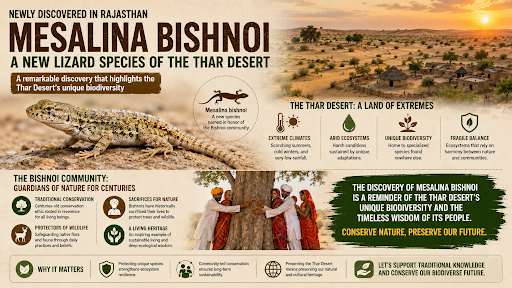
The recent discovery of the Mesalina bishnoi lizard in Rajasthan highlights the Thar Desert's unique biodiversity. Surviving extreme climates, these arid ecosystems heavily rely on traditional conservation by the Bishnoi community, who historically sacrificed lives protecting native flora and fauna.
Why In News?
Scientists have recently discovered a new lizard species, Mesalina bishnoi, in the Thar Desert of Rajasthan.
About Mesalina bishnoi
Scientists from the Zoological Survey of India (ZSI) and other institutions discovered Mesalina bishnoi, a new lizard species.
Researchers spotted the reptile by chance at a roadside tea stall near the Gajner forest area in Bikaner district, Rajasthan.
This discovery provides the first confirmed record of the genus Mesalina in India.
The finding resolves a 90-year-old scientific mystery. In 1935, British zoologist Malcolm A. Smith documented the genus in Jaisalmer, but scientists lacked the physical specimen evidence to prove it until now.
Characteristics
The species belongs to the family Lacertidae, a group that includes many Old World wall lizards.
Researchers classify the lizard under the Mesalina watsonana species complex after verifying its genetic divergence through mitochondrial DNA analysis.
The reptile has a small-bodied structure, measuring just 39.2 mm in snout-vent length.
It exhibits a greyish to olive-brown body with two prominent dorsolateral stripes extending from the neck to the tail.
The lizard features distinct black markings behind the eyes and a mottled appearance created by irregular dark blotches and white spots.
Habitat and Ecology
Mesalina bishnoi operates as a fast-moving, diurnal (day-active) lizard.
The species inhabits the open semi-desert zones of the Thar Desert, favoring hard, rocky soils with sparse desert vegetation.
Scientists currently consider the species endemic to the Thar biogeographic province.
The lizard shares its arid ecosystem with other regional reptiles, including Sahgal's gecko, the spotted desert racer, and the venomous saw-scaled viper.
Nomenclature
Researchers named the species Mesalina bishnoi to honor the Bishnoi community and its historic dedication to nature and wildlife conservation.
About Bishnoi community
Saint Guru Maharaja Jambheshwar (popularly known as Jambhoji) founded the Bishnoi sect in 1485 within the Marwar region of Rajasthan.
The term "Bishnoi" translates to "twenty" (Bish) and "nine" (Noi) in Hindi, which directly represents the 29 ecological edicts formulated by the guru.
The government officially recognizes the group as a subsect of Hinduism today, though historical records until the 1891 Census classified them as Muslims, prompting scholars to view them as a liminal community.
The foundational doctrine centers on living harmoniously with the harsh Thar Desert environment, strictly commanding followers to "not cut green trees" and "be compassionate toward all living beings".
The Khejarli Massacre
The Bishnois are most famous for the Khejarli Massacre of 1730.
Traditional Conservation and Forest Management
The Bishnoi manage their local forests and protect wild animal populations using traditional ecological knowledge and religion-based customary laws.
Villagers maintain community-managed sacred groves that provide critical water reserves and preserve the region's rich biodiversity.
The community operates local animal care centers to rehabilitate sick and injured wildlife, with Bishnoi women sometimes breastfeeding injured fawns.
Members practice sustainable resource extraction, selectively harvesting only the leaves and pods of Khejri trees for vegetables, traditional medicine, and livestock fodder.
Bishnoi settlements exhibit higher natural vegetation cover and support thriving populations of freely roaming wildlife, including blackbucks, Indian gazelles (chinkaras), and peacocks.
National Recognition and Legacy
The Government of India instituted the Amrita Devi Wildlife Protection Award (ADWPA) in 2000 to recognize outstanding contributions to wildlife defense.
The nation observes National Forest Martyrs Day on September 11 (established in 2013) to commemorate the date of the historic Khejarli massacre.
Scientists officially name a newly discovered species of desert lizard, Mesalina bishnoi, in honor of the community's enduring commitment to nature and wildlife conservation
Source: TIMESOFINDIA
|
PRACTICE QUESTION Q. Consider the following statements regarding the newly discovered lizard species Mesalina bishnoi:
Which of the statements given above is/are correct? (a) 1 and 2 only (b) 1 and 3 only (c) 3 only (d) 1, 2, and 3 Answer: (b) Explanation: Statement 1 is correct: The discovery of Mesalina bishnoi near Gajner in Rajasthan's Bikaner district marks the first confirmed, specimen-based record of the genus Mesalina in India. Statement 2 is incorrect: Mesalina bishnoi is not an arboreal (tree-dwelling) species. It is a terrestrial, small-bodied lizard adapted to the arid and semi-arid landscapes of the Thar Desert, primarily found on hard, rocky soil with sparse desert vegetation. Statement 3 is correct: The species was formally named Mesalina bishnoi in honor of the Bishnoi community of Rajasthan, in recognition of their long-standing traditions and commitment to wildlife and environmental conservation. |
Mesalina bishnoi is a newly discovered small-bodied, fast-moving lizard species found in the open semi-desert habitat near Gajner in Bikaner, Rajasthan. It features a greyish to olive-brown body with distinct stripes and black markings behind the eyes.
The Bishnois are a religious sect in the Thar Desert region founded in 1485 by Guru Jambheshwar. They follow 29 edicts that include strictly protecting green trees, like the Khejri, and wildlife, acting as traditional conservationists who run community-based animal care centers.
In 1730, 363 Bishnoi villagers, led by Amrita Devi, sacrificed their lives by hugging Khejri trees to prevent them from being cut down by the Maharaja of Jodhpur's soldiers. This historical event is considered India's first environmental movement.





© 2026 iasgyan. All right reserved