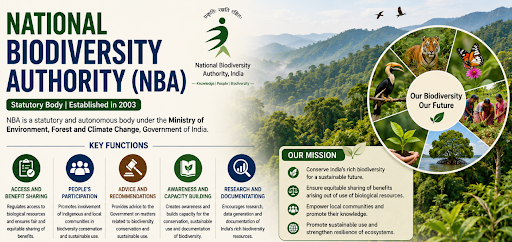
The National Biodiversity Authority (NBA) is a statutory government body established in 2003 under India’s Biological Diversity Act, 2002. Based in Chennai, it regulates the use of biological resources, promotes conservation, and ensures fair, equitable sharing of benefits with local indigenous communities.
Why In News?
The National Biodiversity Authority (NBA) realized Rs 21.26 crore through the Access and Benefit Sharing (ABS) mechanism in FY 2025–26.
What is National Biodiversity Authority (NBA)?
The Central Government establishes the National Biodiversity Authority (NBA) under Section 8 of the Biological Diversity Act, 2002.
It operates as a statutory body with its headquarters located in Chennai.
It implements India's international obligations under the Convention on Biological Diversity (CBD) and the Nagoya Protocol on Access and Benefit Sharing.
Composition of the Authority
The Central Government appoints all members of the NBA.
The NBA consists of a Chairperson, who acts as the Chief Executive. It includes three ex-officio members representing the Ministry of Tribal Affairs and the Ministry of Environment, Forest and Climate Change (MoEFCC).
It holds seven ex-officio members representing various core ministries, including Agriculture, Biotechnology, Ocean Development, Science and Technology, and Indian Systems of Medicine.
It integrates five non-official members chosen from industry representatives, scientists, experts, and traditional knowledge holders.
Core Functions and Powers
The NBA regulates access to India's biological resources and associated traditional knowledge.
It grants prior approval to foreign nationals, non-resident Indians (NRIs), and foreign companies before they undertake any research, bio-survey, or commercial utilization of Indian biological resources.
It determines fair and equitable benefit sharing when it grants access approvals.
It advises the Central Government on policies regarding biodiversity conservation, sustainable use, and equitable benefit sharing.
It advises State Governments on the selection and management of areas of high ecological importance as Biodiversity Heritage Sites.
It opposes the grant of Intellectual Property Rights (IPR) in foreign countries on biological resources or traditional knowledge obtained illegally from India.
Access and Benefit Sharing (ABS) Mechanism
The NBA enforces the Access and Benefit Sharing (ABS) framework to distribute financial and non-monetary benefits to local communities, farmers, and traditional knowledge holders.
It channels collected ABS funds to identified beneficiaries through Biodiversity Management Committees (BMCs) and State Biodiversity Boards (SBBs).
It utilizes ABS funds for the socio-economic development of the originating areas when authorities cannot identify specific beneficiaries.
It manages the National Biodiversity Fund to collect royalties, fees, and grants, and uses this fund to channel benefits to claimers and promote conservation.
Role in Intellectual Property Rights (IPR)
The NBA mandates prior approval for any person applying for a patent or Intellectual Property Right (IPR) based on Indian biological resources, both inside and outside India.
It issues a Certificate of Registration (CoR) to applicants under the reformed Biological Diversity (Amendment) Act, 2023.
It drives a registration-based system that balances scientific advancement with conservation, leading to a massive recent surge in IPR application filings.
Source: PIB
|
PRACTICE QUESTION Q. Consider the following statements regarding the Biological Diversity (Amendment) Act, 2023:
Which of the statements given above is/are correct? (a) 1 only (b) 2 only (c) Both 1 and 2 (d) Neither 1 nor 2 Answer: (c) Explanation: Statement 1 is Correct. The Amendment Act exempts registered AYUSH practitioners, local people and communities, and growers/cultivators of biodiversity from giving prior intimation to State Biodiversity Boards (SBBs) for accessing biological resources for certain purposes (specifically, for commercial utilization based on codified traditional knowledge or for cultivated medicinal plants and their products). Statement 2 is Correct. The Amendment Act mandates that applicants (specifically those under Section 7, i.e., Indian citizens and entities) must register with the National Biodiversity Authority (NBA) and obtain a Certificate of Registration (CoR) prior to seeking (or at the time of making an application for) Intellectual Property Rights (IPR) based on biological resources originating in India. This replaces the earlier requirement of "prior approval" for these applicants, streamlining the process, whereas foreign entities still require prior approval. |
The ABS mechanism is a legal framework under the Biological Diversity Act that ensures the fair and equitable sharing of monetary and non-monetary benefits arising from the utilization of biological resources and traditional knowledge with local communities, farmers, and benefit claimers.
The 2023 Amendment Act introduced a registration-based system mandating a Certificate of Registration (CoR) before seeking IPRs, streamlined approval pathways, and exempted codified traditional knowledge and registered AYUSH practitioners from certain access restrictions.
The Nagoya Protocol is a supplementary agreement to the Convention on Biological Diversity (CBD) that provides a transparent legal framework for the effective implementation of the fair and equitable sharing of benefits arising out of the utilization of genetic resources.




© 2026 iasgyan. All right reserved