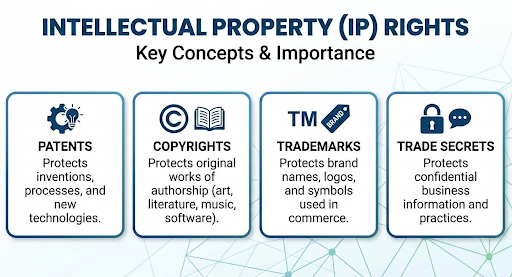
Intellectual Property Rights (IPR) are legal privileges granted to creators for their mental inventions. They provide exclusive control over creations like patents, trademarks, and copyrights for a specific period, encouraging innovation and economic growth by preventing unauthorized use.
The Union Minister for Commerce and Industry urged turning the intellectual property ecosystem into a mass movement to transform ideas into protected assets.
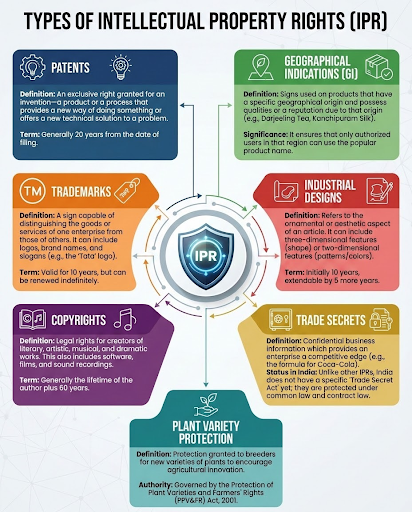
IPR are legal protections granting creators exclusive rights to their innovations for a set time, allowing them to profit from their creativity and investment.
Purpose: IPR balances innovator interests with public benefit, encouraging a creative and innovative environment.
Legal Basis in India: Governed by the Patents Act (1970), Trademarks Act (1999), and Copyright Act (1957).
Global Standard: India is a signatory to the TRIPS (Trade-Related Aspects of Intellectual Property Rights) agreement, which sets the minimum standards for IP regulation globally.
The Early Foundations (Late 19th Century)
The WTO-TRIPS Era (1995): Creation of the TRIPS agreement under the WTO made IPR a core part of international trade. It forced all member nations to adopt a "minimum standard" of IP protection.
The Digital & Bio-Tech Shift (2000s–Present):
Modern Focus: Current global debates focus on AI-generated IP, Green Technology patents, and the TRIPS Waiver for life-saving medicines during pandemics.
India’s IPR regime is a unique balance between incentivizing innovation and protecting public interest (such as affordable medicine and farmers' rights).
Policy Framework: National IPR Policy (2016)
Legislative Pillars
Institutional & Judicial Framework
Administration: Office of the Controller General of Patents, Designs and Trade Marks (CGPDTM), under the Department for Promotion of Industry and Internal Trade (DPIIT), part of the Ministry of Commerce and Industry.
Judicial Reform: In 2021, the Intellectual Property Appellate Board (IPAB) was abolished. Cases are now handled by specialized IP Divisions in High Courts (like Delhi and Madras) to ensure faster resolution.
Protection of Heritage: The Traditional Knowledge Digital Library (TKDL) prevents foreign entities from patenting traditional Indian knowledge like Yoga or medicinal uses of Neem.
Low R&D Intensity: India’s Gross Expenditure on R&D (GERD) is just 0.64% of GDP, lower than the US (3.5%) and China (2.4%), restricting indigenous innovation. (Source: Economic Survey 2025-26).
Procedural Delays: Patent examination takes 3-4 years due to examiner shortages, slower than the 20-24 months in the US or China. (Source: Parliamentary Standing Committee on Commerce)
"Evergreening" Conflict: Strict Section 3(d) of the Patents Act curbs remain a friction point with the US Trade Representative (USTR Special 301 Report) and MNCs regarding "incremental innovation".
Enforcement & Piracy: Weak ground-level enforcement against digital piracy and counterfeits hampers the film and software sectors.
Low Commercialization: Most institutional patents are "defensive" and fail to reach the market as commercial products.
Institutional Streamlining
Financial & Procedural Incentives
Digital Initiatives
Global Collaboration
Boost R&D Spending: India needs to increase R&D investment to 2% of GDP from 0.64%, using tax incentives and "Innovation Bonds" to spur private sector participation.
Commercialize Research: Bridge the "Lab-to-Market" gap by creating Commercialization Cells in universities to facilitate technology transfer to industry.
Enhance Enforcement: Set up specialized IP Courts and train officials to better combat digital piracy and counterfeit goods.
Trade Secrets Act: India should enact a standalone law to ensure legal certainty and attract R&D investments.
MSME IP Literacy: Extend KAPILA and Start-up India to MSMEs, which drive 30% of GDP but lack IPR awareness.
Utility Models: Introduce short-term protection for incremental innovations that miss standard patent thresholds.
IPR is the global economy's foundation. For India to become an innovation hub, it must treat IP as a strategic asset. Balancing creator rights with public health and agriculture needs is key to achieving the "Viksit Bharat @ 2047" vision.
Source: NEWSONAIR
|
PRACTICE QUESTION Q. Despite recent administrative reforms and a surge in patent grants, India's intellectual property landscape faces structural and external challenges. Discuss. 150 words |
India ranked 38th out of 139 economies in the World Intellectual Property Organization’s (WIPO) Global Innovation Index (GII) 2025.
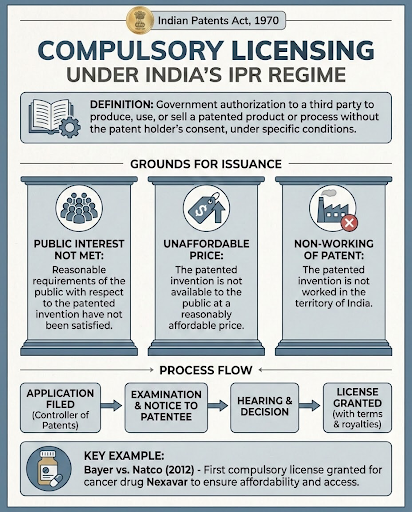
Under Section 84 of the Patents Act, the Indian government can issue a "Compulsory License" to allow a third party to manufacture a patented product without the consent of the patent owner. This flexibility is used if a critical product, like a life-saving drug, is highly unaffordable or unavailable to the public.
The TKDL is an Indian database that documents ancient traditional knowledge (such as Ayurveda, Unani, Siddha, and Yoga) in multiple foreign languages. It acts as "prior art" to successfully block foreign entities from illegitimately patenting traditional Indian remedies (biopiracy).





© 2026 iasgyan. All right reserved