The UN Global Forest Goals Report 2026 warns that targets to reverse deforestation and eradicate forest poverty remain off track. With 40 million hectares lost, the report emphasizes scaling sustainable finance, improving governance, and tackling agricultural expansion for 2030 objectives.
Why in the news?
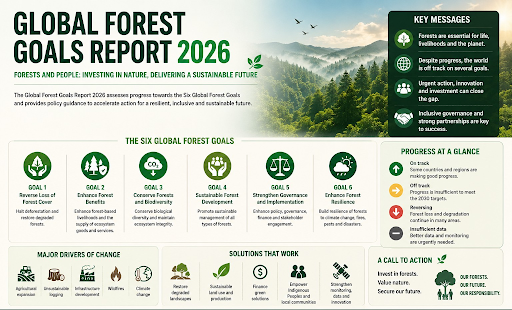
The UN Global Forest Goals Report 2026 warns that the 2030 targets for reversing forest loss and eliminating poverty among forest-dependent populations remain off-track.
About Global Forest Goals Report 2026
The United Nations Department of Economic and Social Affairs (DESA) releases the Global Forest Goals Report 2026 during the 21st session of the UN Forum on Forests (UNFF21) at the UN Headquarters in New York, US.
The report assesses global progress toward the six Global Forest Goals (GFGs) and 26 targets outlined in the UN Strategic Plan for Forests 2017-2030.
The assessment draws data from 48 voluntary national reports (covering 51% of global forests) and the FAO Global Forest Resources Assessment (FRA) 2025.
Overall Progress Status
Goal 1: Reversing Forest Loss (Off Track)
The world fails to halt deforestation, missing the target to increase global forest area by 3%.
The Earth loses over 40 million hectares of total forest cover between 2015 and 2025, with an annual net loss averaging 4.12 million hectares.
South America and Africa record the steepest regional forest area declines.
The world loses 16 million hectares of primary forests, threatening planetary biodiversity and ecological balance.
Global forest carbon stocks show a modest increase, but climate-induced wildfires and droughts put these stocks at severe risk.
Goal 2: Eradicating Forest Poverty (Off Track)
Forestry does not reduce extreme poverty among populations living at $3 per day, despite forests being their primary source of sustenance.
Sub-Saharan Africa sees little improvement, with extreme poverty levels at nearly 46% among forest-dependent communities.
The global forest economy generates $1.5 trillion annually and employs roughly 42 million people, yet millions remain trapped in poverty.
Weak market access, inadequate standards, and lack of business services constrain the economic benefits of non-wood forest products (NWFPs), keeping indigenous and local communities at the low-value end of supply chains.
Goals 3 to 6: Conservation, Finance, and Governance
Goal 3 (Protected Forests): Countries broadly meet the targets to expand protected areas and implement long-term forest management plans.
Goal 4 (Finance): The world mobilized only 84 billion in 2023 for sustainable forest management. This falls below the 300 billion annual requirement by 2030.
Goal 5 (Governance): Countries partially achieve law enforcement goals. Illegal logging and associated criminal trade remain massive problems, accounting for 15% to 30% of the global timber trade.
Goal 6 (Cooperation): Institutions partially achieve cross-sectoral coordination. Competing land pressures from agriculture and infrastructure override forest conservation during policymaking.
|
Key Drivers of Forest Loss & Degradation
|
Strategic Recommendations for 2030
Governments must strongly align agricultural and forest policies to tackle land-use competition and establish deforestation-free supply chains.
Policymakers need to expand access to clean energy alternatives to quickly reduce the heavy regional reliance on fuelwood.
Financial institutions must mobilize innovative green finance mechanisms (like green bonds, biodiversity credits, and payments for ecosystem services) to bridge the annual funding gap.
Authorities must strengthen forest law enforcement and secure land tenure rights for Indigenous Peoples and local communities (IPLCs) to ensure equitable wealth distribution.
Source: DOWNTOEARTH
|
PRACTICE QUESTION Q. The dual objectives of reversing forest cover loss and mitigating climate change impacts face persistent challenges." Elaborate. 150 words |
The UN Department of Economic and Social Affairs (DESA) releases the report to assess global progress toward the six Global Forest Goals (GFGs) and 26 targets outlined in the UN Strategic Plan for Forests 2017-2030.
The report identifies two critical targets as completely off track: halting and reversing global forest loss and eradicating extreme poverty among forest-dependent populations.
Agricultural expansion acts as the largest driver, followed closely by surging demand for fuelwood and charcoal (particularly in Sub-Saharan Africa), and intensifying climate change impacts like wildfires and droughts.




© 2026 iasgyan. All right reserved