India’s SEZ 2.0 framework and Union Budget 2026-27 introduce concessional domestic sales and shift performance metrics to net positive growth. These reforms aim to boost global competitiveness while mitigating challenges posed by the OECD's fifteen percent Global Minimum Tax rules.
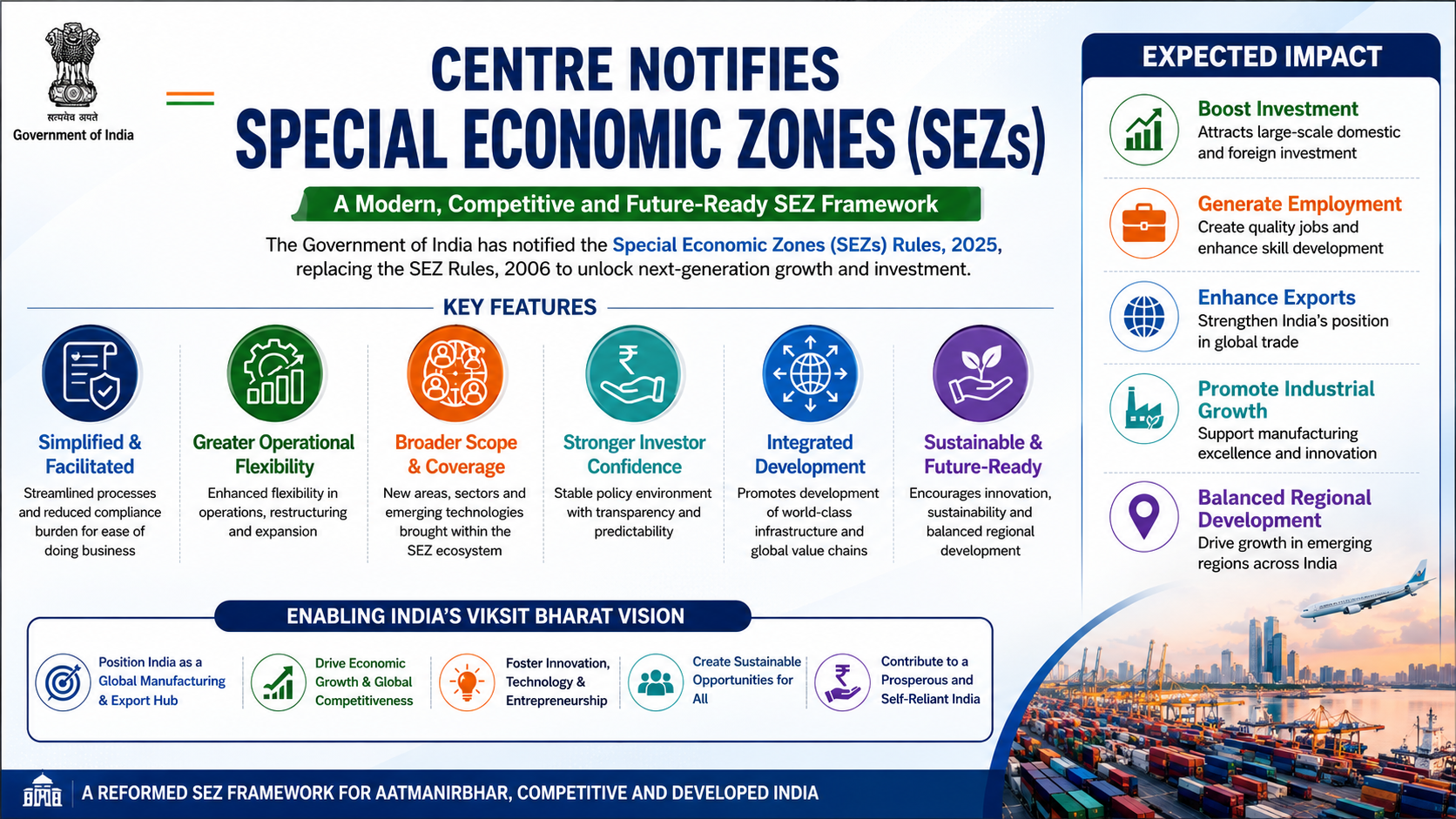
The Government has notified two new Special Economic Zones (SEZs) in Puducherry.
The government designates a Special Economic Zone (SEZ) as a specifically delineated duty-free enclave, treating it as foreign territory for trade operations, duties, and tariffs.
The region operates under liberal economic laws that provide financial incentives related to taxation, trading, quotas, and customs to encourage business setup.
The system aims to achieve three primary goals: increase foreign investment, create jobs, and improve administration.
The Special Economic Zone Act, 2005, and the SEZ Rules, 2006, provide the comprehensive legal and regulatory framework for their establishment and operation.
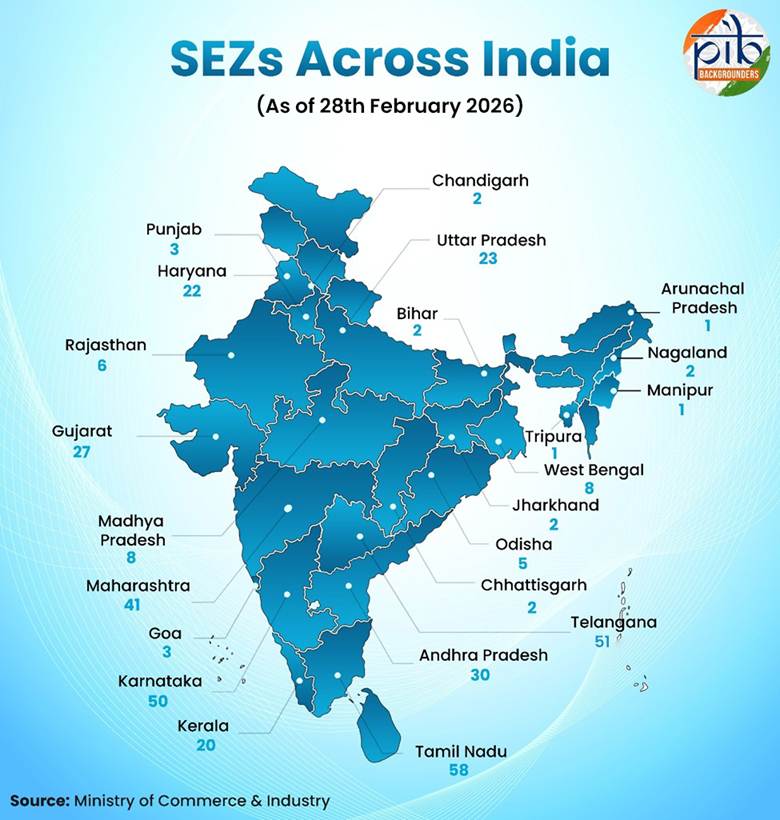
India operates 276 operational SEZs housing 6,279 approved units, out of a total of 368 notified SEZs across the country. (Source: PIB)
SEZs contribute to the economy, generating USD 172.27 billion in exports during 2024–25, which reflects a 7.37% year-on-year growth.
These zones drive substantial economic activity, attracting a total investment of ₹7.86 lakh crores and providing employment to over 31.94 lakh people.
The ecosystem displays a severe sectoral skewness, as the Software and IT/ITES sectors account for more than 60% of India's operational SEZs.
 What Are the Major Advantages of SEZs?
Fiscal Incentives
Businesses enjoy zero customs duty on imported raw materials and capital goods, and procure domestic goods free of Central Excise duty.
GST Exemptions
Government treats supplies from the Domestic Tariff Area (DTA) to SEZ units as zero-rated under the Goods and Services Tax (GST) Act, generating huge cash flow savings.
Ease of Doing Business
Unit Approval Committee (UAC) provides single-window clearance for Central and State-level approvals, reducing bureaucratic red tape.
FDI & Repatriation
Framework allows 100% Foreign Direct Investment (FDI) automatically in the manufacturing sector and permits businesses to freely repatriate their profits.
Operational Flexibility
Developers offer world-class, ready-to-use "plug-and-play" infrastructure paired with more flexible labor laws to ensure high productivity.
Land Underutilization
Rigid denotification regulations leave vast tracts of acquired SEZ land as unproductive, stranded infrastructural assets.
Tax Arbitrage Erosion
Imposition of the Minimum Alternate Tax (MAT) and the enforcement of sunset clauses dismantle the foundational tax advantages that originally attracted foreign capital.
Tariff Asymmetry (Reverse Tariff Inversion)
SEZ units pay standard customs duties when selling in the domestic market, making their goods more expensive domestically than finished products imported under zero-duty Free Trade Agreements (FTAs).
Competition from PLI Schemes
Domestic Production Linked Incentive (PLI) schemes cannibalize the investment pipeline, diverting high-tech manufacturing capital away from SEZs.
Global Tax Regime Impact
The OECD’s Pillar Two Global Minimum Tax (15%) neutralizes the competitive advantage of SEZ tax holidays for multinational corporations.
Complex FTA Value-Addition Norms
Stringent Rules of Origin within recent FTAs (like the India-UAE CEPA) penalize SEZ units that rely heavily on imported raw materials.
 Reforms Introduced by the Government to Support SEZs
SEZ 2.0 Policy Framework
Government constitutes a 17-member committee to overhaul the SEZ Act, 2005, aligning it with WTO standards and replacing export-only requirements with domestic-market integration.
One-Time Concessional DTA Sales
Union Budget 2026–27 permits eligible SEZ manufacturing units to sell a prescribed proportion of their output in the Domestic Tariff Area (DTA) at concessional customs rates.
Restoration of RoDTEP Scheme
The Commerce Ministry restores Remission of Duties and Taxes on Exported Products (RoDTEP) benefits for SEZs to neutralize embedded local levies and reduce cost disabilities.
Semiconductor & High-Tech Demarcations
Government amends SEZ rules to reduce the minimum contiguous land requirement to 10 hectares and relaxes encumbrance norms, approving specialized hubs like Micron in Sanand.
Commercial Real Estate Revitalization
Amended rules permit developers to demarcate portions of IT/ITES SEZs as non-processing areas, allowing the co-location of domestic firms to stabilize the real estate sector.
Institutional Innovation Over Tax Breaks
China's Shanghai Free Trade Zone (SFTZ) proves that aligning with international rules, ensuring currency conversion freedom, and boosting trade facilitation generate sustainable FDI better than relying on tax holidays.
Progressive Economic Integration
Successful global programs gradually eliminate tax exemptions and proactively integrate the SEZ tax regime with the national economy to avoid an inevitable "race to the bottom".
Focus on Non-Fiscal Incentives
High-performing zones prioritize non-fiscal incentives—such as excellent infrastructure, skilled local labor, supply chain links, and seamless business administration—since tax incentives cannot compensate for a poor investment climate.
Implement the DESH Framework
Transition from the old SEZ Act to the Development of Enterprise and Service Hubs (DESH) model, transforming isolated export-only zones into inclusive, multi-sectoral domestic economic hubs.
Shift Performance Metrics
Evaluation framework must transition from purely tracking Net Foreign Exchange (NFE) to measuring "Net Positive Growth," which factors in capital investment, technology upgradation, and direct employment generation.
"One India" Tariff Equalization
Adopt a dual-use regulatory framework to equalize tariff treatment for SEZ goods sold domestically, effectively neutralizing the "reverse tariff inversion".
Multi-Modal Logistics Integration
Integrate SEZs into the PM Gati Shakti National Master Plan to guarantee "last-mile" rail-to-factory connectivity and establish efficient Free Trade Warehousing Zones (FTWZs).
Green Infrastructure and ESG Compliance
Build Circular Economy enclaves powered by renewable energy grids to meet stringent global Environmental, Social, and Governance (ESG) mandates and attract premium FDI.
Adapt to the Global Minimum Tax
Replace vulnerable profit-based tax exemptions with investment-linked incentives and infrastructure credits to remain compliant with the OECD's Pillar Two tax framework.
Modernizing SEZs into integrated, sustainable tech hubs is vital for India's $5 trillion economy and the Viksit Bharat @2047 vision.
Source: pib
|
PRACTICE QUESTION Q. How Special Economic Zones (SEZs) contributed to India's export-led growth strategy? Discuss their achievements and limitations. 150 Words |
It is a comprehensive policy overhaul guided by a 17-member committee to modernize India's SEZ Act, 2005, harmonize export schemes, and shift from an export-only orientation to integrated multi-sectoral hubs.
The Development of Enterprise and Service Hubs (DESH) Bill was proposed to replace the SEZ Act, 2005, aiming to transform SEZs into "Development Hubs" that cater to both the export and domestic markets but was stalled due to inter-ministerial differences.
The GloBE rules mandate a minimum 15% effective tax rate for large multinational enterprises, meaning the 100% corporate tax exemptions often offered in SEZs may trigger top-up taxes, thereby reducing the attractiveness of such tax holidays.





© 2026 iasgyan. All right reserved