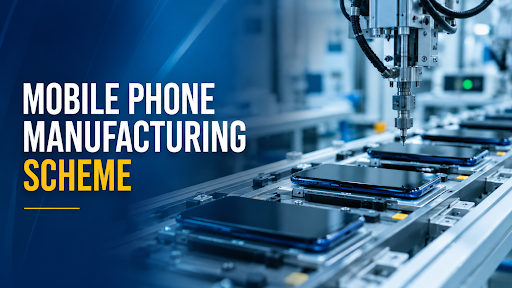
The Mobile Phone Manufacturing Scheme (MPMS), backed by a ₹62,500 crore outlay, aims to transition India from a mobile assembly hub to a global manufacturing powerhouse. It directly incentivizes domestic value addition, Indian brand creation, and strategic component localization.
Why In News?
The Union Cabinet approved the Mobile Phone Manufacturing Scheme (MPMS) to advance India's deep tech and electronics capabilities.
What is the Mobile Phone Manufacturing Scheme (MPMS)?
The MPMS is a financial incentive program that aims to shift India's status from a low-level assembly destination to a deep electronics manufacturing hub by focusing on domestic component sourcing and Indian brand building.
The scheme runs for 5 years from FY 2026-27 to FY 2030-31, acting as the direct successor to the concluded Production Linked Incentive for Large Scale Electronics Manufacturing (PLI-LSEM).
The program scales up mobile production, deepens Domestic Value Addition (DVA), forges technological sovereignty, strengthens supply chain resilience, and captures economic value by creating Indian patents in design and R&D.
Why is MPMS Important for India's Manufacturing Strategy?
Supports Make in India: Accelerates the Make in India vision, which drives electronics manufacturing to grow 7 times and exports to grow 11 times since 2014-15. (Source: PIB)
Strengthens Electronics Value Chains: Transitions the industry beyond bare assembly operations by incentivizing local component manufacturing and bridging critical voids in sub-assemblies like displays and camera modules.
Reduces Import Dependence: Targets import reliance, noting that while domestic assembly accounts for 99.2% of mobile phones used in India, high-tech component imports remain structurally high.
Boosts Export Competitiveness: Bridges a 10-15% cost disability, positioning India against global heavyweights like China and Vietnam as smartphones become India's single largest exported product category in 2025.
Enhances Technological Capabilities: Pushes local manufacturers into higher-value nodes such as product design, prototype creation, and intellectual property ownership.
Supports Atmanirbhar Bharat: Cultivates technological sovereignty by establishing a supportive subsidy ecosystem for domestic brands to overcome barriers against established foreign competitors.
What are the Key Features of MPMS?
Incentives on Eligible Sales: Offers direct financial support at differentiated rates ranging from 2.25% to 5% on eligible sales of mobile phones manufactured in India.
Incentives for Domestic Value Addition: Provides an additional incentive of up to 1.5% linked directly to the domestic sourcing of key components and sub-assemblies to stimulate deeper manufacturing.
Incentives for Indian Brands: Grants an extra 3% incentive on eligible sales dedicated exclusively to building Indian brands through product design and local R&D.
Focus on Manufacturing Ecosystem Development: Targets ecosystem depth by supplementing the ₹1.27 lakh crore Semicon 2.0 mission, which localizes chip design, semiconductor machinery, and fabrication.
Export-Oriented Growth Strategy: Aligns production scale with global market demands to convert massive domestic production pipelines into high-value global exports.
What are the Major Concerns Associated with Mobile Manufacturing?
Dependence on Imported Components: High-tech components remain largely imported, keeping localization pegged below 25% for critical sub-assemblies like displays and camera modules.
Limited Domestic Semiconductor Capacity: While ISM 1.0 successfully approved 12 units, actual silicon fabrication remains nascent, with India's first fab only scheduled for commissioning in 2028.
Global Competition: India faces stiff tariff disadvantages, as the Free Trade Agreement (FTA) weighted tariff for mobile components stands at 6.2% in India, far higher than Vietnam's 0.7% and China's 4%.
Supply Chain Vulnerabilities: Domestic ecosystems critically lack foundational design and prototype capabilities, keeping India reliant on geopolitical shifts and vulnerable to global supply chain disruptions.
Technology Transfer Constraints: Multinational corporations primarily utilize India for assembly operations rather than transferring core technological know-how, which hinders deep domestic IP creation.
Need for Skilled Workforce: The industry faces an acute labor skill gap for operating and maintaining advanced, automated electronics manufacturing equipment.
What Measures Can Help India Become a Global Mobile Manufacturing Hub?
Expanding Domestic Component Manufacturing: The government must rationalize tariff structures down to an ASEAN-competitive level to foster a thriving, cost-effective component ecosystem.
Strengthening Semiconductor Ecosystems: Accelerating the execution of Semicon 2.0 projects, particularly localizing Assembly, Testing, Marking, and Packaging (ATMP) operations and silicon fabs, structurally secures hardware supply lines.
Promoting Research and Development: Domestic brands must maximize the 3% MPMS incentive by investing heavily in in-house IP, robust software ecosystems, and proprietary product architecture.
Enhancing Logistics and Infrastructure: Improving power reliability, simplifying land acquisition protocols, and bolstering transport networks dramatically lowers the cost of doing business.
Encouraging Global Value Chain Integration: Proactively attracting core international component suppliers to establish joint ventures in India transitions the sector from isolated factories to a comprehensive ecosystem.
Developing Skilled Human Capital: Upgrading ITIs via programs like PM-SETU and utilizing the 315 universities mapped under Semicon 2.0 trains the workforce in advanced fabrication and electronic design.
Conclusion
By shifting from basic assembly to deeply integrated value chains, the MPMS initiatives strategically position India to achieve long-term technological sovereignty and global manufacturing dominance.
Source: PIB
|
PRACTICE QUESTION Q. Consider the following statements regarding the newly approved Mobile Phone Manufacturing Scheme (MPMS): 1. It completely replaces and subsumes the India Semiconductor Mission (ISM). 2. It offers an additional 3% incentive specifically tailored for the design and R&D of Indian brands. Which of the statements given above is/are correct? A) 1 only B) 2 only C) Both 1 and 2 D) Neither 1 nor 2 Answer: B Explanation: Statement 1 is incorrect: The Mobile Phone Manufacturing Scheme (MPMS) does not replace or subsume the India Semiconductor Mission (ISM). Both initiatives were approved concurrently by the Union Cabinet as two distinct policies. While MPMS focuses specifically on scaling up mobile handset production and its component ecosystem, the ISM (along with the newly approved ISM 2.0) is focused on deeper upstream investments like chip fabrication, packaging, and semiconductor R&D. Statement 2 is correct: To promote domestic intellectual property and build homegrown capabilities, MPMS offers an additional incentive of 3% on eligible sales specifically tailored for the design and R&D of Indian brands. |




© 2026 iasgyan. All right reserved