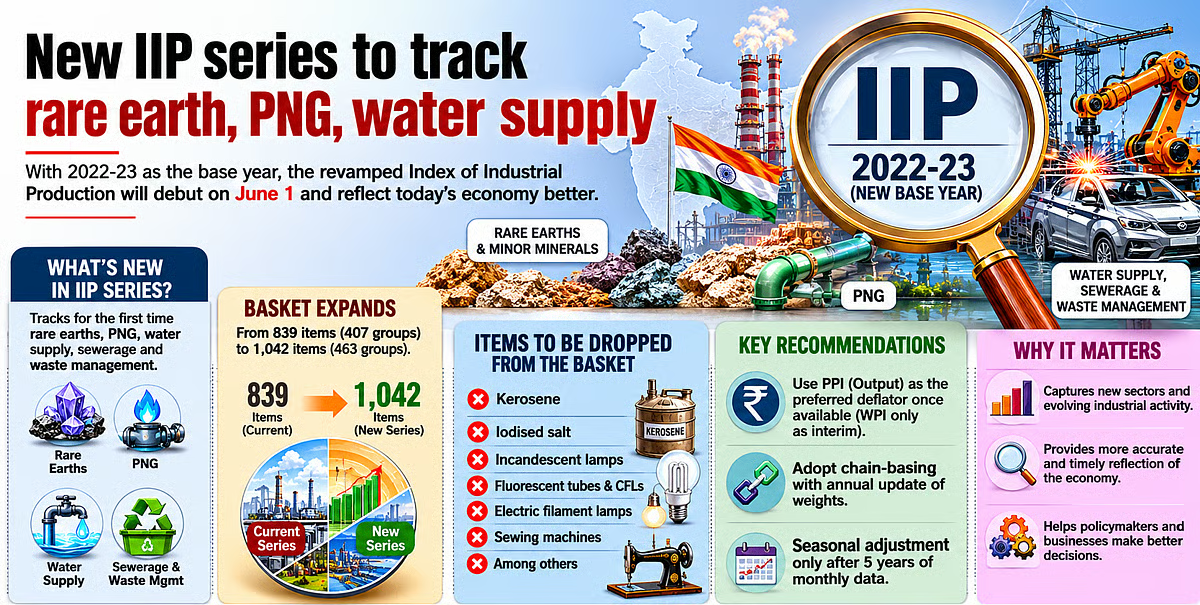
The government revised the Index of Industrial Production (IIP) base year to 2022-23, adding sectors like water and waste management. Driven by manufacturing and capital goods, industrial output recorded a 4.9% growth in April 2026 under this new series.
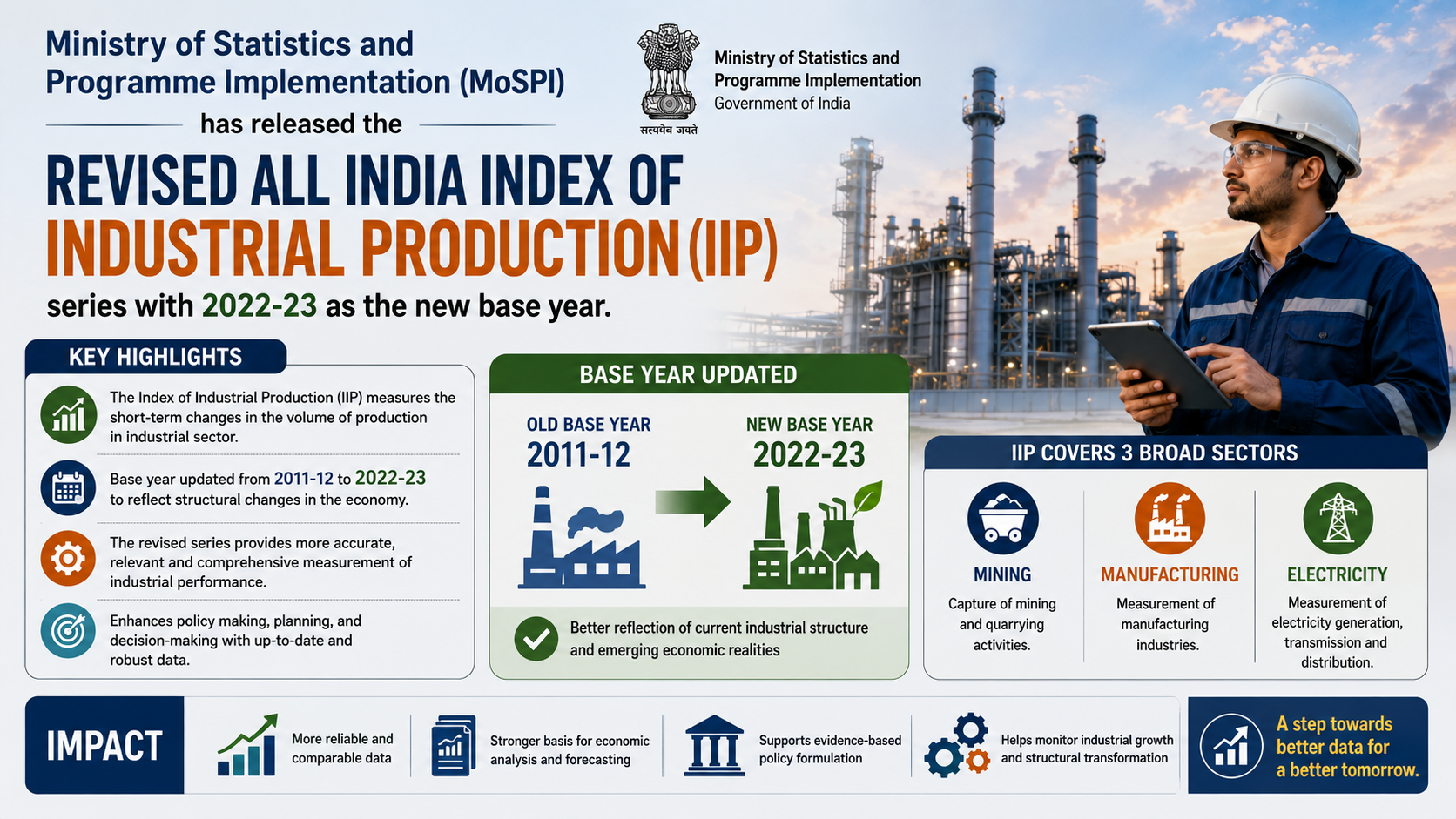
The Ministry of Statistics and Programme Implementation (MoSPI) released the revised All India Index of Industrial Production (IIP) series with 2022-23 as the new base year.
The National Statistical Office (NSO) under the Ministry of Statistics and Programme Implementation (MoSPI) compiles and releases the IIP every month.
The index measures short-term changes in the volume of industrial production over a specific period.
The government relies on this indicator for policy formulation, GDP estimation, and guiding broader economic analysis.
MoSPI updates the base year from 2011-12 to 2022-23 to make the index more representative of the current economic structure and consumption patterns.
The statistical framework adopts the National Industrial Classification (NIC)-2025, replacing the older NIC-2008 standards.
Statisticians calculate the linking factor between the old and new series using the Geometric Mean (GM) method.
Expanded Sectoral Coverage and Weights The new series reorganizes the industrial economy from three into four core sectors:
Revamped Item Basket
The updated basket tracks 1,042 products mapped across 463 item groups, increasing from the old series (839 products in 407 groups).
Key Additions: The index embraces modern industrial activities by adding magnetic stripe cards (debit/credit), CCTV cameras, non-woven textiles, aircraft and spacecraft parts, stents, and vaccines.
Key Deletions: The index discards obsolete and uncommon items such as kerosene, fluorescent tubes and CFLs, printing machinery, and bicycle/rickshaw tyre tubes.
 Data Collection & Methodology Upgrades
The government increases the number of data source agencies from 12 to 16 (adding agencies like IREL for rare earths, State for minor minerals, and MoHUA for urban utilities).
The NSO uses the Wholesale Price Index (WPI) to deflate value-based item groups currently, but plans to transition to the Output Producer Price Index (PPI) once it demonstrates stability.
The revised methodology permits authorities to substitute closed factories with comparable operational units to maintain an accurate and representative sample base.
Use-Based Classification The index categorizes all goods into six distinct use-based segments to gauge demand types:
Current Performance Trends (April 2026 Data)
The overall IIP registers a 4.9% growth under the new 2022-23 base year.
Capital Goods surge by a robust 16%, which clearly signals strong, expanding investment demand in the economy.
At the sectoral level, Manufacturing grows by 6.2%, whereas Mining contracts by 5.1%
Source: PIB
|
PRACTICE QUESTION Q. Consider the following statements regarding the newly revised Index of Industrial Production (IIP) series:
Which of the statements given above are correct? (A) 1 and 2 only (B) 2 and 3 only (C) 1 and 3 only (D) 1, 2, and 3 Answer: (A) Explanation: Statement 1 is correct: The Ministry of Statistics and Programme Implementation (MoSPI) updated the base year of the All-India Index of Industrial Production (IIP) to 2022-23 from 2011-12. Statement 2 is correct: The updated IIP series expanded its coverage by adding "Water Supply, Sewerage and Waste Management" as an entirely new sector. Statement 3 is incorrect: The IIP is compiled and published monthly by the National Statistical Office (NSO) under MoSPI, not by the Reserve Bank of India (RBI). |
India has moved from the 2011-12 series to a new IIP series with 2022-23 as the base year to provide a relatively stable economic period for meaningful comparisons.
The IIP is compiled and released every month by the National Statistics Office (NSO) under the Ministry of Statistics and Programme Implementation (MoSPI).
In addition to the existing mining, manufacturing, and electricity sectors, the new series broadens coverage to include gas supply, water supply, sewerage, and waste management.





© 2026 iasgyan. All right reserved