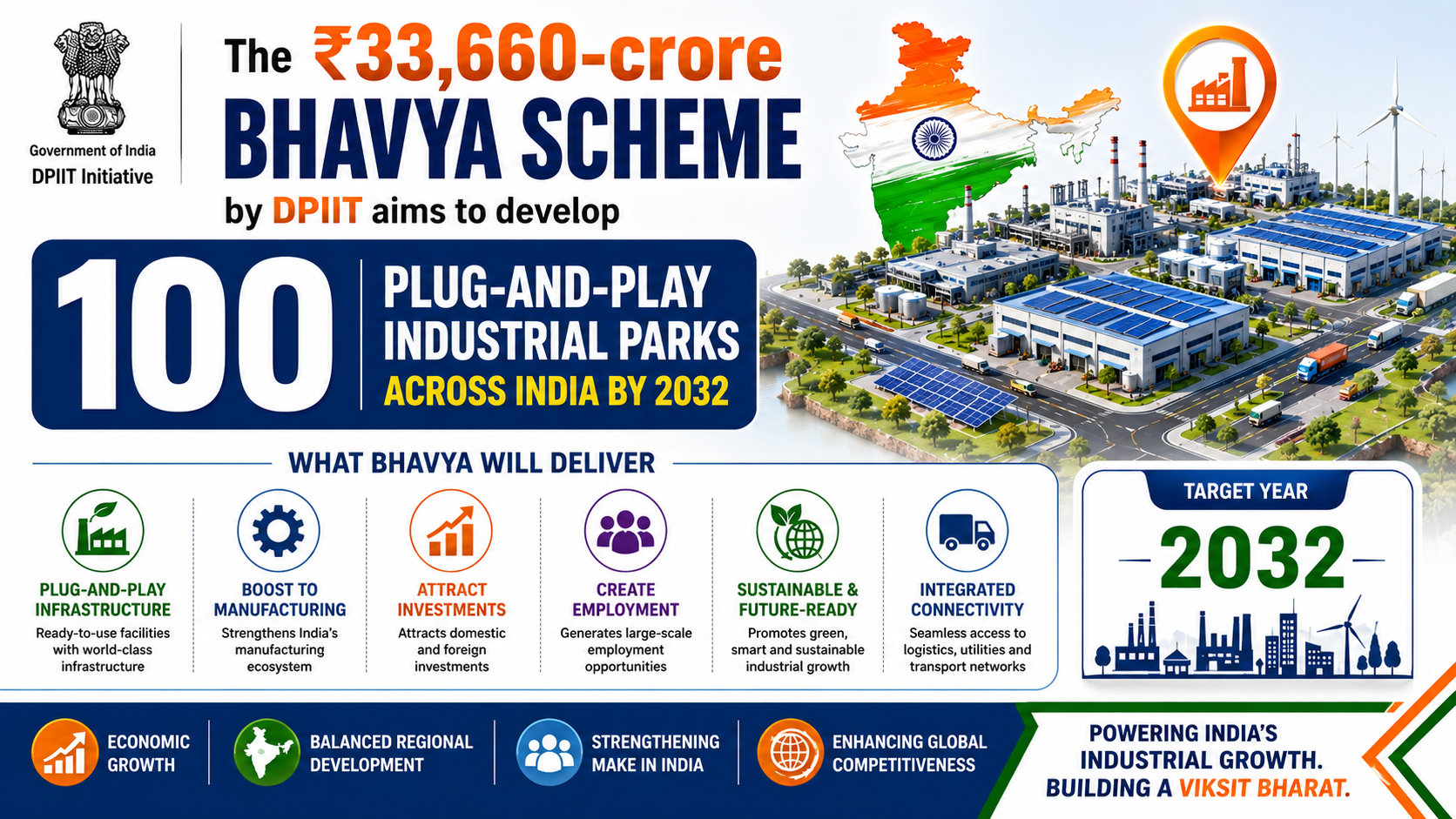
The ₹33,660-crore BHAVYA scheme by DPIIT aims to develop 100 plug-and-play industrial parks across India by 2032. Managed by NICDC via SPVs, it leverages a competitive challenge-based selection process to enhance the manufacturing ecosystem and PM Gati Shakti integration.
The Department for Promotion of Industry and Internal Trade (DPIIT) released the operational guidelines for the Bharat Audyogik Vikas Yojna (BHAVYA) Scheme.
|
Read all about: BHARAT AUDYOGIK VIKAS YOJNA l BHAVYA SCHEME |
The Bharat Audyogik Vikas Yojna (BHAVYA) is a Central Sector Scheme notified by the Department for Promotion of Industry and Internal Trade (DPIIT), Ministry of Commerce and Industry, in April 2026.
It aims to revolutionize the manufacturing landscape by developing world-class, investment-ready industrial infrastructure.
Total Financial Outlay: ₹33,660 crore (includes ₹60 crore for administration).
Scheme Duration: Six years, from Financial Year 2026-27 to 2031-32.
Core Objective: Develop 100 globally competitive industrial parks with plug-and-play facilities to enable ease of investment and enhance manufacturing capacity.
Strategic Alignment: The scheme integrates with PM Gati Shakti principles, focusing on multi-modal connectivity and proximity to urban centers and industrial hubs.
Selection Process (Challenge Mode)
Competitive Selection: Projects are selected through a challenge-based competitive model rather than discretionary allocation.
Phased Implementation: The scheme selects parks in two or more phases. The first phase targets up to 50 proposals.
Evaluation Matrix: Proposals receive scores based on:
Eligibility Criteria
Land Requirements:
Land Ownership: Sponsoring agencies must possess 90% encumbrance-free land at the time of application.
Implementation Framework (Special Purpose Vehicles)
SPV Structure: Each approved park is implemented by an SPV incorporated under the Companies Act, 2013.
Partnerships: SPVs are joint ventures between the National Industrial Corridor Development and Investment Trust (NICDIT) and the State Nodal Agency.
Private Participation: Private developers may participate as co-promoters or anchor investors (allowed to self-allot up to 25% of land).
Institutional Oversight
Project Management Agency (PMA): The National Industrial Corridor Development Corporation (NICDC) serves as the PMA.
National Level Steering Committee (NLSC): Chaired by the Secretary, DPIIT; approves projects and monitors fund release.
State Level Committee (SLC): Chaired by the Chief Secretary of the concerned state to recommend projects and facilitate external infrastructure.
Plug-and-Play Ecosystem: Provides pre-certified, fully serviced factory sheds and utility links, allowing manufacturers to commence operations without delay.
Reduced Gestation Periods: Minimizes the time and capital expenditure for startups and large enterprises by providing ready-to-use infrastructure.
De-risking Investment: Transparent corporate governance through SPVs shields investors from municipal liabilities and ensures clean land titles.
Logistics Synergy: Alignment with PM Gati Shakti ensures synchronization with Dedicated Freight Corridors, ports, and highways, lowering cargo movement costs.
Sustainability Standards: Mandates Common Effluent Treatment Plants (CETPs), renewable energy infrastructure, and solid waste management, aligning with green supply-chain standards.
Worker-Centric Design: Stabilizes the labor force by providing safe worker housing, on-site day care, and skill development centers within the park.
Digital Integration: Uses GIS-based tracking systems and digital single-window clearance for land management, building construction.
The BHAVYA scheme establishes a competitive, objective, and sustainable framework for developing 100 world-class industrial parks to drive India's global manufacturing leadership.
Source: IBEF
|
PRACTICE QUESTION Q. Consider the following statements regarding the Bharat Audyogik Vikas Yojna (BHAVYA) Scheme:
Which of the statements given above is/are correct? (a) 1 and 2 only (b) 2 and 3 only (c) 1 and 3 only (d) 1, 2, and 3 Answer: (a) Explanation: Statement 1 is correct: BHAVYA (Bharat Audyogik Vikas Yojna) is a Central Sector Scheme aimed at developing 100 plug-and-play industrial parks across India. The projects are selected through a challenge-based competitive selection process designed to encourage states to implement reform-oriented policies. Statement 2 is correct: The National Industrial Corridor Development Corporation (NICDC) under the DPIIT acts as the Project Management Agency (PMA) for the scheme. Statement 3 is incorrect: The scheme does not permit up to 100% central funding for external infrastructure. Instead, central financial assistance for external infrastructure (such as road, rail, and port connectivity) is capped at up to 25% of the total project cost. Central funding for core internal and social infrastructure is provided up to ₹1 Crore per acre. |
BHAVYA (Bharat Audyogik Vikas Yojna) is a Central Sector Scheme launched by the DPIIT with a financial outlay of ₹33,660 crore. It aims to develop 100 world-class, plug-and-play industrial parks across India from FY 2026-27 to FY 2031-32 to boost manufacturing capacity.
It is an advanced infrastructure model where completely built, pre-certified factory sheds are provided with pre-installed utility links (power, water, waste management). This allows incoming manufacturers to begin operations immediately without constructing basic infrastructure from scratch.
Projects are selected through a challenge-based competitive evaluation process. Proposals are scored on objective parameters including multi-modal connectivity, site suitability, quality of infrastructure, industrial ecosystem, policy enablers, and sustainability.





© 2026 iasgyan. All right reserved