Animal slaughter bans in India cause agrarian distress by turning unproductive cattle into liabilities. This devastates meat and leather industries, worsens nutritional anemia, and escalates a stray cattle menace that destroys standing crops, threatening the broader rural livelihood economy.
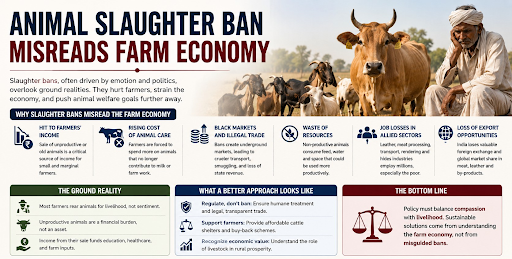
Stricter implementation of animal slaughter laws in states like West Bengal have revived debates on agriculture, rural livelihoods and cattle economics.
Article 48 (Directive Principles of State Policy): Directs the State to organize agriculture and animal husbandry on modern, scientific lines.
Article 48A: Directs the State to protect and improve the environment and safeguard forests and wildlife.
Legal Restrictions: Cow slaughter is currently banned in 20 of 29 states. Legislation has evolved from simple slaughter bans (1950–1980) to stricter bans on the possession or sale of beef since the 1980s.
Judicial Challenges: Butchers, tanners, and cattle dealers have challenged these bans in the Supreme Court, citing violations of Fundamental Rights regarding trade (Article 19(1)(g)) and religion (Article 25).
Transition from Draft to Dairy: Indian agriculture has moved beyond the "age of the bullock cart." Mechanization (12 million tractors) has replaced bullocks for ploughing and transport. Farmers now primarily rear bovines for milk production.
Economic Contributions:
Subsidiary Income: Rearing livestock provides income, employment, and agricultural sustainability for rural households.
Unproductivity: Cows stop giving sufficient milk after 5-6 calvings (around 8–10 years of age).
Economic Deficit: Maintaining an unproductive cow costs approximately USD 94.12 per month. Without the option to sell for slaughter, farmers face severe financial strain.
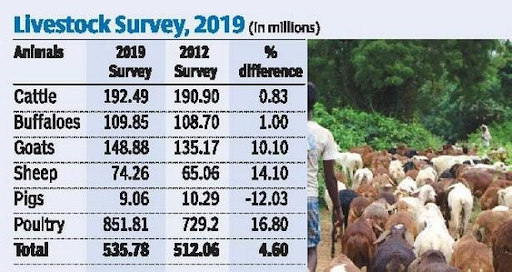
Mechanization: Male cattle are redundant due to the use of tractors, power pumps, and harvesters. Male cattle populations dropped from 61.95 million in 2012 to 43.94 million in 2019.
Feed Scarcity: Lack of space, high costs of fodder, and the replacement of natural breeding with artificial insemination reduce the incentive to keep non-milking animals.
Social Changes: Youth migration to urban areas and the "waste of time" perception of cattle rearing among the educated have led to increased abandonment.
Economic Slowdown in Allied Sectors: The ban has caused a slowdown in the leather industry, particularly hitting small-time tanneries in the unorganized sector that lack organized sourcing systems.
Loss of Income for Minorities: The ban hampers the economic prospects of Muslim and Dalit communities, who almost exclusively work as traders, butchers, and retailers in the meat value chain.
Dairy Viability: If farmers must feed unproductive cows for their full lifespan (20–25 years), the cost of milk production doubles, making cow-rearing uncompetitive compared to buffalo-rearing.
Nutritional Costs:
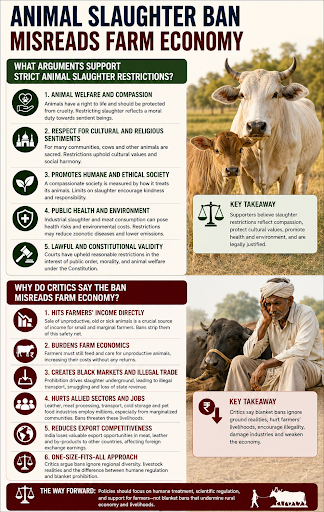
Stray Cattle Menace: There are approximately 5 million stray cattle in India. States with strict bans, like Chhattisgarh, saw a 33.93% increase in stray cattle between 2012 and 2019.
Crop Destruction: Stray animals trample and eat standing crops. Farmers in some regions (e.g., Janjgir district) have stopped growing Rabi (second) crops because they cannot protect fields from wandering livestock.
Social and Communal Conflict:
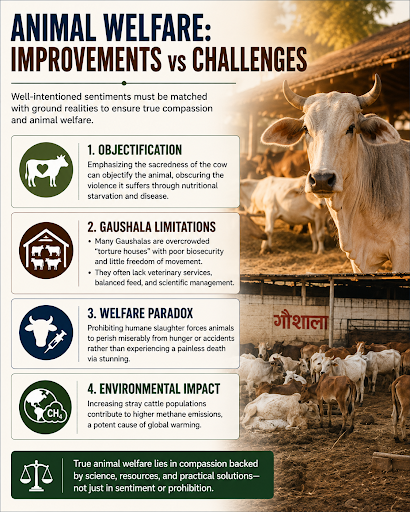
Economic Incentives: Shift the focus from purely ethical/religious arguments to economic viability. Utilize cow dung and urine for organic fertilizers, pesticides, and biogas (Waste to Wealth).
Scientific Management:
Economic Integration (Waste to Wealth): Transform Gaushalas into self-sufficient units by converting dung and urine into biogas, organic manure, and eco-friendly products.
Humane Slaughter Standards: Modernize licensed facilities with stunning (rendering the animal unconscious) and shielding (hiding the sight of slaughter) to ensure a painless process.
Institutional Support:
Depoliticization: Shift the policy focus from symbolic protection to the actual material welfare of both the animal and the rural communities that depend on them.
The animal slaughter ban in India creates economic and nutritional deficits for rural livelihoods and minority communities while inadvertently worsening animal welfare through the stray cattle menace.
Source: INDIANEXPRESS
|
PRACTICE QUESTION Q. Critically examine the socio-economic impacts of the ban on cow slaughter on the agrarian economy and marginalized communities in India. 150 words |
Article 48 of the Constitution under the Directive Principles of State Policy directs the State to prohibit the slaughtering and smuggling of cows, calves, and other milch and draught cattle.
The ban restricts the supply of hides and skins, causing India's leather industry—previously valued at USD 12 billion—to lose international orders and trigger massive layoffs among marginalized working-class communities.
While Gaushalas rehabilitate disowned cattle, they often suffer from overcrowding, lack of scientific management, and severe resource constraints, requiring integration with AI-driven circular economies (like biogas generation) to become financially self-sustainable.



© 2026 iasgyan. All right reserved