India targets inclusion in the Bloomberg Global Aggregate Bond Index to attract foreign capital, lower borrowing costs, and strengthen the rupee. However, operational hurdles like settlement delays remain, prompting government reforms to ensure macroeconomic stability and secure index entry.
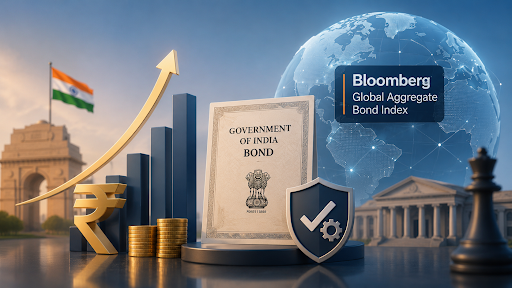
India seeks inclusion in the Bloomberg Global Aggregate Bond Index, a major fixed-income benchmark.
The Bloomberg Global Aggregate Bond Index operates as an international fixed-income benchmark that tracks the performance of investment-grade, fixed-rate bonds globally.
It functions as the global tracking ledger for the multi-trillion-dollar sovereign and corporate debt markets, much like how the Nifty 50 tracks equities.
Key Features of the Index
Massive Asset Base: The index tracks over $70 trillion in fixed-income assets globally.
Diverse Coverage: It provides a highly transparent, multicurrency macro-measurement tool covering treasury, government-related, corporate, and securitized debt from both developed and emerging markets.
Investment Blueprint: It serves as a passive investment blueprint for Exchange-Traded Funds (ETFs) and index funds, and acts as a rigorous performance scorecard for active global asset managers.
Criteria for Inclusion
Credit Quality: Bonds require an investment-grade rating (Baa3/BBB-/BBB- or higher) from major agencies like Moody’s, S&P, and Fitch.
Liquidity Minimums: Securities must meet a minimum par amount outstanding and carry at least one year until final maturity.
India-Specific Criteria: India secures inclusion entirely through Fully Accessible Route (FAR) designated Government Securities (G-Secs), which allow foreign investors to invest without capital caps.
Global Certification: Entry into the index publicly certifies that India's financial markets meet strict global operational and liquidity standards.
Wider Reach: It places Indian government bonds in front of a categorically larger pool of capital, including sovereign wealth funds, pension funds, and massive multi-asset managers.
Benefits for the Indian Economy
Massive Capital Inflows: India expects to attract 20–25 billion in passive foreign portfolio investment.
Lower Borrowing Costs: Massive sustained foreign participation lowers bond yields, reducing the overall borrowing costs for the Indian government.
Currency Strengthening: The massive conversion of foreign capital into rupees increases currency demand, directly strengthening the Indian Rupee.
Market Depth: The influx of institutional investors improves liquidity, narrows bid-ask spreads, and stabilizes the overall interest rate environment.
Challenges and Risks
Operational Hurdles: Bloomberg defers India's inclusion due to critical friction points: lengthy fund registration, settlement delays, limited post-trade automation, and complex tax processes.
Threat of Capital Flight: High passive investor dependency leaves India vulnerable; any reduction in index weightage or global geopolitical shock can trigger an exodus of funds.
Macroeconomic Instability: Sudden bulk withdrawals severely pressure forex markets, depreciate the rupee, and inflate the Current Account Deficit (CAD) and import bills.
Steps Taken
Tax Reforms: The Indian government scraps the 12.5% long-term capital gains (LTCG) tax and the 20% withholding tax for FPIs to sweeten the investment appeal.
Expanded Security Pool: The RBI adds 15-, 30-, and 40-year G-secs and sovereign green bonds to the FAR list to deepen the investable asset base.
India must upgrade market infrastructure and maintain strong macroeconomic fundamentals to harness the foreign capital inflows from global bond indices while shielding the economy from sudden capital flight risks.
Source: BUSINESS-STANDAR
|
PRACTICE QUESTION Q. Consider the following statements regarding the Bloomberg Global Aggregate Bond Index:
Which of the statements given above is/are correct? A) 1 only B) 2 only C) Both 1 and 2 D) Neither 1 nor 2 Answer: B Explanation Statement 1 is incorrect: The Bloomberg Global Aggregate Bond Index tracks only investment-grade, fixed-rate bonds and does not include high-yield (or "junk") speculative bonds. Statement 2 is correct: India's inclusion and evaluation in the index rely exclusively on Fully Accessible Route (FAR) designated Government Securities. These are specific central government bonds without investment caps for non-resident investors. |
The Bloomberg Global Aggregate Bond Index is a flagship, multi-currency benchmark that measures global investment-grade fixed-rate debt performance from sovereign, corporate, and securitized issuers across the globe.
India's entry, to integrate Indian Fully Accessible Route (FAR) bonds into global portfolios, creating a dedicated 0.44% allocation weight that elevates the nation's financial status.
Inclusion automatically attracts billions in foreign capital by compelling passive global index-tracking funds to programmatically purchase Indian debt to precisely match their mandated benchmark asset allocations.
Deep global integration exposes the domestic economy to high capital flight vulnerability, increased bond yield volatility, and foreign exchange shocks whenever international investors abruptly pull out funds during global financial crises.





© 2026 iasgyan. All right reserved