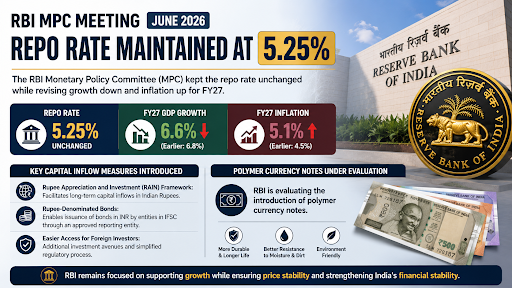
The June 2026 RBI MPC meeting maintained the repo rate at 5.25% while revising FY27 GDP growth down to 6.6% and inflation up to 5.1%. The RBI also introduced key capital inflow measures and is evaluating polymer currency notes.
Why In News?
The Reserve Bank of India (RBI) maintained the repo rate at 5.25% in its June 2026 MPC meeting while revising the FY27 inflation forecast to 5.1%.
What is the Monetary Policy Committee (MPC)?
Establishment: The Government constitutes the MPC by amending the Reserve Bank of India Act, 1934 via the Finance Act, 2016.
Background: The government forms the MPC based on proposals from the Urjit Patel Committee, addressing concerns of excessive government influence and friction by shifting rate-setting power from the Governor alone to a dedicated committee.
Primary Mandate: The committee fixes the benchmark interest rate to maintain 4% annual inflation, operating within an upper tolerance limit of 6% and a lower tolerance limit of 2%.
Composition: The committee comprises six members, featuring three internal RBI officials and three external experts nominated by the Government of India.
Leadership & Voting: The Governor of the Reserve Bank of India acts as the Chairperson ex officio and holds a casting vote to resolve any ties.
Accountability: The committee answers directly to the Government of India if headline inflation exceeds the prescribed tolerance range for three consecutive quarters.
Key Decisions of the RBI Monetary Policy Committee (MPC) June 2026
Status Quo on Rates: The MPC unanimously votes to keep the policy repo rate unchanged at 5.25%.
Policy Stance: The committee officially retains a neutral policy stance amidst global uncertainties.
Unchanged Facility Rates: The RBI maintains the Marginal Standing Facility (MSF) rate and Bank Rate at 5.50%, alongside keeping the Standing Deposit Facility (SDF) steady at 5%.
Foreign Capital Inflow Measures: The RBI deploys measures to attract foreign capital, including scrapping income and capital gains taxes for Foreign Portfolio Investors (FPIs) on government securities.
Hedging Cost Subsidies: The central bank introduces a facility to absorb the full hedging costs for fresh 3-5 year Foreign Currency Non-Resident (FCNR-B) deposits to incentivize external commercial borrowing.
Polymer Currency: Discussion on the introduction of Polymer (plastic) currency notes to replace traditional paper notes. .
|
Growth and Inflation Outlook
|
Why Did RBI Maintain Status Quo?
Balancing Growth and Inflation: The MPC chooses to support domestic economic activity rather than tightening rates, acknowledging that current inflation shocks remain highly supply-driven.
Shift to External Vulnerabilities: The RBI shifts its focus from domestic demand toward stabilizing the external sector, addressing persistent foreign portfolio outflows and widening Balance of Payments (BoP) gaps.
Preventing Imposed Costs: The MPC notes that hiking rates to combat globally driven energy shocks imposes unnecessary costs on economic growth without materially easing inflation.
Benign Underlying Pressures: RBI Governor affirms that despite volatile crude prices, underlying inflation pressures remain benign, allowing the committee to look past immediate shocks.
Conclusion
By holding the repo rate steady while deploying strategic external capital incentives, the RBI masterfully balances domestic growth sustainability against severe global inflationary shocks and currency volatility.
Source: INDIANEXPRESS
|
PRACTICE QUESTION Q. With reference to the Monetary Policy Committee (MPC) of India, consider the following statements:
Which of the statements given above is/are correct? A) 1 only B) 2 only C) Both 1 and 2 D) Neither 1 nor 2 Answer: C Explanation: Statement 1 is correct: The MPC is a six-member body constituted under the Reserve Bank of India Act, 1934. It consists of three officials from the Reserve Bank of India (including the Governor) and three external members nominated by the Government of India. Statement 2 is correct: The primary mandate of the MPC under the Flexible Inflation Targeting (FIT) framework is to maintain consumer price inflation at an annual target of 4%. It has an upper tolerance limit of 6% and a lower tolerance limit of 2%. |
The newly appointed RBI Governor, Sanjay Malhotra, announced that the benchmark policy repo rate remains unchanged at 5.25%.
Retaining a neutral stance means the MPC is keeping all tactical options open rather than committing to a definitive directional path toward either raising or cutting rates.
Monetary policy curbs inflation by manipulating systemic liquidity and short-term interest rates to deliberately cool down excessive market demand and stabilize consumer price expectations.






© 2026 iasgyan. All right reserved