The ₹81,000-crore Great Nicobar project builds a mega transhipment port, airport, and township. While promising strategic maritime dominance, it threatens pristine rainforests, endangered Leatherback turtles, and vulnerable Shompen tribes, raising deep economic and ecological viability concerns for modern India.
Why In News?
A Finance Ministry investment body criticized the Great Nicobar port project for insufficient commercial viability and a lack of clear strategic goals.
|
Read all about: Great Nicobar Project |
What is the Great Nicobar Port project?
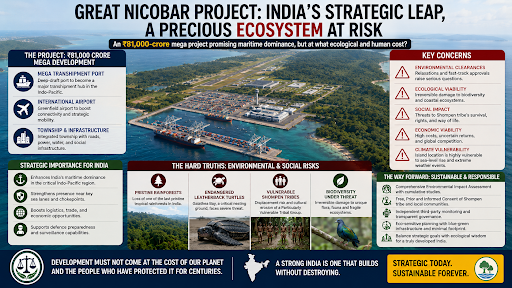
It constitutes a ₹81,000-crore mega infrastructure initiative located on the ecologically pristine Great Nicobar Island.
The master plan integrates four core components: a 14.2 million TEU International Container Transshipment Terminal (ICTT) at Galathea Bay, a Greenfield International Airport, a 450 MVA gas and solar power plant, and a sprawling 16,610-hectare township.
The government designs the project to transform India into a regional maritime hub, strategically capturing global cargo traffic and ending logistics dependence on foreign ports like Colombo, Port Klang, and Singapore.
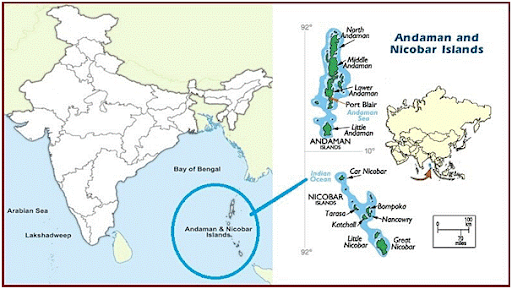
How can the project strengthen India's maritime presence?
The project capitalizes on Galathea Bay's prime geographic location, situated just 40 nautical miles from the critical East-West international shipping route.
The site has a natural deep-water draft exceeding 20 metres, allowing India to berth massive mother vessels without requiring expensive capital dredging.
The infrastructure aligns with India’s Indo-Pacific strategy, boosting maritime domain awareness and projecting power near the Malacca Strait, a vital global chokepoint.
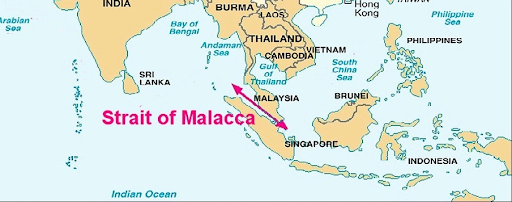
The port stimulates the Blue Economy by integrating with the Sagarmala Programme and PM Gati Shakti, directly competing for the lucrative global shipping trade currently dominated by China and Sri Lanka.
What ecological concerns surround Great Nicobar Island?
The infrastructure demands the permanent diversion of 130 square kilometres of tropical rainforests, mandating the felling of at least 8.65 lakh trees.
Authorities denotified the Galathea Bay Wildlife Sanctuary—a globally critical nesting site for the endangered Giant Leatherback turtle—to facilitate port construction.
The development invites high ecological collapse risks, as massive deforestation and dredging occur in a highly sensitive seismic and cyclone-prone zone.
The island anchors the Sundaland global biodiversity hotspot; the massive land reclamation threatens endemic species like the saltwater crocodile, Nicobar megapode bird, and rare coral reefs.
How could the project affect tribal communities and biodiversity?
The project directly threatens the survival of the indigenous Shompen (hunter-gatherers) and Nicobarese tribes, both protected as Particularly Vulnerable Tribal Groups (PVTGs).
The Tribal Council of Little and Great Nicobar formally withdrew its consent, asserting the administration used pressure to obtain clearances and bypassed the Forest Rights Act (FRA) of 2006.
The introduction of an estimated three lakh new settlers and tourists exposes isolated tribal populations to deadly infectious diseases and extreme cultural displacement.
Massive construction destroys vital foraging grounds, disrupts coastal sediment, and degrades the natural habitats the tribes rely on for daily survival.
Way Forward
Execute an independent, transparent cost-benefit and cumulative ecological impact study before advancing construction.
Shift focus toward scaled-down alternatives that prioritize eco-tourism, small-scale community ports, and targeted military upgrades.
Leverage and strengthen existing mainland deep-water ports, such as the Vizhinjam Port in Kerala, which offers a proven transhipment alternative without catastrophic indigenous displacement.
Strictly uphold the Free, Prior, and Informed Consent (FPIC) mandate by restoring the authority of local Gram Sabhas under the Forest Rights Act.
Conclusion
The Great Nicobar Project ambitiously aims to cement India's dominance in global maritime logistics, but it risks catastrophic, irreversible destruction of a unique ecological hotspot and its indigenous tribes unless pivoted toward truly sustainable, mainland-focused alternatives.
Source: THEHINDU
|
PRACTICE QUESTION Q. The Great Nicobar Island Development Project aims to boost India's Blue Economy and maritime domain awareness. Evaluate its economic viability against the ecological costs it imposes. 150 words |
The mega infrastructure plan integrates four distinct facilities: an International Container Transshipment Terminal (ICTT) at Galathea Bay, a Greenfield International Airport, a massive 16,610-hectare township, and a power plant.
The port development targets the mouth of Galathea Bay, which serves as a globally critical nesting site for the endangered Giant Leatherback Turtle, actively threatening their breeding cycles through dredging and reclamation.
The Ministry of Defence applies the "strategic" tag to the project, a move critics argue deliberately allows the government to bypass rigorous environmental transparency and block Right to Information (RTI) inquiries.




© 2026 iasgyan. All right reserved