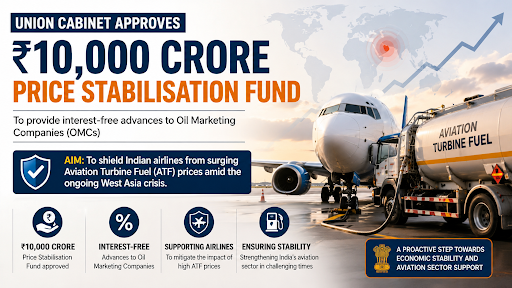
The Union Cabinet approved a ₹10,000 crore Price Stabilisation Fund providing interest-free advances to OMCs. This mechanism offers fixed-price ATF to domestic airlines, shielding them from massive price volatility caused by the West Asia crisis and structural tax challenges.
Why In News?
The Union Cabinet approved a ₹10,000 crore Price Stabilisation Fund to provide interest-free advances to Oil Marketing Companies (OMCs) to stabilize Aviation Turbine Fuel (ATF) prices for scheduled Indian airlines.
What is the Price Stabilization Fund for Scheduled Indian Airlines?
The Central Government establishes the fund as a temporary, single-window micro-economic buffer mechanism.
The scheme allocates a ₹10,000 crore interest-free budgetary advance to Oil Marketing Companies (OMCs).
It specifically combats the extreme global fuel market volatility caused by the West Asia crisis, which drove international ATF prices from ₹60.50 per litre in March 2026 to ₹142 per litre in May 2026.
Why is Aviation Turbine Fuel (ATF) Crucial for Airlines?
ATF dictates 40% of standard airline operating costs, and escalates to 60% of total operating expenditure during extreme price volatility.
Rising ATF costs directly erode airline profitability; a mere $1 per barrel increase in crude oil adds approximately ₹300 crore to IndiGo’s annual fuel bill.
Indian carriers suffer disproportionately from ad valorem taxes (percentage-based), which
amplify the absolute tax burden when base fuel prices spike.
Key Features of the Price Stabilization Fund
Interest-Free Advance: The Ministry of Petroleum and Natural Gas funnels up to ₹10,000 crore to offset OMC losses.
Fixed ATF Pricing: The framework sets a base benchmark price of ₹86.32/litre (domestic) and ₹104.49/litre (international). After taxes, this translates to a fixed selling price of ₹115 per litre in Delhi.
Universal Coverage: The scheme covers all willing scheduled Indian carriers across both domestic and international flight paths.
Exclusive Sourcing Lock-In: Participating airlines sign a Memorandum of Understanding (MoU) committing to purchase ATF exclusively from participating OMCs for up to 36 months (3 years).
Strict Oversight: A Monitoring Committee (comprising the Ministry of Civil Aviation, Ministry of Petroleum & Natural Gas, and Department of Expenditure) enforces claim verification and independent audits.
How Will the Fund Work?
Compensation Phase: The corpus compensates OMCs for financial losses whenever the international Import Parity Price (IPP) exceeds the scheme's designated benchmark price.
Recovery and True-Up Mechanism: When global ATF rates drop below the threshold, the government recovers the differential cushion from the OMCs and returns it to the Consolidated Fund of India.
Settlement Conditions: Airlines can exit the voluntary arrangement only after they clear all outstanding dues or when the advance amount achieves full settlement.
Expected Benefits of the Scheme
Cost Predictability: The fixed-price fuel agreements eliminate daily open-market trading volatility, providing airlines with clear cost predictability for financial planning.
OMC Protection: The mechanism shields Oil Marketing Companies from absorbing heavy under-recoveries during geopolitical energy shocks.
Sustainable Support: The fund functions as temporary liquidity support rather than a permanent fiscal subsidy, utilizing a non-deficit revolving model.
Source: THEPRINT
|
PRACTICE QUESTION Q. With reference to the pricing and taxation of Aviation Turbine Fuel (ATF) in India, consider the following statements:
Which of the statements given above is/are correct? (a) 1 only (b) 2 only (c) Both 1 and 2 (d) Neither 1 nor 2 Answer: (b) Explanation: Statement 1 is incorrect: Aviation Turbine Fuel (ATF) is currently kept outside the purview of the GST regime. It continues to be taxed via central excise duty and state-level Value Added Tax (VAT), which vary significantly across different states. Because of this, ATF prices are highly uneven depending on the state. Statement 2 is correct: India follows an ad valorem tax structure for ATF (charging a fixed percentage of the fuel's total value). Consequently, when global crude oil prices spike, the base price of the fuel increases, and the tax applied to it also rises proportionally. This cascading effect amplifies the tax burden on airlines during global price shocks. |
The Price Stabilization Fund acts as a temporary, recoverable micro-economic buffer mechanism that provides interest-free advances to oil marketing companies to insulate scheduled domestic carriers from skyrocketing global aviation fuel prices.
Aviation Turbine Fuel is a specialized crude-oil-derived jet fuel that powers aircraft and accounts for a massive 40% to 60% of an airline's total operating expenditure.
Extreme fuel price fluctuations devastate airline profitability, disrupt predictable route planning, and force carrier companies to aggressively cut flights to control their ballooning operational overheads.





© 2026 iasgyan. All right reserved