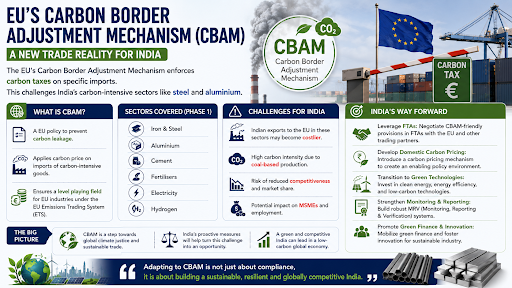
The EU's Carbon Border Adjustment Mechanism enforces carbon taxes on specific imports. This challenges India’s carbon-intensive sectors like steel and aluminium. India must leverage FTAs, develop domestic carbon pricing, and transition to green technologies to ensure global competitiveness.
Why In News?
The EU's Carbon Border Adjustment Mechanism (CBAM) pressures India's steel and aluminium exports.
|
Read all about: EU'S CARBON BORDER TAX (CBAM) l CARBON BORDER ADJUSTMENT MECHANISMS (CBAM) |
What Are Tariffs?
A tariff is a tax or duty imposed by a government on goods and services imported from another country.
It is a primary tool of trade policy, used to make foreign products more expensive and less attractive to domestic consumers, thereby encouraging people to buy locally produced goods.
Why Tariffs are Imposed?
Industrial Protection: High tariffs, such as the 50% import tariff imposed by the United States on certain metals, shield domestic producers from cheaper foreign competition.
Revenue Generation: Governments use tariffs as a reliable fiscal tool. In the developed world, sectors like steel and aluminum remain the most protected through these traditional mechanisms.
Competitive Leveling: Tariffs attempt to equalize the market price of imports with domestic goods that may have higher production or labor costs.
Why Is Carbon Becoming the New Trade Barrier?
Carbon regulation, specifically through mechanisms like the Carbon Border Adjustment Mechanism (CBAM), is emerging as a "green" trade barrier that replaces or complements traditional tariffs.
Prevention of Carbon Leakage: The EU uses CBAM to prevent companies from moving production to countries with relaxed climate rules, a process known as carbon leakage.
Price Equalization: CBAM imposes a cost on imported goods equivalent to the carbon price paid by domestic producers under the EU Emissions Trading System (ETS).
Targeted Sectors: The mechanism initially focuses on energy-intensive products: Steel, Aluminum, Cement, Fertilizers, Electricity, and Hydrogen.
Accounting Rigor: Unlike general sustainability reports, this is a strict factory-level accounting system covering Scope 1 (direct fuel) and Scope 2 (electricity) emissions.
Cost of Compliance: With EU carbon prices at approximately €75-€77 per tonne of CO2, the tax represents a significant new financial burden at the border.
How Will Carbon Regulations Affect India?
Export Erosion: The EU absorbs roughly 22% of India's steel and aluminum exports. CBAM could erase 16% to 22% of real prices collected by Indian exporters.
Declining Volumes: In FY 2025, Indian steel and aluminum exports to the EU dropped 24% year-on-year due to reporting hurdles and compliance costs during the transition phase.
MSME Crisis: Small and Medium Enterprises (MSMEs) face increases in production costs related to emissions reporting and verification.
Contractual Shifts: European buyers now demand CBAM-adjusted pricing and include clauses allowing them to deduct carbon costs from the final purchase price.
Is Carbon Regulation a Climate Necessity or Green Protectionism?
The debate centers on whether these measures are genuine environmental tools or a new form of industrial warfare.
The Inequity: While high climate costs are manageable for wealthy economies, they slow industrial growth in developing nations with almost no immediate impact on global emissions.
How Is India Responding to the New Trade Architecture?
IBAM (India Border Adjustment Mechanism): India is exploring a domestic version of CBAM to collect carbon tax locally. This ensures revenue stays in the Indian exchequer rather than being paid to the EU.
CCTS (Carbon Credit Trading Scheme): The government is maturing the CCTS into a globally recognized compliance market. This allows Indian firms to use domestic carbon certificates as proof of "price already paid" to reduce EU tax liability.
National Green Hydrogen Mission (NGHM):
FTA Negotiations: India uses the India-EU Free Trade Agreement (FTA) framework, specifically Annex 14-A, to negotiate technical dialogues and recognition of Indian carbon prices.
Hydrogen Diplomacy: Forming partnerships with the EU, Japan, and Gulf nations; leveraging the India-Middle East-Europe Economic Corridor (IMEC) for future hydrogen exports.
What Should India Do to Remain Competitive in the Green Trade Era?
Adopt Cleaner Production: Shift from coal-based Blast Furnace-Basic Oxygen Furnace (BF-BOF) to Gas-based Direct Reduced Iron (DRI) or Electric Arc Furnaces (EAF) using scrap, which face the lowest CBAM burdens.
Establish Green Hydrogen Hubs: Develop integrated hubs at strategic ports like Deendayal (Kandla), Paradip, and V.O. Chidambaranar (Tuticorin) to combine manufacturing with export capabilities.
Mutual Recognition Agreements (MRAs): Negotiate official treaties so EU regulators accept Indian carbon assessments and certifications, reducing the audit burden on MSMEs.
Capacity Building for MSMEs: Provide government-subsidized carbon-accounting software and digital tools to help smaller exporters avoid expensive third-party audits.
Global Advocacy: Lead a coalition of developing nations to demand that carbon border revenues be returned to the country of origin to fund a "Just Transition."
Strategic Pricing: Use two-tier pricing—a base price and a CBAM-adjusted price—to maintain transparency and bargaining power in European contracts.
Conclusion
In the new trade landscape, competitiveness will depend on emission levels rather than production costs, necessitating carbon pricing internalization and a transition to green industrial models in India.
Source: THEHINDU
|
PRACTICE QUESTION Q. With reference to the EU's Carbon Border Adjustment Mechanism (CBAM), consider the following statements:
Which of the statements given above is/are correct? (a) 1 only (b) 2 only (c) Both 1 and 2 only (d) Neither 1 nor 2 Answer: c Explanation: Statement 1 is correct: The Carbon Border Adjustment Mechanism (CBAM) initially focuses on imports from the most carbon-intensive sectors where the risk of "carbon leakage" is highest. These specific sectors are steel (including iron), aluminium, cement, fertilizers, electricity, and hydrogen. Statement 2 is correct: One of the core design features of CBAM is to ensure that a carbon price is not paid twice. Importers can claim a reduction in the number of required CBAM certificates if they can provide verified evidence that a carbon price has already been effectively paid in the product's country of origin |
CBAM is a policy tool introduced by the European Union that imposes a tax on imported goods based on the carbon emissions generated during their production to prevent "carbon leakage".
Indian MSMEs will face an increase in production costs due to strict carbon accounting, expensive auditing requirements, and higher compliance burdens, which threatens their survival in the EU export market.
IBAM is a proposed domestic policy measure designed to collect carbon taxes within India at the point of export. This ensures carbon revenues stay in the Indian exchequer rather than being collected by the EU.


© 2026 iasgyan. All right reserved