

Copyright infringement not intended
Picture Courtesy: INDEPENDENT
India and the European Union are close to finalizing a comprehensive Free Trade Agreement, along with separate pacts on Investment Protection and Geographical Indications.
|
Read all about: INDIA EUROPEAN UNION RELATIONS l INDIA-EU FREE TRADE AGREEMENT |
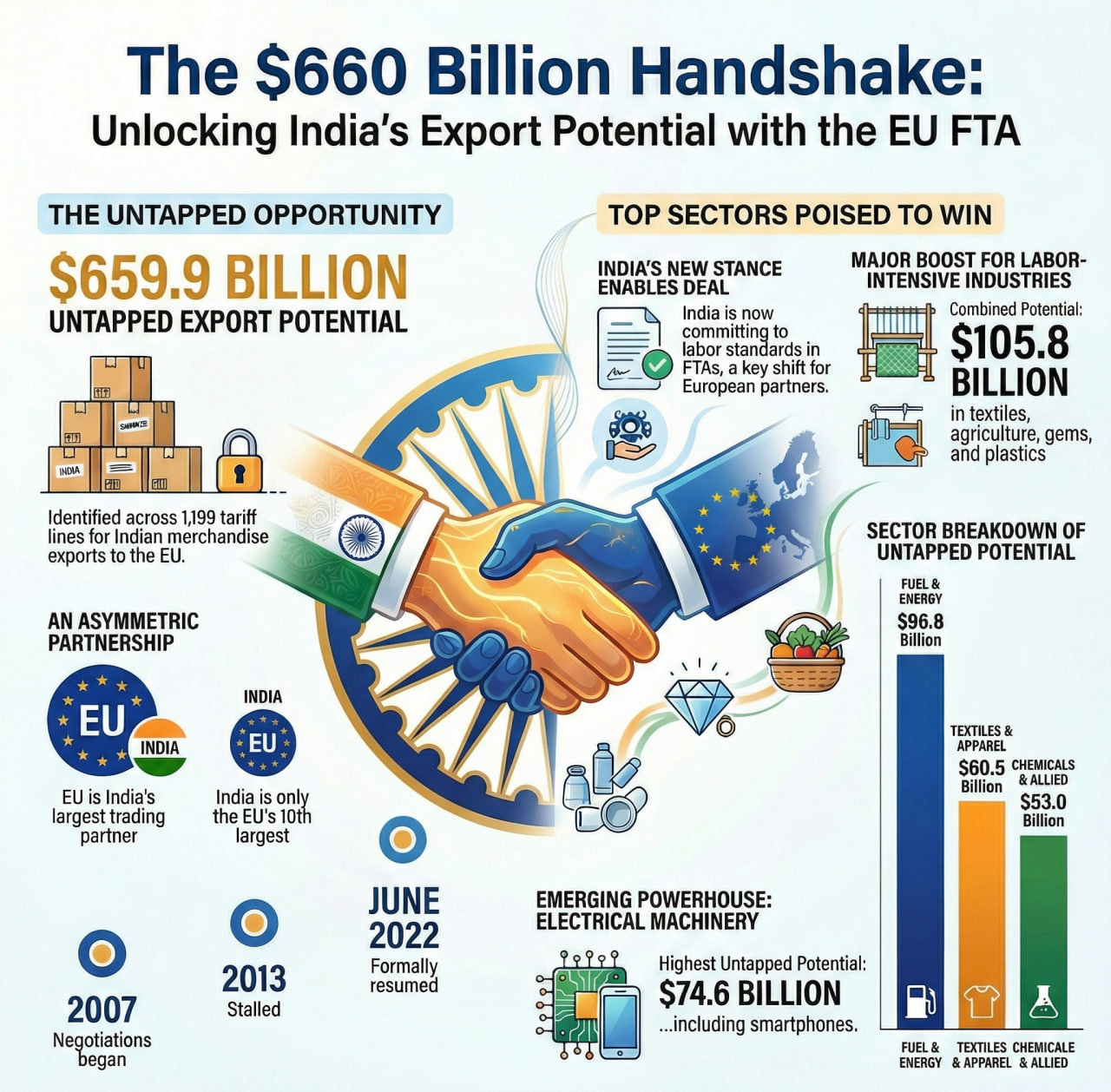
India and the European Union are negotiating a comprehensive Free Trade Agreement, officially called the Broad-based Trade and Investment Agreement (BTIA), aimed at eliminating or significantly reducing trade barriers between them.
Initial talks began in 2007 and stalled for nearly a decade, negotiations were formally re-launched in 2022.
As of January 2026, the India-EU Free Trade Agreement (FTA) is on the verge of completion, with a final announcement expected during the India-EU Summit on January 27, 2026.
 Significance of the FTA for India
Economic and Market Access
An FTA with the EU offers India access to a major, developed market, expected to boost bilateral trade by removing tariffs and non-tariff barriers, making Indian goods and services more competitive.
Enhanced Market Access for Exports
India's bilateral trade in goods with the EU was $137.41 billion in 2023-24, making it the largest trading partner of India for goods. (Source: PIB)
The FTA will provide duty-free access to the EU market, eliminating existing tariffs of up to 10-16% on key Indian exports, making them more competitive against rivals like Vietnam and Bangladesh.
Job Creation
The boost to labour-intensive manufacturing and services is projected to create employment opportunities within India.
FDI Inflows
The Investment Protection Agreement is expected to increase high-quality European FDI in key Indian sectors—such as green energy, semiconductors, and digital infrastructure—boosting technological advancement and global value chain integration.
Key Sectoral Gains
Labour-intensive Goods: Sectors such as textiles, apparel, leather products, and marine products are expected to be major winners due to tariff elimination.
Engineering & Automotive: Exports of engineering goods and automotive components are expected to become more competitive, integrating India into EU-centric supply chains.
Pharmaceuticals and Chemicals: Streamlined approvals and aligned standards will benefit high-value sectors, such as generics and specialty chemicals, by ensuring easier market access.
Services Sector: This is a critical area for India. Key demands include:
Strategic and Geopolitical
The FTA is more than a trade pact; it is a powerful geopolitical signal, strengthening the India-EU Strategic Partnership, founded on shared values of democracy and a commitment to a rules-based international order.
Diversification and Stability: Amid rising global protectionism and trade volatility (e.g., U.S. tariffs), the FTA offers India a stable, rules-based trading partner and a crucial buffer against geopolitical disruptions.
"China-Plus-One" Strategy: The agreement will position India as a reliable "China-plus-one" alternative for European companies seeking to de-risk and diversify supply chains away from China.
Indo-Pacific Strategy: The FTA reinforces the EU's growing focus on the Indo-Pacific and recognizes India as a key partner for stability and security in the region.
Standards Alignment: Engaging with the EU, a "regulatory superpower," prompts Indian industry to upgrade domestic standards (product safety, sustainability, data protection), boosting global competitiveness.
Key Economic and Regulatory Obstacles
Tariff Disparities
The EU is pressing India to reduce high import duties on automobiles, wines, spirits, and medical devices. India remains cautious about these cuts to protect its domestic manufacturing ecosystem.
Carbon Border Adjustment Mechanism (CBAM)
Effective from January 1, 2026, this carbon tax on imports like steel, aluminum, and cement is a major point of friction. India views it as a "green protectionist" barrier that could increase the cost of its exports by 20–35%.
Agriculture and Dairy
India has designated these as "red lines," refusing to fully open these sectors to protect the livelihoods of millions of small-scale farmers. The EU seeks lower tariffs on agricultural products like cheese and grains.
Non-Tariff Barriers
Indian exporters, particularly in the pharmaceutical and agricultural sectors (e.g., Basmati rice), face stringent EU standards regarding pesticide residues, certification, and labeling.
Services and Digital Challenges
Labor Mobility
India is pushing for easier visa access and the "Mutual Recognition Agreement" of professional qualifications for its IT, medical, and engineering professionals. EU member states remain divided on relaxing these migration-related rules.
Data Governance
A mismatch exists between the EU’s GDPR and India’s DPDP Act 2023. The EU pushes for the "free flow of data with trust," while India emphasizes "data sovereignty" and local storage for national security, complicating digital trade.
Intellectual Property Rights (IPR)
The EU's demand for stricter IPR norms and data exclusivity could delay the production of affordable generic medicines, a move India resists to maintain its role as a global pharmacy.
Strategic and Geopolitical Roadblocks
Russia-Ukraine Conflict
Differences in foreign policy—specifically India's neutral stance and continued energy ties with Russia—have created a "trust deficit".
Public Procurement
The EU seeks access to bid for Indian government contracts, which directly clashes with India’s "Aatmanirbhar Bharat" policy that prioritizes local suppliers.
Trade Deficits are a Risk
Many of India's earlier FTAs (with ASEAN, Japan, and South Korea) led to faster import growth than export growth, causing wider trade deficits. Future negotiations must be careful to achieve balanced outcomes and protect domestic sectors from cheaper imports.
Importance of Strong Safeguards and Rules of Origin (RoO)
Past agreements with inadequate Rules of Origin allowed goods from non-FTA countries to bypass tariffs, hurting domestic manufacturing. The India-South Korea CEPA's impact on zinc trade, which reversed India's trade balance, highlights the necessity for strong value-addition and anti-dumping provisions.
Protecting Sensitive Sectors
The ASEAN FTA harmed vulnerable sectors like rubber and palm oil. Learning from this, India now insists on "red lines" in negotiations with the EU and others, excluding sensitive agricultural and dairy products to protect its millions of small-scale farmers.
Non-Tariff Barriers (NTBs) can Dilute Tariff Benefits
Indian exporters struggle with strict non-tariff barriers (NTBs) like SPS standards and IPR issues in developed markets, which undermine tariff reductions. The India-EU talks aim to fix this by seeking easier regulatory paths and mutual recognition of standards for pharmaceuticals and other products.
Leverage Strengths in Services and Mobility
India's service sector (IT, engineering, healthcare) is a major advantage. Future Free Trade Agreements, such as the one being negotiated with the EU, aim to include provisions for professional mobility and mutual recognition of qualifications to enhance market access for Indian professionals.
Integrated Approach to Trade and Investment
India's recent trade deal with the European Free Trade Association (EFTA) includes binding investment commitments (targeting $100 billion FDI over 15 years) within the trade agreement, setting a template for future deals.
Effective Implementation is Crucial
Low utilization of FTA benefits by Indian exporters is a major challenge, often due to poor awareness and difficulty with complex documentation. Better outreach, simplified rules, and improved trade infrastructure are needed to maximize economic gains from FTAs.
FTAs as Geopolitical Tools
Beyond economics, recent FTAs are viewed as strategic instruments for geopolitical alignment, securing supply chain resilience ("China Plus One" policy), and attracting foreign investment in a fragmented global order.
Adopt a Phased Approach
Conclude an "early harvest" agreement on goods and services where consensus exists, similar to the India-Australia ECTA. This can build momentum to tackle more contentious issues later.
Collaborate on CBAM
Negotiating a mutually acceptable solution for the Carbon Border Adjustment Mechanism (CBAM) is necessary, with potential solutions including the EU providing technical and financial aid for the green transition of Indian MSMEs or formally recognizing India's domestic carbon credit trading scheme.
Focus on Regulatory Cooperation
The FTA must go beyond tariffs. It needs to establish robust mechanisms for Mutual Recognition Agreements (MRAs) on standards and certifications, especially for pharmaceuticals and agricultural goods, to overcome EU's stringent sanitary and phytosanitary (SPS) measures.
Prioritize Domestic Reforms
Invest in R&D, infrastructure, and skill development to boost the competitiveness of Indian industries, especially MSMEs, to meet stringent EU technical and environmental standards (NTBs).
Improve FTA Utilization
Address the low utilization rate of existing FTAs by improving trade facilitation measures, simplifying documentation, and creating awareness among exporters about available market access opportunities.
The India-EU FTA offers vast strategic and economic potential. Despite hurdles like CBAM and market access, the geopolitical need for partnership is strong. A flexible, balanced approach is crucial for a landmark deal that solidifies their relationship and promotes a stable, multipolar world.
Source: INDIAN EXPRESS
|
PRACTICE QUESTION Q. Discuss the role of the India-EU Broad-based Trade and Investment Agreement (BTIA) in strengthening the 'China Plus One' strategy. (150 Words) |
The India-EU FTA, officially known as the Broad-based Trade and Investment Agreement (BTIA), is a comprehensive trade deal being negotiated between India and the European Union. It aims to eliminate or significantly reduce tariffs on goods, facilitate trade in services, and create a more predictable environment for investments between the two economies.
CBAM is a policy by the European Union to impose a carbon tax on certain imports from 2026. It is a major concern for India because it could act as a non-tariff barrier, making Indian exports like steel and aluminum more expensive and less competitive in the EU market.
Established in 2022, the TTC is a high-level strategic forum for India and the EU to cooperate on key trade, technology, and security issues. It serves as a crucial platform to find common ground on complex topics like CBAM by focusing on green technology transfer and digital governance, turning potential conflicts into areas for collaboration.
© 2026 iasgyan. All right reserved