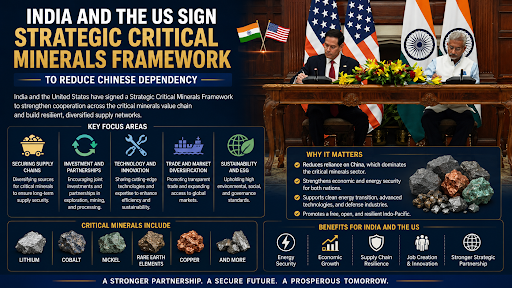
India and the US signed a strategic critical minerals framework to reduce Chinese dependency. Supported by the Quad's $20 billion initiative, Pax Silica, and India's NCMM, the partnership secures resilient supply chains for advanced technology, clean energy, and national defense.
Why In News?
India and the US signed a strategic framework to secure critical mineral supply chains, countering China's rare earth dominance.
|
Read all about: INDIA-US TRADE DEAL 2026 l NEW ERA IN INDIA-US DEFENCE PARTNERSHIP l INDIA'S STRATEGY AGAINST US PRESSURE l INDIA-US INTERIM TRADE DEAL |
What Are Critical Minerals and Rare Earth Elements (REEs)?
Critical Raw Materials (CRMs) refer to raw materials designated by governments as essential for their national economies and national security.
Defining Characteristics
Rare Earth Elements (REEs)
China dominates the business, controlling over 70% of global refining capacity and a massive share of the processing market.
Major economies like the US, EU, Japan, and Australia maintain specific "Critical Mineral Lists" tailored to their national priorities.
India-US Critical Minerals Framework
Key Pillars of Cooperation
Value Chain Integration: Covers the entire lifecycle, including mining, processing, and recycling.
Financial Mobilization: The US seeks to mobilize over $30 billion through investments, loans, and letters of interest for critical mineral projects.
Policy Alignment: Focuses on harmonizing domestic laws and regulations to facilitate easier supply chain access and tighten national security controls.
Resource Management: Includes collaboration on financing and the effective management of rare earths scrap.
Institutional Frameworks
TRUST (Transforming Relationship Utilizing Strategic Technology): The successor to iCET (Initiative on Critical and Emerging Technology), which includes critical mineral supply chains as a core domain.
Pax Silica: A US-led initiative India joined in February 2026, focusing on "trusted" supply chains for semiconductors, AI, and minerals.
Quad Critical Minerals Framework: A four-nation initiative (India, US, Japan, Australia) to coordinate investments and establish stable supply chains operated by companies headquartered within partner countries.
Significance of this Agreement for India
Breaking Monopolies: Directly targets the Chinese influence on processing and refining, reducing "coercive dependencies."
Energy Security: Secures minerals like Lithium, Cobalt, and Nickel, which are fundamental to India’s goal of 30% EV penetration by 2030.
Technological Ambitions: Supports the build-out of AI data centers, semiconductor manufacturing, and advanced electronics.
Defense Modernization: Ensures reliable access to materials needed for missile guidance systems, military radars, and fighter jets.
Climate Goals: Vital for achieving India's target of 500 GW non-fossil fuel capacity by 2030 and Net-Zero by 2070.
Sanction Relief: Recent US actions lifted Cold War-era sanctions on Indian entities like Indian Rare Earths Ltd (IREL) and Bhabha Atomic Research Centre (BARC), boosting collaborative research and technology access.
What Challenges Could Limit India’s Gains?
Geopolitical Risk: China’s ability to use export restrictions (e.g., on Gallium, Germanium, and Antimony) as leverage against sovereign interests.
Midstream Bottleneck: Even if India extracts minerals, it lacks sufficient refining and processing infrastructure, often forcing it to export raw concentrates.
Institutional Fragmentation: Policy coordination remains split across multiple ministries and agencies, leading to potential overlaps and stasis.
High Costs and Lead Times: Domestic mining projects often face land acquisition hurdles, infrastructure deficits, and lengthy regulatory approvals.
Market Volatility: Sharp price fluctuations and aggressive trade policies from competitors can undermine the bankability of long-term domestic projects.
Resource Nationalism: Growing trends in countries like Indonesia and Chile to restrict raw material exports to maximize their own economic benefits.
What Should Be India’s Way Forward?
Strengthen Downstream Capacity: Shift focus from just "mining" to establishing Refining Parks and high-tech processing units to capture the full value chain.
Diversify Partnerships: Prioritize Global South ties (Africa, Latin America) for upstream access while leveraging Global North (US, Japan) for technology and finance.
Implement Incentive Schemes: Operationalize the approved ₹1,500 crore incentive scheme for critical mineral recycling from e-waste and battery scrap.
Foster MSMEs and Start-ups: Integrate smaller players into the global value chain through targeted financing and technology transfer requirements.
Develop Strategic Stockpiles: Establish and maintain Mineral Stockpiles to ensure uninterrupted supply during geopolitical crises or market shocks.
Build Negotiation Capacity: Integrate geological, economic, and foreign policy expertise into a specialized unit to manage complex international mineral diplomacy.
Learn from Global Models
Australia’s Strategic Reserve: Uses mechanisms like Price Floors to bring market stability and National Offtake Agreements where the government acquires minerals to secure assets.
EU’s Regulatory Approach: The Critical Raw Materials Act sets specific recycling and processing targets to reduce dependency on single-source suppliers.
US Defense Production Act: Leverages domestic industry through direct state intervention and financing for national security priorities.
Circular Economy: Emphasis on recycling and secondary recovery (e.g., from e-waste and mine tailings) to reduce the burden on fresh extraction.
Conclusion
Securing a resilient critical mineral supply chain is the essential foundation for India's technological sovereignty, economic growth, and clean energy transition.
Source: THEHINDU
|
PRACTICE QUESTION Q. Consider the following statements regarding the 'Pax Silica' initiative:
Which of the statements given above is/are correct? A) 1 only B) 2 only C) Both 1 and 2 D) Neither 1 nor 2 Answer: A Explanation: Statement 1 is correct: The Pax Silica initiative is a United States-led strategic alliance launched in late 2025. It is designed to secure and strengthen the entire "silicon stack," which includes critical mineral supply chains, semiconductor manufacturing, and AI infrastructure. The primary goal is to build resilient supply chains among trusted partners to reduce dependence on rivals, specifically countering China's dominance in these sectors. Statement 2 is incorrect: India was not a founding member of the initiative. The inaugural Pax Silica Summit was held in Washington D.C. in 2025, and the founding signatories included the US, Japan, South Korea, Australia, Singapore, Israel, the UK, Greece, Qatar, and the UAE. India formally joined later, signing the Pax Silica Declaration in February 2026, during the India AI Impact Summit in New Delhi. |
It is a bilateral framework aimed at securing the mining, processing, and recycling of critical minerals and rare earths. The US is mobilizing over $30 billion to support projects under this initiative and reduce dependence on Chinese monopolies.
Pax Silica is a US-led technology and AI supply-chain security initiative launched in December 2025. It coordinates trusted supply chains for semiconductors, AI infrastructure, and critical minerals. India officially joined the pact on February 20, 2026.
Launched in 2025 with an outlay of ₹16,300 crore, the NCMM aims to secure supply chains by boosting domestic exploration, establishing recycling capacities (400 kilo tonnes), setting up Centres of Excellence, targeting 1,000 patents by 2030, and facilitating overseas asset acquisitions.


© 2026 iasgyan. All right reserved