India has joined the U.S. led Pax Silica coalition to secure critical minerals and AI supply chains, reduce reliance on China, and strengthen initiatives like the IndiaAI Mission and KABIL. The move boosts technology access and investment but raises concerns over strategic autonomy and data sovereignty.
Copyright infringement not intended
Picture Courtesy: THE HINDU
Context
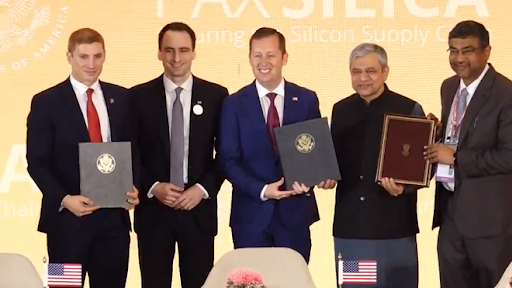
India joined the US-led 'Pax Silica' coalition to secure supply chains for critical minerals and AI infrastructure.
|
Read all about: What is Pax Silica? New US Tech Alliance |
Pax Silica is a "coalition of capabilities" securing the future of high-technology industries by connecting resource-rich, capital-rich, and technology-leading nations into one value chain.
Core Objective: To establish a secure economic order for technology supply chains, from mineral extraction to AI deployment, free from monopolistic control or coercion.
Member Nations: The alliance includes India, USA, Australia, Greece, Israel, Japan, Qatar, Republic of Korea, Singapore, UAE, and the UK.
Strategic Importance: It connects resource-rich nations (Australia), capital-rich nations (UAE, Qatar), and technology powerhouses (USA, Japan, Korea, India) into a single value chain.
Breaking the Critical Mineral Monopoly
India's tech industry is highly dependent on imports. China processes over 60% of the world's lithium and 90% of rare earth elements. India imports nearly 100% of its lithium and cobalt needs. (Source: IEA)
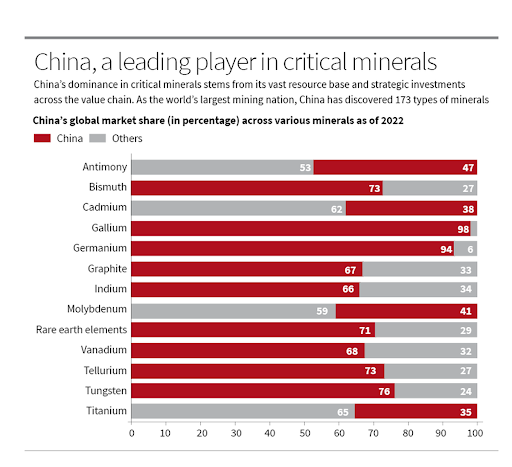
Partnering with resource-rich members like Australia (the world’s largest lithium producer) gives India direct access to minerals essential for Electric Vehicle (EV) and renewable energy targets.
Accelerating the AI and Semiconductor Ecosystem
India launched the IndiaAI Mission and the India Semiconductor Mission (ISM) to build domestic capabilities, but progress is dependent on access to advanced hardware (GPUs) and a stable chip raw material supply.
Pax Silica integrates India into the global semiconductor value chain, ensuring that domestic projects, such as the Tata-PSMC semiconductor plant in Dholera, have a secure supply of technology and materials.
Countering Geopolitical Coercion
Nations use control over key resources as a political weapon, like China's 2023 export controls on Gallium and Germanium (minerals vital for chipmaking).
Joining a US-led alliance diversifies India's supply chain risks, reducing vulnerability, and aligns with the Economic Survey 2023-24's recommendation for integration into diverse "Global Value Chains" (GVCs).
Alignment with India's Domestic Policies
Khanij Bidesh India Ltd (KABIL): Provides a diplomatic framework for KABIL to acquire overseas mineral assets in member nations like Australia.
Semiconductor Manufacturing (ISM): Ensures a stable supply of raw materials and technology transfers for new fabrication units, supporting 'Make in India'.
National Green Hydrogen Mission: Links AI's high energy demand with clean energy, opening export opportunities for India's green hydrogen to coalition partners like Japan and Singapore.
Erosion of Strategic Autonomy
Joining a US-led coalition could strain relations with nations like China and Russia, signaling departing from historical non-alignment policy.
Dependence on Foreign Tech Standards
The emphasis on "trustworthy systems" might lead to the mandatory adoption of US-developed AI and data standards, which could impact India's data sovereignty, as warned by Justice B.N. Srikrishna Committee.
The 'Resource Nationalism' Hurdle
Member countries might prioritize domestic industries by banning critical mineral exports, contradicting the coalition's goal of free material flow.
Leverage for Indigenization
Use the alliance to secure technology transfers and build domestic capabilities, transitioning India from a consumer to a producer within the global value chain.
Maintain Diplomatic Balance
Align with the West while maintaining engagement with the Global South (Africa, Latin America) for raw materials. Diversify cooperation with China and Russia to maintain balanced relations and avoid US bloc alignment.
Invest in R&D
Increase the Gross Expenditure on R&D (GERD) from the current 0.7% to 2% of GDP, as recommended by the NITI Aayog, to absorb and innovate the technologies shared within the coalition.
India joining Pax Silica recognizes technology as the new frontier of geopolitics. Success depends on converting this international declaration into domestic industrial strength.
Source: THE HINDU
|
PRACTICE QUESTION Q. "India’s entry into the 'Pax Silica' coalition marks a shift from non-alignment to strategic alignment." Critically analyze. 150 words |
Pax Silica is a US-led strategic alliance involving 11 nations (including India) aimed at building resilient supply chains for critical minerals and Artificial Intelligence (AI). It seeks to create an economic order free from monopolistic coercion and integrates resource-rich, capital-rich, and technology-rich nations.
India joined to reduce its dependency on imports for critical minerals (currently dominated by China), accelerate its AI and semiconductor ecosystem by accessing global value chains, and counter geopolitical risks like export controls on essential tech hardware.
The alliance includes India, USA, Australia, Greece, Israel, Japan, Qatar, Republic of Korea, Singapore, UAE, and the UK.


© 2026 iasgyan. All right reserved