The ECI-hosted IICDEM led to the Delhi Declaration 2026, uniting 42 EMBs around five pillars to counter disinformation and interference. Through ECINET and IIIDEM, India emerges as a global democratic leader, advancing institutional strength, technology, and South-South cooperation.
Copyright infringement not intended
Picture Courtesy: thehawk
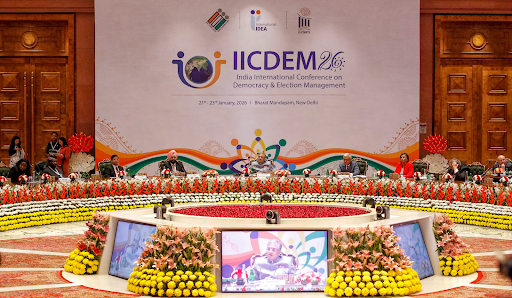
The International Conference on Democracy and Election Management (IICDEM) 2026 concluded in New Delhi with the adoption of the Delhi Declaration 2026.
What is International Conference on Democracy and Election Management (IICDEM)?
The Inaugural IICDEM was held in New Delhi from January 21-23, 2026, to promote global cooperation on democracy and election administration.
Host and Organizer: Hosted by the Election Commission of India (ECI) and organized by the IIIDEM, ECI's training and research arm.
Participants: Heads and representatives from 42 Election Management Bodies (EMBs) from over 70 countries, as well as academic experts and other stakeholders.
Objective: Provide a global platform for EMBs to share best practices, innovations, and address common challenges in electoral processes worldwide.
Theme: "Democracy for an Inclusive, Peaceful, Resilient & Sustainable World".
Key Outcome: Conference concluded with the unanimous adoption of the Delhi Declaration 2026, a resolution outlining five pillars for cooperation among participating EMBs.
Five Pillars of the Delhi Declaration 2026
Pillar I: Purity of Electoral Rolls
Pillar II: Conduct of Elections
Pillar III: Research and Publications
Pillar IV: Use of Technology
Pillar V: Training and Capacity Building
Source: PIB
|
PRACTICE QUESTION Q. The 'Delhi Declaration 2026' outlines five foundational pillars to strengthen democratic processes. Which of the following is NOT one of those pillars? (a) Purity of Electoral Rolls (b) Regulation of Political Funding (c) Use of Technology (d) Training and Capacity Building Answer: (b) Explanation: The 'Delhi Declaration 2026', adopted by over 40 election management bodies (EMBs) on January 23, 2026, outlines five foundational pillars to strengthen democratic processes. The five pillars are:
|
The Delhi Declaration 2026 is a resolution unanimously adopted by 42 global Election Management Bodies (EMBs) at a conference hosted by the Election Commission of India. It represents a collective commitment to strengthen democratic and electoral processes worldwide by collaborating on shared principles and best practices.
The five foundational pillars are:
Training and Capacity Building: Enhancing the professionalism of election officials globally.
ECINET is a unified digital platform launched by the Election Commission of India. It integrates over 40 different applications to provide services like voter registration, information dissemination, and grievance redressal, making it one of the largest electoral service platforms in the world.


© 2026 iasgyan. All right reserved