Renewed U.S. interest in Greenland reflects its strategic Arctic location, the Pituffik Space Base, and vast rare earth and energy resources. The push aims to counter Russian militarization and China’s Polar Silk Road, reduce supply chain dependence, and secure emerging sea routes, despite firm opposition from Denmark and Greenland.

Copyright infringement not intended
Picture Courtesy: INDIATODAY
Context
Recent expressions of interest by the United States in acquiring Greenland highlight the island's rising strategic importance.
What is Greenland?
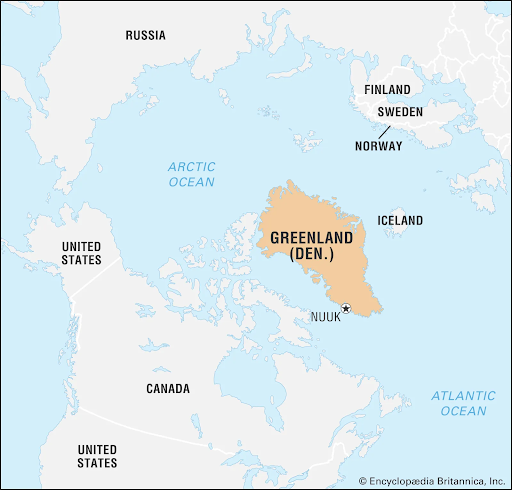
Greenland (Kalaallit Nunaat) is the world's largest non-continental island, located between the Arctic and North Atlantic Oceans.
While geographically part of the North American continent, it is an autonomous territory of the Kingdom of Denmark.
Approximately 80% of the island is covered by the Greenland Ice Sheet, the second largest in the world after Antarctica.
Why Greenland Is Strategically Important?
Greenland's value is due to its geographic location at the nexus of the Arctic and Atlantic oceans, which is critical for military power projection, trade, and regional control.
Forward Military Presence: The U.S. operates the Pituffik Space Base, a vital NATO installation that provides a strategic foothold in the Arctic.
Missile Defense & Space Surveillance: The base houses advanced radar systems for the U.S. Ballistic Missile Early Warning System (BMEWS), monitoring missile flight paths over the polar routes.
Control of New Sea Routes: As climate change opens up the Northwest Passage and the Northern Sea Route, control over Greenland offers influence over these shorter emerging maritime corridors.
Natural Resources: Greenland holds immense, largely untapped natural resources, making it a focal point for economic competition.
Geopolitical Competition: U.S. interest is a response to the growing military and economic activities of Russia and China in the Arctic.
Response from Denmark and Greenland
The idea of a sale has been rejected. Greenlandic officials are focused on greater self-determination and eventual independence, not changing sovereign powers. Public opinion also opposes any sale.
Source: INDIATODAY
|
PRACTICE QUESTION Q. "The aggressive pursuit of territorial acquisition by the US challenges the foundational principles of NATO and European security." Discuss. 150 words |
The US interest is multifaceted, driven by:
Formerly Thule Air Base, Pituffik Space Base is the northernmost U.S. military installation. Its strategic importance lies in its role in the U.S. ballistic missile early warning system and as a key site for space surveillance, tracking objects over the polar region.
Greenland is estimated to hold the world's largest deposits of rare-earth elements (REEs) outside of China. These elements are critical for manufacturing high-tech products like smartphones, electric vehicles, and advanced defense systems. It also has significant potential reserves of oil, natural gas, uranium, and zinc.


© 2026 iasgyan. All right reserved