The US-led “Pax Silica” alliance excludes India due to its early-stage semiconductor ecosystem, limited advanced manufacturing and trade frictions. Though a short-term setback, it echoes India’s MSP trajectory. Ongoing initiatives like the India Semiconductor Mission and National Critical Mineral Mission aim to build capacity for future inclusion.
Copyright infringement not intended
Picture Courtesy: INDIAN EXPRESS
Context
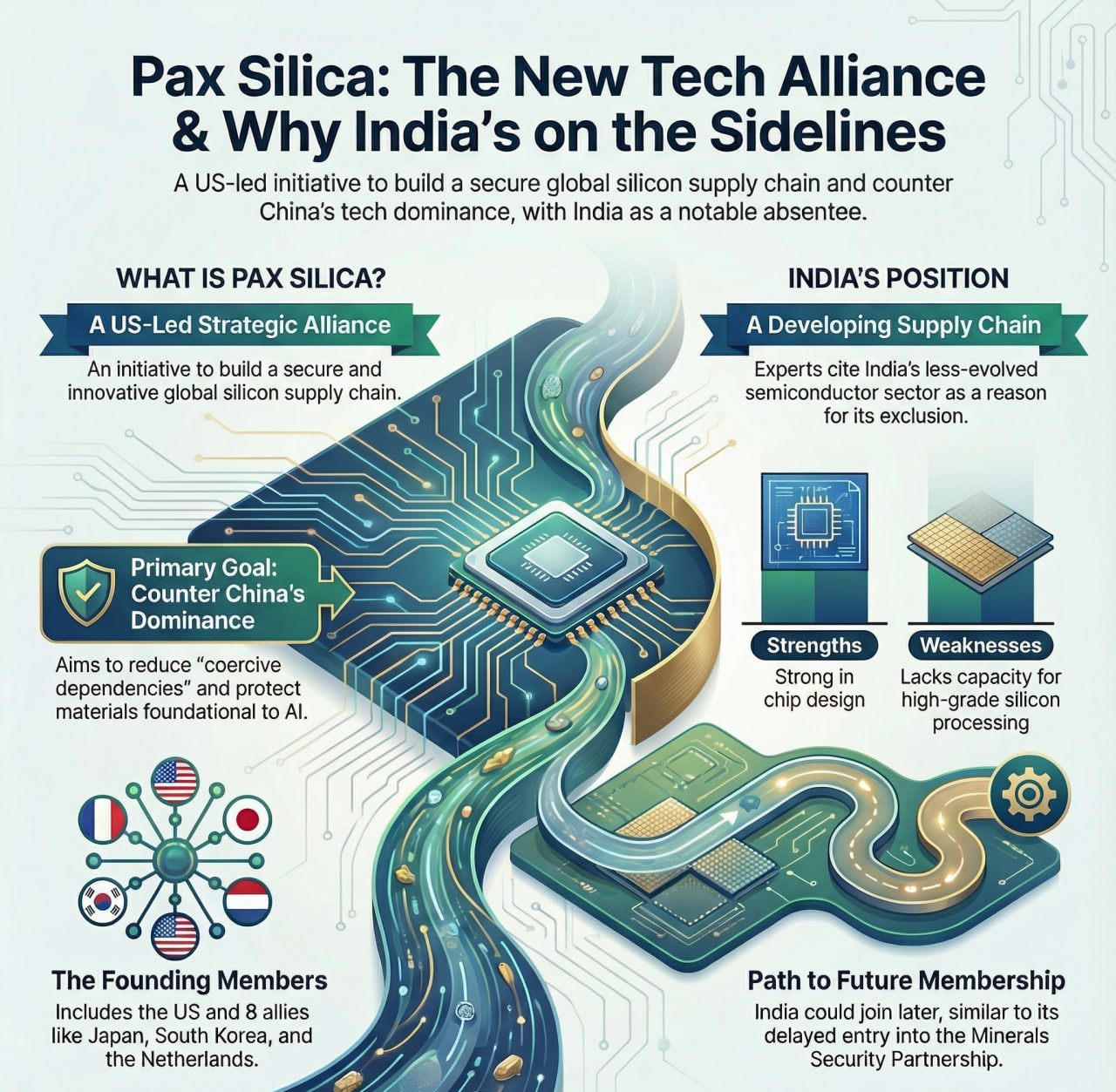
The United States launched "Pax Silica" with key partners (excluding India) to secure global supply chains for semiconductors, critical minerals, and AI.
It is a strategic initiative led by the United States aimed at creating a secure and resilient global supply chain for the semiconductor and Artificial Intelligence (AI) industries.
It aims to build a "secure, prosperous, and innovation-driven silicon supply chain" among trusted allies.
It is designed to counter China's dominance in critical minerals and technology manufacturing.
 What are the Objectives of Pax Silica?
Reduce over Dependencies: To minimize reliance on any single country for essential materials and components, especially after China imposed restrictions on critical exports like rare earth magnets.
Secure AI Foundations: Protect the materials (like high-purity silicon) and capabilities (like advanced chip fabrication) that are fundamental to developing and deploying AI technologies.
Promote Allied Innovation: Ensure that aligned nations can collaboratively develop and scale transformative technologies without geopolitical disruptions.
Build Trusted Ecosystems: Create secure technology networks, including ICT systems, subsea fibre-optic cables, data centers, and foundational AI models.
The inaugural members of Pax Silica are nations with established, high-value roles in the global semiconductor supply chain. India was not included.
|
Founding Members |
Key Contribution to Supply Chain |
|
United States |
Leads in chip design (IP), electronic design automation (EDA) software, and manufacturing equipment. |
|
Japan |
Dominates in specialized materials like photoresists and silicon wafers. |
|
Republic of Korea |
Global leader in memory chip (DRAM, NAND) fabrication and a major player in logic chip manufacturing. |
|
Netherlands |
Home to ASML, which holds a monopoly on essential Extreme Ultraviolet (EUV) lithography machines for advanced chipmaking. |
|
United Kingdom |
Strong in semiconductor IP and design, notably through companies like Arm Holdings. |
|
Other Members |
Singapore, Israel, UAE, and Australia, each contributing in areas like R&D, fabrication, investment, and raw materials. |
India's exclusion is not a reflection of its strategic importance but rather its current position within the high-tech manufacturing supply chain. Key reasons include:
India often joins alliances later. For example, India wasn't a founding member of the US-led Minerals Security Partnership (MSP) but joined in 2023, this indicates that as India's domestic capabilities develop, inclusion in frameworks like Pax Silica is highly probable.
Source: INDIAN EXPRESS
|
PRACTICE QUESTION Q. Critically analyze the factors contributing to India's exclusion from the inaugural 'Pax Silica' initiative. 150 words |
Pax Silica is a strategic initiative led by the United States with eight partner countries. Its core objective is to build a secure, stable, and innovation-driven global supply chain for semiconductors, critical minerals, and artificial intelligence (AI), thereby reducing dependence on countries like China.
India's exclusion is primarily due to three factors: its semiconductor manufacturing ecosystem is still in a nascent stage, it currently lacks the advanced technology and scale that the alliance focuses on, and unresolved frictions in the ongoing India-US trade deal negotiations.
The founding members are the United States, Japan, the Republic of Korea, Singapore, the Netherlands, the United Kingdom, Israel, the United Arab Emirates, and Australia.


© 2026 iasgyan. All right reserved