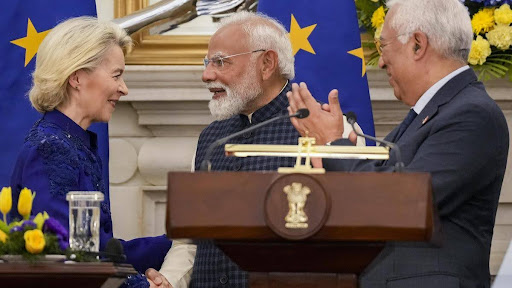
India and the EU have concluded the BTIA, creating a two-billion-people market. By cutting tariffs and opening services, it boosts Indian exports, global value-chain integration, and IMEC. Despite CBAM and ratification hurdles, it marks a historic strategic and economic compact.
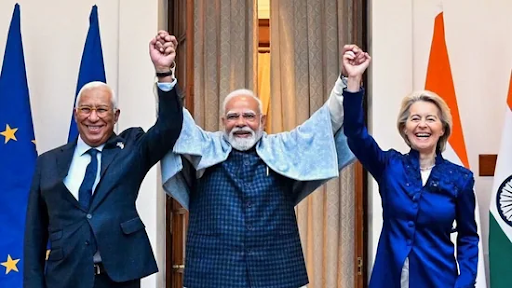
Context
India and the European Union (EU) have concluded negotiations for a comprehensive Free Trade Agreement (FTA), dubbed the "Mother of all Deals," creating a free trade zone of about 2 billion people, accounting for roughly 25% of global GDP and one-third of global trade.
|
Read all about: INDIA-EU FREE TRADE AGREEMENT l INDIA-EFTA FREE TRADE AGREEMENT |
Key Provisions of the Agreement
Trade in Goods
Massive Market Access: Over 99% of Indian exports by trade value will enter the EU duty-free, boosting exports by $75 billion.
Labour-Intensive Sectors: Approximately $33 billion in exports from sectors such as textiles, apparel, leather, and gems will see tariffs eliminated. For example, EU tariffs on leather goods will drop from 17% to 0%.
Automobile Sector: A calibrated, quota-based system lets EU automakers enter India's higher price segments with lower duties (110% down to 10% over time) and strengthen 'Make in India' for possible future EU exports.
Agriculture and Dairy
Export Gains: Indian tea, coffee, spices, and processed foods gain enhanced competitiveness in the EU.
Domestic Protections: India has fully safeguarded sensitive sectors. There are no concessions for dairy, cereals, poultry, and certain fruits and vegetables to protect local farmers.
Regulatory Alignment: Provisions address non-tariff barriers through transparent customs and alignment on Sanitary and Phytosanitary (SPS) standards.
Trade in Services
Reciprocal Access: India secured market access in 144 sub-sectors (e.g., IT, professional services, finance), while the EU gained access to 102 sub-sectors.
Financial Innovation: The pact focuses on cross-border electronic payments and fintech cooperation.
Mobility of Professionals
Predictable Framework: Streamlines visas for skilled talent, including Intra-Corporate Transferees (ICTs) and their families, as well as Business Visitors (BVs).
Broad Commitments: The EU opened 37 sectors for Contractual Service Suppliers and 17 sectors for Independent Professionals.
Social Security & Education: Includes a framework for Social Security Agreements within five years and supports student mobility.
Emerging and Regulatory Areas
CBAM & Climate: Provides technical cooperation on the Carbon Border Adjustment Mechanism (CBAM), ensuring India receives any flexibilities granted to other countries.
Intellectual Property: Reinforces TRIPS protections while recognizing India’s Traditional Knowledge Digital Library (TKDL) and prioritizing public health.
High-Tech Cooperation: Facilitates joint efforts in AI, clean tech, and semiconductors.
Strategic Significance for India
Forging a 'Trusted Partnership'
Amid geopolitical uncertainty, the FTA strengthens the partnership between the world's 4th (India) and 2nd (EU) largest economies, which together comprise 25% of global GDP. This diversifies India's economic dependencies.
Aligning with 'Viksit Bharat 2047'
The agreement scales up bilateral trade, supporting India's 2047 developed nation goal. It integrates MSMEs, artisans, and women into global value chains.
Access to the Entire European Continent
Combined with recent FTAs with the UK and the European Free Trade Association (EFTA), this agreement provides Indian businesses with preferential access to nearly all of Europe, a highly prosperous market.
Geopolitical Hedge
Positions India and the EU as a democratic alternative to China’s dominance, securing India's role in a new, stable global supply chain.
"China Plus One" Hub
Makes India the top manufacturing destination for European firms, accelerating 'Make in India' by removing trade barriers for 27 countries at once.
Defence & Tech Leap
Goes beyond trade to include defence co-production and "insider access" to European R&D in semiconductors, AI, and Green Hydrogen.
Setting the Rules
India is no longer a "rule-taker." By negotiating on the Carbon Tax (CBAM) and digital standards, India now helps write the laws of 21st-century commerce.
The Talent Highway
Secures a predictable, legal path for Indian professionals and students to work and study across the entire EU, reinforcing India as a global talent hub.
What are the Potential Challenges For India?
Ensuring Competitiveness
Domestic industries, especially in automobiles and high-tech services, will face increased competition from EU companies and must innovate to remain competitive.
The "Carbon Tax" (CBAM)
The EU’s new carbon tax could raise costs for Indian steel and aluminum exports by 20–35%, potentially cancelling out the benefit of zero tariffs.
Strict Regulations
The EU has some of the world's toughest quality and safety standards. Indian farmers and pharma companies will face expensive "red tape" to prove their products meet EU rules.
Sustainability Clauses
The EU demands strict labour and environmental laws. India views these as "non-trade issues" that could be used as an excuse to block Indian goods.
Data Wars
The EU wants free data flow (GDPR style), while India insists on Data Sovereignty (keeping Indian data in India) for national security.
Generic Medicines
EU pressure for stronger Intellectual Property (IPR) could make it harder for India to produce the cheap generic drugs it's famous for.
Way Forward of India
Swift Ratification: Both parties must work towards a prompt and effective implementation of the agreement.
Domestic Capacity Building: India must invest in enhancing the capabilities of its industries, especially MSMEs, to leverage the new market access.
Stakeholder Engagement: Continuous dialogue between the government and industry is essential to address implementation challenges and maximize gains.
Green Transition: Companies in steel and cement must move fast to verify their carbon footprints using the EU's Carbon Border Adjustment Mechanism (CBAM) standards to avoid heavy penalties.
Quality Overhauls: Upgrade testing labs to match EU health and safety rules. This prevents Indian shipments—especially food and pharma—from being rejected at European ports.
Professional Recognition: Finalise Social Security Agreements and "Mutual Recognition" for degrees so that Indian doctors, engineers, and IT pros can work across the EU without re-certification.
MSME Support: Launch "Help Desks" for small businesses in textiles and leather to help them navigate EU digital paperwork and sustainability rules.
Infrastructure: Integrate with the India-Middle East-Europe Economic Corridor (IMEC) to slash shipping times and costs to the European market.
Conclusion
The India-EU Free Trade Agreement establishes a comprehensive strategic and economic partnership, acting as a powerful engine for growth that integrates the vision of 'Aatmanirbhar Bharat' with the global economy, promoting inclusive, resilient, and future-ready economic growth.
Source: INDIANEXPRESS
|
PRACTICE QUESTION Q. "The India-EU Free Trade Agreement is not just a commercial pact but a strategic maneuver to hedge against rising global protectionism." Critically analyze. (250 words) |
The India-EU Free Trade Agreement, officially the Broad-based Trade and Investment Agreement (BTIA), is a comprehensive trade pact designed to liberalize and facilitate trade in goods, services, and investment between India and the European Union, creating a combined market of nearly two billion people.
India will see immediate elimination of tariffs in key labor-intensive sectors like textiles (currently 12% tariff), leather and footwear (17% tariff), and gems and jewellery. This is expected to boost exports worth $33 billion and enhance the competitiveness of Indian goods in the EU market.
CBAM is a tariff or levy imposed by the EU on imports of carbon-intensive products like steel and aluminium. It could reduce the benefits of tariff concessions for Indian exporters in these sectors by adding a new cost. India and the EU have agreed to a technical dialogue to mitigate its impact.

© 2026 iasgyan. All right reserved