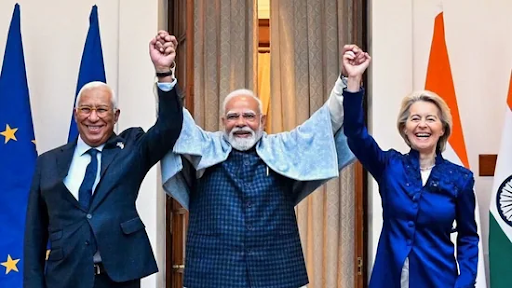
The India - EU Free Trade Agreement is a landmark trade pact between India and the European Union that aims to deepen economic ties through extensive tariff reductions, expanded services access, and improved investment flows. The EU will provide preferential access covering nearly all of India’s export value, benefiting labour-intensive sectors such as textiles, leather, and marine products, while also opening opportunities in IT and professional services. At the same time, India will gradually lower tariffs on a large share of EU goods with safeguards for sensitive sectors. However, strict EU regulatory standards, sustainability norms, and carbon-related measures remain key challenges that could limit gains unless Indian industries upgrade compliance capacity. Overall, the agreement strengthens India’s integration with a major global market while requiring domestic reforms to fully realize its benefits.
Copyright infringement not intended
Picture Courtesy: The Hindu
Context:
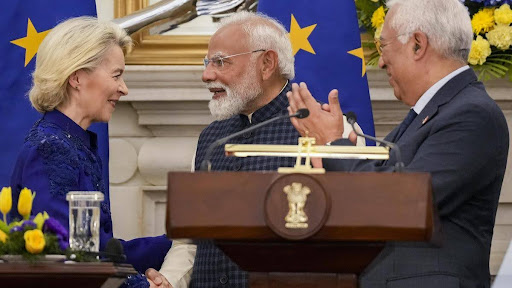
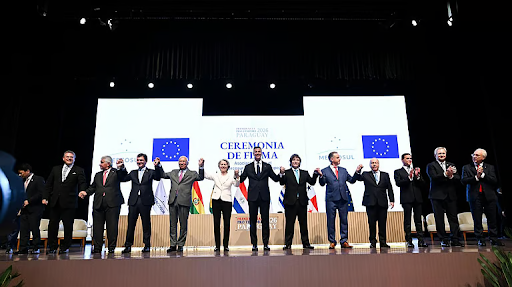
India and the European Union recently concluded negotiations on a long-pending Free Trade Agreement during the 16th India–EU Summit.
|
Must Read: INDIA EUROPEAN UNION RELATIONS | |
What is the India–EU FTA?
The agreement is a comprehensive trade and investment pact between India and the EU’s 27 member countries. It aims to:
Because of the economic size involved, it is often described as one of India’s most ambitious trade deals to date.
Significance of the India–EU trade deal:
Massive market integration: The agreement connects India with the European Union, a 27-nation market, and together they account for nearly 25% of global GDP and about one-third of global trade.
Strong existing trade base: India - EU bilateral goods trade reached about $136 billion in 2024–25, with Indian exports around $76 billion, while services trade was about $83 billion, making the EU one of India’s largest trading partners.
Near-universal tariff access for Indian exports: The EU’s tariff concessions cover around 97% of tariff lines, translating into benefits for about 99% of India’s export value, which means most Indian goods will enjoy duty-free or reduced-duty entry.
Employment boost in labour-intensive sectors: Zero or lower tariffs improve competitiveness in sectors such as textiles, leather, footwear, marine products, and gems & jewellery, which together support millions of MSME and women-led jobs.
New opportunities for farm & food exports: Preferential access for products like tea, coffee, spices, fruits, vegetables, and processed foods enhances India’s agricultural export diversification while safeguarding sensitive domestic crops.
Integration into European value chains: Lower tariffs and clearer rules of origin help Indian engineering, chemicals, and intermediate goods producers plug into European manufacturing supply chains.
Key provisions of the India–EU trade agreement:
Why EU rules matter more than tariffs for India?
European Union’s complex regulatory system remains the toughest hurdle for Indian exporters because market access increasingly depends on meeting strict non-tariff standards rather than just paying lower duties.
Expansion of sustainability regulations: EU rules on environmental protection, labour rights, and corporate due diligence now require exporters to prove that their supply chains are sustainable and ethically managed, which raises compliance costs for Indian firms.
Rise of non-tariff barriers over tariffs: While tariffs are falling, regulations related to product safety, traceability, packaging, carbon footprint, and waste management are becoming decisive barriers to entry into the EU market.
Strict traceability requirements: Indian exporters must increasingly provide end-to-end documentation of sourcing, production, and logistics, which is difficult for sectors relying on fragmented supply chains such as textiles, leather, and agriculture.
Disproportionate Impact on MSMEs: Micro, small, and medium enterprises lack the financial and technical capacity to meet expensive certification, testing, and audit requirements, limiting their ability to benefit from tariff concessions.
Carbon-Linked Trade Measures (CBAM): The EU’s carbon pricing system on imports of steel, aluminium, cement, fertilisers, and electricity exposes Indian producers — many dependents on coal-based energy — to higher costs, reducing competitiveness.
What is the MFN-Forward clause on climate-linked trade measures?
It states that if the EU grants any future concessions, relaxations, transition periods, or exemptions on climate-linked trade measures to another trading partner, those same benefits will automatically extend to India.
Since the EU’s climate trade rules apply uniformly and the EU does not offer country-specific exemptions easily, India secured this clause to prevent future discrimination if the EU softens its rules for someone else.
The clause does not remove or reduce existing EU climate charges for India right now; it only activates if the EU later gives better treatment to another country.
Challenges of India – EU FTA:
Regulatory asymmetry: The European Union maintains stringent environmental, labour, and product safety standards that often fluctuate with evolving EU policies. Unlike tariffs, non-tariff regulations are not negotiated as part of tariff concessions, leaving Indian exporters to comply without having equal influence over rule-making.
Carbon Border Adjustment Mechanism (CBAM): CBAM applies to imports of carbon-intensive products such as steel, aluminium, cement and fertilisers sectors where India is a net exporter to the EU. The EU’s carbon pricing system effectively imposes a carbon cost on high-emission imports, raising production costs for Indian firms that rely on coal-based energy, thereby reducing their price competitiveness even after tariff elimination.
Non-Tariff barriers are rising relative to tariffs: About 99% of India’s export value gets preferential access, compliance with EU rules on traceability, packaging, waste reduction, and supply-chain transparency is increasingly becoming a bigger trade hurdle than tariffs. For example, certification for sustainability (EUDR, eco-labelling) can cost MSMEs 10–15% of shipment value, which will lead to shrinking export margins.
MSME vulnerability: India’s MSMEs contribute around 30% of exports but often lack technology, capital, and regulatory systems to meet EU compliance requirements such as digital documentation, multiple certifications, and periodic audits which limit their ability to take full advantage of the FTA.
Phased tariff reductions delay gains: While tariff concessions are extensive, many sensitive items see phased cuts over 5–10 years. Products like automobiles and certain processed foods will not see immediate tariff elimination, postponing short-term export gains.
Conclusion:
The India - EU Free Trade Agreement marks a major step in deepening ties with the European Union, offering near-complete tariff access and strong opportunities in goods and services trade; however, its real success will depend on India’s ability to help exporters, especially MSMEs meet stringent EU regulatory, sustainability, and carbon-related standards so that market access translates into actual trade gains.
Source: The Hindu
|
Practice Question Q. India–EU Free Trade Agreement is being described as a landmark in India’s trade diplomacy. Discuss. (250 words) |
It is a comprehensive Free Trade Agreement between India and the European Union aimed at reducing tariffs, expanding services trade, improving investment flows, and strengthening economic cooperation.
The EU is one of India’s largest trading partners, with goods trade around $136 billion and services trade over $80 billion, so better access to this market can significantly boost exports and employment.
Labour-intensive industries such as textiles, leather, footwear, marine products, and gems & jewellery benefit the most, along with services sectors like IT and professional services.




© 2026 iasgyan. All right reserved