

Copyright infringement not intended
Picture Courtesy: INDIAN EXPRESS
Context
India is strategically engaging with the United States through an "Interim Trade Arrangement" to secure market access for its exports and protect its economy from global protectionism and trade disputes.
Evolution of India’s Trade Philosophy
Era of Insulation (1947–1990): Post-independence, India's trade policy prioritized stability and self-reliance over open competition.
The 1991 Reforms: A severe balance of payments crisis triggered the dismantling of protectionist policies, resulting in export growth and the rise of the IT services sector, proving Indian industry's global competitiveness.
Era of Purposeful Engagement (2014–Present): India has adopted a more proactive and aggressive trade policy, reflected in the shift from "Look East" to "Act East" and the signing of several Free Trade Agreements (FTAs) with partners like the UAE, Australia, and the EFTA bloc (Switzerland, Norway, Iceland, Liechtenstein).
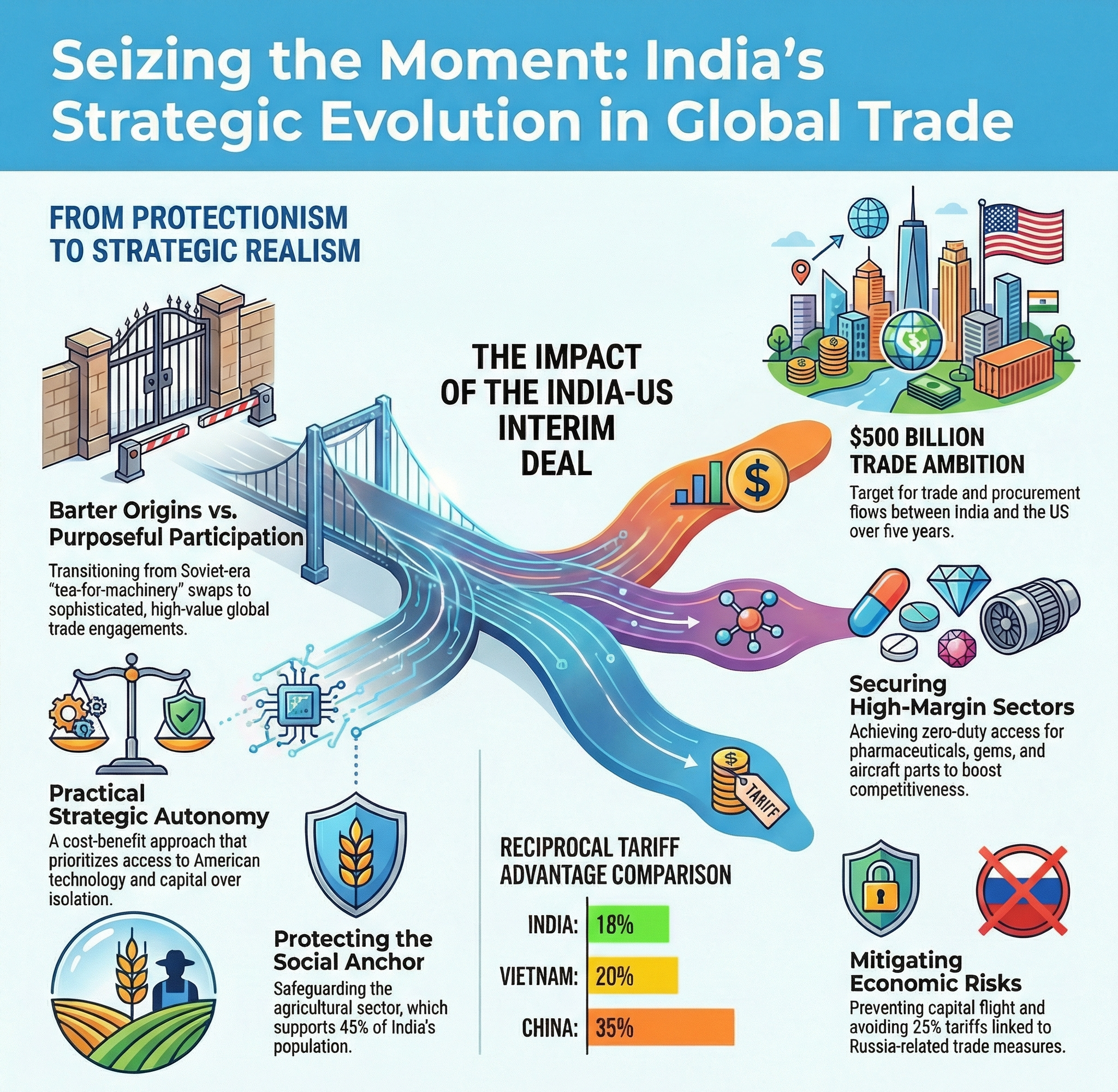 Significance of the India-US Interim Arrangement
Avoiding High Tariffs: The deal offers India a competitive edge, avoiding high US tariffs by setting rates at 18%.
|
Country/Bloc |
US Tariff Rate |
|
India (with deal) |
18% |
|
Vietnam |
20% |
|
ASEAN Nations |
19% |
|
China |
35% |
Securing Key Export Sectors: The US is India’s largest trading partner, with merchandise exports reaching $86.5 billion in 2024-25. The deal secures zero-duty access for vital sectors:
Preventing Capital Flight: A stable trade relationship with the US boosts investor confidence, prevents the outflow of foreign investment, stabilizes the Indian Rupee, and protects the nation's Foreign Exchange Reserves.
Decline of Multilateralism
The World Trade Organization (WTO) is facing a crisis. Its Dispute Settlement Body is non-functional, and the "Doha Development Agenda" has stalled. This has forced nations like India to pursue bilateral agreements for trade stability.
Rodrik’s Trilemma
This economic principle states a country cannot simultaneously have deep globalization, national sovereignty, and democratic politics.
By opting for a managed trade deal, India and the US are prioritizing sovereignty and democracy over hyper-globalization.
The "Spaghetti Bowl" Effect
Economist Jagdish Bhagwati coined this term for the complex web of overlapping bilateral trade deals. In the absence of a strong WTO, these agreements offer the only predictability for global trade.
Enhanced Sovereignty
Integration with the US economy provides India with technology and capital, strengthening domestic defense and manufacturing capabilities and thus enhancing its sovereignty.
Buffering Against Sanctions
Deepening economic ties with the US provides a cushion against potential secondary sanctions, such as those under CAATSA (Countering America's Adversaries Through Sanctions Act), related to India's continued defense and energy trade with Russia.
Case Study: India vs Bangladesh
|
Country |
Approach to Trade |
Outcome |
|
Bangladesh |
Gained "free access" to US/EU markets but had to open its sensitive sectors to foreign influence and subsidies. |
Economy became more vulnerable to external shocks and pressures. |
|
India |
Pursued a balanced "interim deal" that secures market access while protecting sensitive domestic sectors. |
Key sectors like Agriculture (employing 45% of the workforce) are shielded from competition from large US corporations. |
Contract Enforcement: Delays in the judicial system and poor contract enforcement remain major concerns for foreign investors.
Dispute Resolution: A credible and efficient arbitration framework is necessary. While the International Arbitration Centre in GIFT City (Gujarat) is a positive move, its acceleration is needed, using models like the Abu Dhabi Global Market (ADGM).
Logistics Costs: India's logistics costs are high at 8-9% of GDP (developed nations average 6-7%). Despite infrastructure efforts like PM Gati Shakti, these costs harm export competitiveness. (Source: LEADS Report)
Implement Deeper Reforms
Act on the recommendations of panels like the N.K. Singh Committee to ensure fiscal discipline and structural reforms that boost competitiveness.
Strengthen Arbitration Mechanisms
Develop GIFT City into a world-class hub for international dispute resolution to attract more US investment.
Diversify the Export Basket
Use policies like the Production Linked Incentive (PLI) schemes to move up the value chain into high-tech manufacturing areas such as semiconductors and electric vehicles (EVs).
The India-US interim trade arrangement is a pragmatic move that balances India's economic interests with global geopolitical realities.
Source: INDIAN EXPRESS
|
PRACTICE QUESTION Q. India's foreign policy is transitioning from 'strategic autonomy' to 'strategic pragmatism'." Discuss. 150 words |
It is a strategic trade deal between India and the US aimed at securing market access and preventing high tariffs. It marks a shift from India's traditional defensive stance to proactive engagement, capping reciprocal tariffs at 18% to protect Indian exports from US protectionism.
Proposed by economist Dani Rodrik, the trilemma states that a country cannot simultaneously achieve Deep Globalization, Democratic Politics, and National Sovereignty. It must choose two. The article suggests India and the US are prioritizing Sovereignty and Democracy, leading to a "managed" rather than "hyper" globalized relationship.
GIFT City (Gujarat International Finance Tec-City) is India’s first operational greenfield smart city and international financial services hub located in Gandhinagar, Gujarat. It is designed to compete with global hubs like Singapore and Dubai, offering a specialized regulatory environment for banking, insurance, capital markets, and asset management.
© 2026 iasgyan. All right reserved