Copyright infringement not intended
Picture Courtesy: INDIANEXPRESS
India and the United States announced a bilateral trade agreement intended to de-escalate trade tensions that had peaked in late 2025.
|
Read all about: TARIFFS AND THE US ECONOMY: IMPACT ON INDIA AND WAY FORWARD l INDIA'S STRATEGY AGAINST US PRESSURE l INDIA'S STRATEGY ON US TARIFFS l TRUMP'S TARIFFS AND A U.S.-INDIA TRADE AGREEMENT |
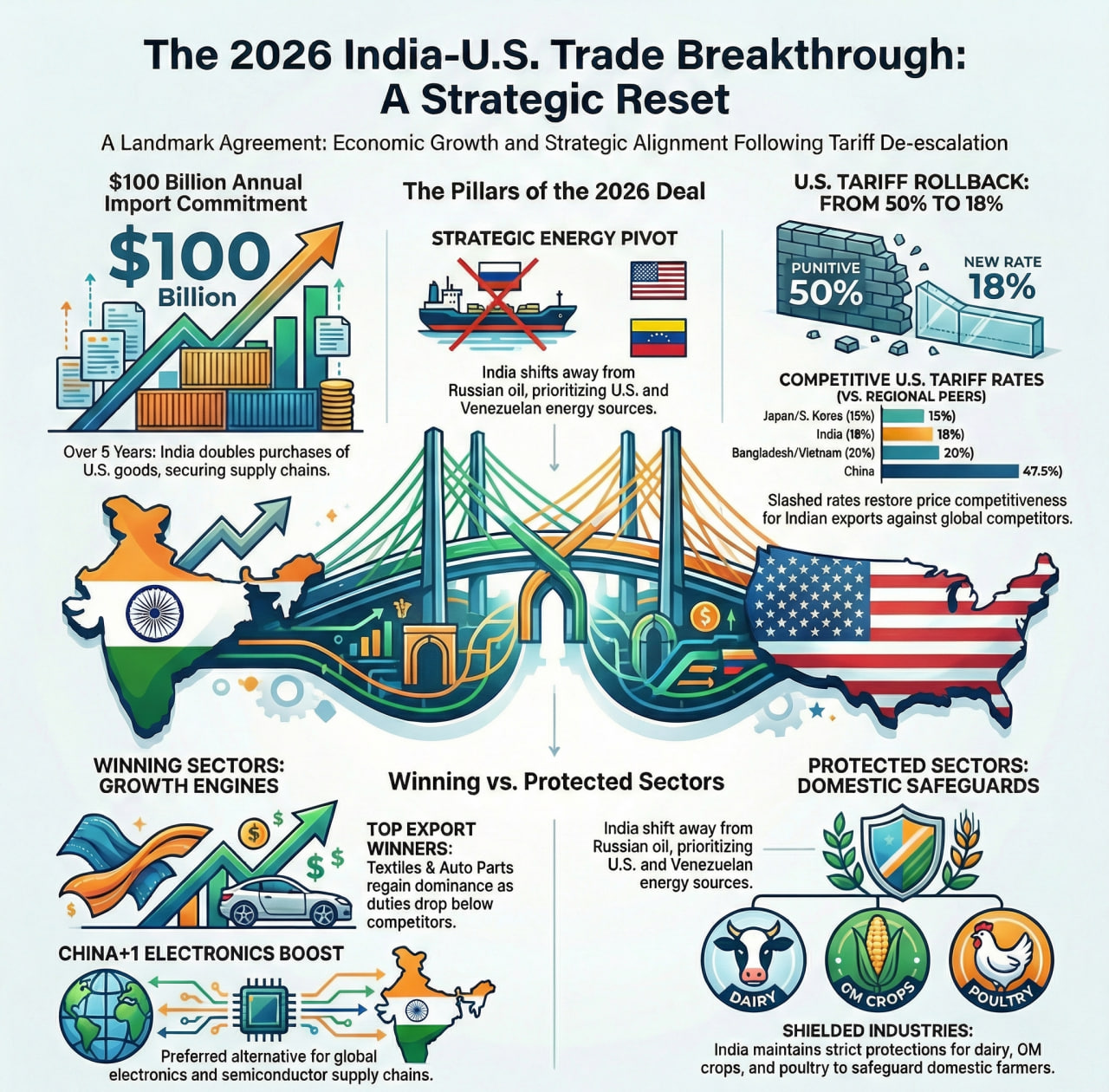
The agreement is built on four central pillars that balance market access with the protection of sensitive domestic sectors.
|
Pillar |
Key Provisions & Details |
Significance |
|
Tariff Rationalisation |
The U.S. will reduce tariffs on Indian goods to a standard rate of 18%. This removes the previous punitive structure, which included a 25% base tariff plus an additional 25% penalty related to India's oil trade with Russia. |
This aligns U.S. tariffs with India's average applied tariff rate, creating a more predictable and balanced trade environment. |
|
Protection of Sensitive Sectors ("Red Lines") |
The deal explicitly excludes India's Agriculture and Dairy sectors from any new market access commitments. |
This protects the livelihoods of millions of Indian farmers from competition with highly subsidized U.S. agricultural products, in line with recommendations from the M.S. Swaminathan Committee. |
|
Energy Pivot |
India has committed to curbing its purchase of Russian oil. It is expected to increase energy imports, including LNG and crude oil, from the U.S. and Venezuela. |
This marks a geopolitical concession and a move towards diversifying India's energy sources away from Russia, which could impact long-standing bilateral ties. |
|
Market Access for Labour-Intensive Goods |
Sectors like Textiles, Leather, Gems & Jewellery, and Seafood will gain improved access to the U.S. market. |
This provides a major boost to sectors that employ nearly 45 million people, enhancing their competitiveness against rivals like Vietnam and Bangladesh. |
Reviving the Export Engine: The U.S. is India's largest trading partner ($131.8 billion in 2024–25) Reducing the tariff wall from 50% to 18% restores price competitiveness for Indian goods.
Boost to "Make in India": The agreement strengthens key manufacturing sectors.
Improved Market Sentiment: A stable tariff regime boosts investor confidence. The announcement indicates positive expectations for Foreign Portfolio Investment (FPI) and Foreign Direct Investment (FDI).
 Geopolitical Implications and Challenges
Erosion of "Strategic Autonomy"
India's foreign policy has historically been "multi-aligned," balancing relationships with powers like the U.S. and Russia.
Agreeing to U.S. conditions on Russian oil suggests a shift towards a more transactional foreign policy, straining the "Special and Privileged Strategic Partnership" with Russia, especially in critical defence supplies (e.g., S-400 missile system).
Energy Security Risks
Shifting from discounted Russian crude oil to more expensive U.S. or Venezuelan oil could increase India's import bill. This may lead to inflationary pressures and widen the Current Account Deficit (CAD).
Domestic Political Concerns
Opposition parties have criticized the deal as a compromise on national sovereignty, and farmer groups like the Samyukt Kisan Morcha (SKM) raised concern that the U.S. might push for the entry of Genetically Modified (GM) crops through non-tariff barriers in the future.
Accelerate Energy Diversification
Reduce dependence on all foreign oil by promoting the National Green Hydrogen Mission and achieving E20 (20% ethanol blending) biofuel targets.
Maintain "Red Lines"
Ensure that Agriculture and Dairy remain protected. India must strengthen its Sanitary and Phytosanitary (SPS) standards to prevent the indirect entry of goods that do not meet its safety norms.
Leverage the iCET Framework
Use the positive momentum from the trade deal to fast-track collaboration under the Initiative on Critical and Emerging Technology (iCET), focusing on jet engines, semiconductors, and space technology.
Diversify Trade Partnerships
Expedite Free Trade Agreements (FTAs) with other major economies like the Gulf Cooperation Council and Eurasian Economic Union to reduce over-reliance on the U.S. market.
The 2026 India-U.S. trade deal is a high-stakes gamble, offering immediate labor sector stimulus. Long-term success requires managing geopolitical costs, securing economic gains, maintaining strategic independence, and navigating the shift from Russia.
Source: THE HINDU
|
PRACTICE QUESTION Q. "Trade policy is often an extension of foreign policy." Discuss this statement in the context of the India-U.S. Trade Deal 2026. 150 words |
The U.S. has agreed to slash reciprocal tariffs on Indian goods from a peak of approximately 50% to a unified rate of 18%.
India agreed to curb Russian crude oil imports and substitute them with increased energy imports from the U.S., effectively pivoting its energy sourcing strategy.
It is a major boost. High tariffs had made Indian textiles uncompetitive against Vietnam and Bangladesh. The reduction to 18% is expected to restore order volumes for clusters like Tiruppur, protecting over 600,000 jobs.
© 2026 iasgyan. All right reserved