India is leveraging Artificial Intelligence and Digital Public Infrastructure to revolutionise financial inclusion. Initiatives like ULI, Banking BHASHINI, and MuleHunter.AI are democratising credit, bridging language barriers, and enhancing security, guided by RBI's FREE-AI framework for ethical and responsible innovation.
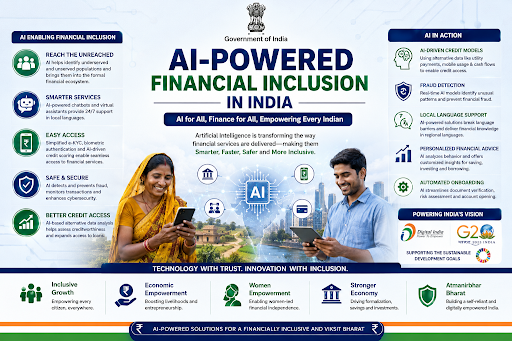
AI-Powered Financial Inclusion delivers inclusive, personalized, and real-time formal financial services to underserved segments like MSMEs and rural populations.
Financial inclusion means ensuring access to timely, adequate, and affordable financial services for vulnerable and low-income groups.
AI-powered financial inclusion leverages Artificial Intelligence (AI) and Digital Public Infrastructure (DPI) to deliver intelligent, personalized, and real-time financial services at scale.
The system uses alternative data—such as digital footprints, utility payments, and GST returns—to assess creditworthiness, bypassing the need for traditional credit scores.
India transitions from focusing purely on basic banking access to building a highly integrated, technology-driven ecosystem.
The JAM Trinity (Jan Dhan-Aadhaar-Mobile) forms the digital foundation, guaranteeing universal financial identity and nationwide connectivity.
The Unified Payments Interface (UPI) democratizes digital transactions, handling nearly 81% of retail payment volume in India. (Source: PIB)
The Direct Benefit Transfer (DBT) eliminates intermediaries and transfers welfare subsidies directly into beneficiary accounts, generating financial savings.
The ecosystem currently evolves toward intelligent financial empowerment, merging foundational digital systems with Advanced Analytics and AI.
Alternative Credit Scoring: Lenders deploy AI models via the Unified Lending Interface (ULI) to evaluate borrowers lacking conventional credit histories through dynamic risk profiling.
Account Aggregator (AA) Framework: AAs facilitate the consent-based, secure sharing of financial data, reducing documentation requirements and accelerating loan approvals.
Language Accessibility: Government initiatives like Banking BHASHINI use Natural Language Processing (NLP) to deliver banking services in 22 scheduled Indian languages, dismantling language barriers.
Robo-Advisory for Wealth Management: AI-driven platforms provide personalized, goal-based investment advice, democratizing wealth management for first-generation investors in Tier 2 and Tier 3 cities.
Agricultural Insurance: Machine learning models process satellite imagery to predict crop loss, which expedites claim settlements under the PM Fasal Bima Yojana.
Fraud Detection: AI tools like MuleHunter.AI analyze real-time transaction metadata to identify anomalies related to cybercrime and money laundering.
Informal Workforce Integration: NITI Aayog proposed Mission Digital ShramSetu harnesses AI and blockchain to integrate 490 million informal workers into the formal economy with verified skilling and social protection.
Bridges the Credit Gap: AI models unlock an estimated USD 130-170 billion credit gap for MSMEs, reducing their dependency on high-interest informal lending channels. (Source: ANI)
Empowers Women: AI addresses gender-specific barriers by facilitating customized microloans and reducing human bias in lending decisions, promoting women entrepreneurship.
Enhances Operational Efficiency: AI automates data entry and customer inquiries, slashing operational costs and speeding up loan processing times from weeks to minutes.
Strengthens Risk Management: Predictive analytics detect market volatility, while real-time monitoring prevents "deepfake" fraud and sophisticated cyber-attacks.
Reduces Regulatory Compliance Costs: AI automates Anti-Money Laundering (AML) and Know Your Customer (KYC) transaction screening, minimizing costly human errors.
Algorithmic Bias: Machine learning models trained on historical data risk reinforcing social biases, penalizing borrowers from historically underserved communities or specific pin codes.
"Black Box" Opacity: AI systems lack transparency, resulting in unexplainable automated loan rejections that damage customer trust.
Data Privacy Vulnerabilities: Heavy reliance on sensitive financial data increases the risk of unauthorized processing, data breaches, and the lack of meaningful informed consent from borrowers.
Infrastructural and Skill Gaps: India faces a deficit in data center capacity and a shortage of skilled AI professionals, creating an uneven playing field for smaller cooperative banks and NBFCs.
Digital Divide: Low financial and digital literacy in rural areas hinders marginalized populations from navigating AI-driven services safely.
Adopt Explainable AI (XAI): Institutions must utilize XAI tools so every AI-driven credit decision remains traceable and easily understandable to regulators and consumers.
Implement Algorithmic Audits: Regulators must mandate regular third-party fairness audits to detect and eliminate gender, geographic, or socio-economic biases.
Strengthen Grievance Redressal: Financial entities must establish accessible, human-review pathways to address automated rejections and protect consumers.
Leverage Regulatory Sandboxes: Fintech startups must test new AI products in the RBI Regulatory Sandbox to assess risks and ensure consumer safeguards before large-scale public release.
Enforce Data Protection Laws: Entities must align with the Digital Personal Data Protection (DPDP) Act, 2023, to ensure data minimization and explicit user consent.
Follow RBI’s FREE-AI Framework: Stakeholders must align with the Framework for Responsible and Ethical Enablement of Artificial Intelligence, centering on: Trust, People First, Innovation, Fairness, Accountability, Understandability, and Safety.
Promote Financial AI Literacy: Expand National skilling programs to teach users how automated advice works and how their digital data footprint generates dynamic credit scores.
India is combining its Digital Public Infrastructure with ethical AI governance and digital literacy to create an intelligent financial ecosystem that drives the vision of Viksit Bharat 2047.
Source: PIB
|
PRACTICE QUESTION Q. Evaluate the potential of Artificial Intelligence in advancing women's financial inclusion and formalizing India's informal workforce. 150 words |
It refers to the use of Artificial Intelligence to expand affordable access to banking, credit, insurance, and wealth management for underserved populations, moving beyond traditional methods like conventional credit scores.
MuleHunter.AI is an advanced AI/ML-powered tool launched by the Reserve Bank Innovation Hub (RBIH) to detect and mitigate "mule" bank accounts used for money laundering and cybercrimes by analyzing real-time transaction patterns.
Mission Digital ShramSetu is a proposed national initiative that harnesses AI, Blockchain, and Immersive Learning to create an accessible ecosystem for India's 490 million informal workers, providing tools for social protection and real-time skill verification.





© 2026 iasgyan. All right reserved