India's agricultural exports demonstrated remarkable resilience, growing to $53.1 billion in 2025-26 despite aggressive US tariffs. This was driven by strategic market diversification to Asia and Europe, offsetting challenges from stringent non-tariff barriers and WTO subsidy disputes over MSP.
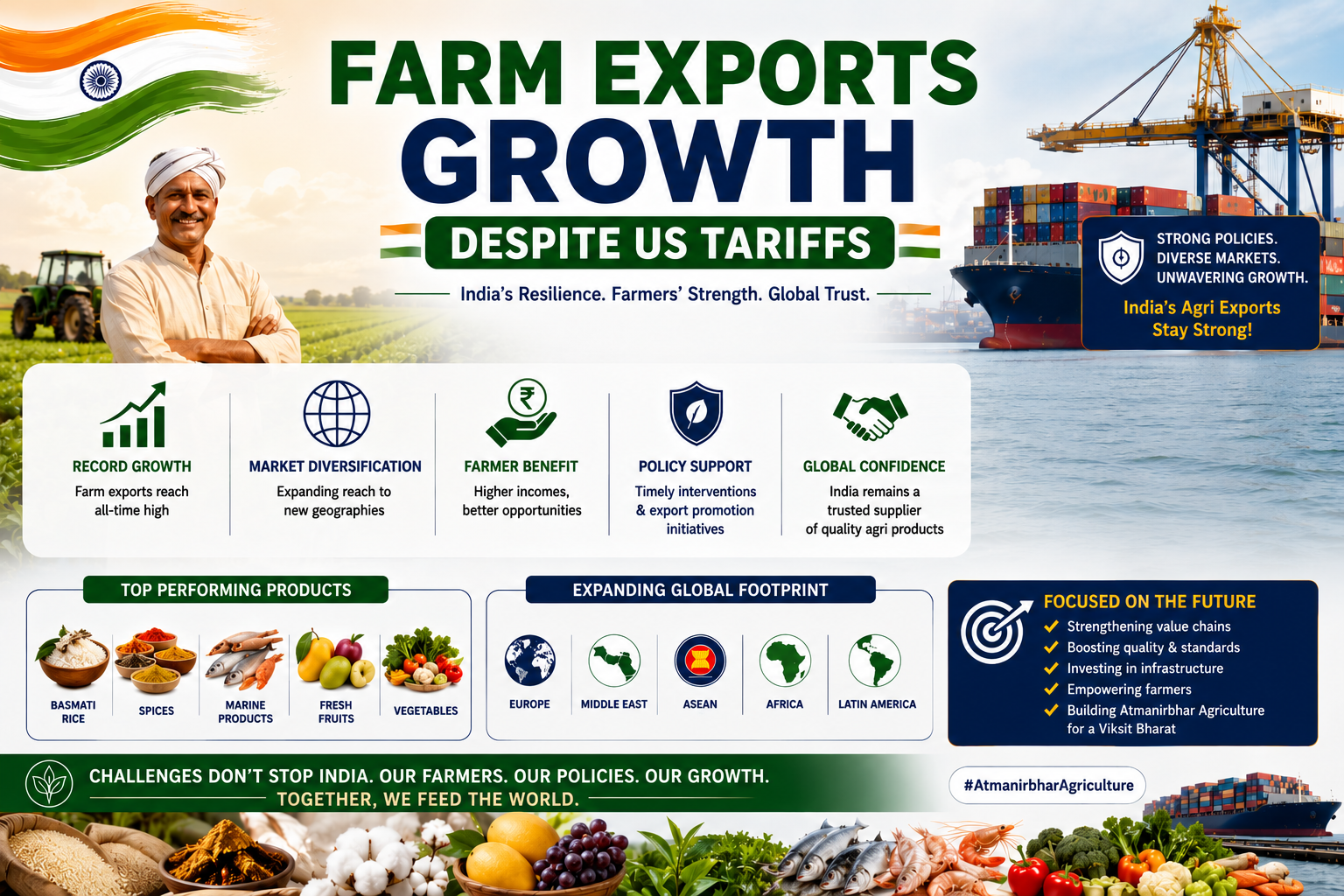
Despite US tariff challenges, India's agricultural exports rose 2.3% to $42.26 billion during April–February 2025–26, driven by strong demand for rice and marine products.
Resilient Growth: India’s agricultural exports grow by 2.3% year-on-year in 2025-26, reaching $53.1 billion.
Outperforms Overall Merchandise: Farm export growth (2.3%) surpasses India’s overall merchandise export growth (0.9%).
Shrinks Trade Surplus: India’s agricultural trade surplus narrows to $12.7 billion (from a peak of $27.7 billion in 2013-14) because import volumes (edible oils, pulses, fresh fruits) grow faster than exports.
Turns Net Importer in Cotton: India shifts from a leading cotton exporter to a net importer of raw cotton due to domestic yield stagnation.
Imposes Reciprocal Tariffs
The US administration implements reciprocal tariffs under its "America First" policy to counter foreign trade barriers and balance the US trade deficit.
Targets Tariff Disparities
The US penalizes India for its high protective agricultural tariffs. India maintains a simple average tariff of 39% (and trade-weighted 65%) on agriculture, compared to the US's 5%.
Escalates Duties Sharply
The US raises tariffs on Indian goods from 10% to 25%, and subsequently imposes a 50% penalty tariff (effectively reaching 58.26% on items like shrimp).
Threatens Major Export Sectors
Tariffs directly hit India's price competitiveness, triggering sharp export declines to the US in marine products (frozen shrimp), basmati rice, spices, and processed foods.
Creates Livelihood Crisis
The 50% tariff threatens the livelihoods of millions of smallholder farmers and workers in highly export-dependent states like Andhra Pradesh (which accounts for 80% of India's shrimp exports).
Executes Market Diversification
Indian exporters shift away from the US market to offset losses. They redirect shipments to alternate markets in Asia, Europe, and the Middle East.
Offsets US Losses in Seafood
Exporters ship marine products to China, Vietnam, Japan, Thailand, and the European Union, pushing total marine exports to a record $8.4 billion (a 13.9% growth) despite the US tariff wall.
Expands Buffalo Meat Exports
India captures higher demand in Vietnam, Egypt, Malaysia, and the UAE, lifting buffalo meat exports by 25.6% to a record $5.1 billion.
Capitalizes on Global Supply Disruptions
India doubles its coffee exports to over $2 billion, taking advantage of low global stocks and poor harvests in major producing nations like Brazil and Vietnam.
Benefits from Favorable Monsoons
Consecutive good monsoons drive a rebound in domestic farm production.
Removes Export Restrictions
Indian government lifts export bans and curbs on non-basmati rice (imposed earlier to control domestic inflation), revitalizing rice export volumes.
Maintains Competitive Pricing
Indian exporters retain structural price competitiveness in labor-intensive and agro-processing sectors due to large-scale output.
Non-Tariff Barriers (NTBs)
Developed nations impose strict Sanitary and Phytosanitary (SPS) measures and Maximum Residue Limits (MRLs). India faces frequent shipment rejections in the EU and Japan over pesticide residues and pests.
Low Value Addition
India exports primary commodities. Processed agricultural exports constitute only 20.4% of the total, keeping India behind competitors like China (50%) and the US (25%).
WTO Subsidy Disputes
Developed nations (US, Canada, Australia) challenge India's Minimum Support Price (MSP) policy at the WTO, accusing India of breaching the 10% Amber Box limit for trade-distorting subsidies.
Policy Inconsistency
Frequent domestic policy shifts—such as sudden export bans on wheat, sugar, and onions to control inflation—disrupt supply chains and erode India's reliability as a global supplier.
High Import Dependence
India relies heavily on imports, spending on vegetable oils ($19.5 billion), pulses, and fresh fruits, draining foreign exchange and narrowing the trade surplus.
What Should Be India’s Way Forward to Sustain Agricultural Export Growth?
Promote Phased Tariff Reductions
India must negotiate reciprocal tariff relief with the US (like the recent cuts to 18%) by selectively lowering its own outlier tariffs on items like apples, walnuts, and specific dairy products.
Accelerate Free Trade Agreements (FTAs)
Fast-track trade pacts (e.g., India-UK CETA, EU-India FTA) to secure zero-duty access and level the playing field against competitors like Vietnam and Ecuador.
Invest in Agri R&D and Yield Enhancement
Shift the focus from tariff protectionism to productivity-driven competitiveness. India must repurpose fertilizer subsidies into agricultural R&D, seed technology, and precision farming to close global yield gaps.
Drive Product Diversification and Value Addition
Move up the value chain from raw commodities to ready-to-cook, breaded, and seasoned products. Enhance investments in food processing, cold-chain logistics, and Individual Quick Freezing (IQF) facilities.
Strengthen Biosecurity and SPS Compliance
Establish robust traceability-linked production systems, promote antibiotic-free aquaculture, and upgrade Export Inspection Agencies (EIA) to meet global health and safety standards.
Ensure Predictable Trade Policy
Maintain a stable export environment by using price-linked export windows instead of abrupt, blanket export bans, encouraging long-term capital investment in agriculture.
India’s farm export performance highlights that diversification, competitiveness, and adaptive trade strategies can sustain growth even amid rising protectionism and tariff barriers.
Source: INDIANEXPRESS
|
PRACTICE QUESTION Q. Despite being a top global producer of agricultural commodities, India's share in processed agricultural exports remains comparatively low. Discuss the structural challenges responsible for this and suggest policy measures to enhance value addition. (250 words) |
The US implemented aggressive tariffs reaching up to 50%, which heavily impacted key Indian exports like marine products, spices, and basmati rice to the American market. However, India's total agricultural exports still grew by 2.3% year-on-year to $53.1 billion in 2025-26, outperforming overall merchandise exports.
Under the WTO's Agreement on Agriculture, trade-distorting subsidies are placed in the Amber Box and capped at 10% of total agricultural production value for developing nations. Developed nations accuse India of breaching this limit with its Minimum Support Price (MSP) policy, though India defends its stance by highlighting that the WTO calculations use outdated 1986-88 base prices.
Developed countries frequently impose strict Sanitary and Phytosanitary (SPS) measures and Maximum Residue Limits (MRLs) as non-tariff barriers. For instance, India's basmati rice and tea exports have faced European bans over pesticide residues, and Japan has banned Indian cut flowers over zero-tolerance pest rules.


© 2026 iasgyan. All right reserved