India targets 100 GW nuclear capacity by 2047, requiring Rs 23-25 lakh crore in investments (Source: TERI). The SHANTI Act 2025 facilitates private sector entry and amends liability laws, while SMRs and fast breeder reactors advance the clean energy transition.
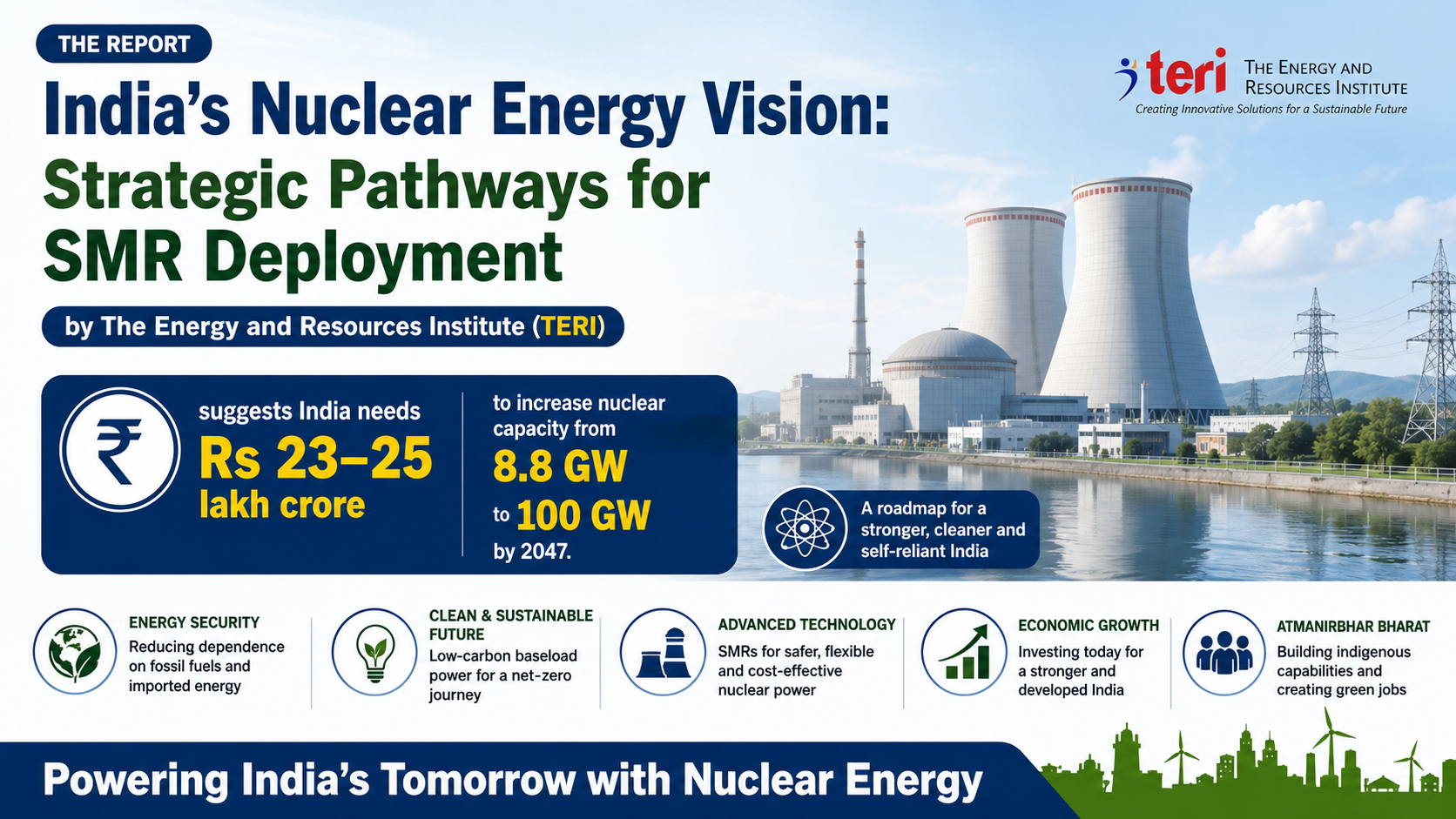
The report, India’s Nuclear Energy Vision: Strategic Pathways for SMR Deployment, by The Energy and Resources Institute (TERI), suggests India needs Rs 23–25 lakh crore, to increase nuclear capacity from 8.8 GW to 100 GW by 2047.
|
Read all about: INDIA'S NUCLEAR ENERGY REVOLUTION SHANTI BILL: PRIVATE SECTOR IN NUCLEAR ENERGY |
Ambitious Nuclear Target
India requires an investment of Rs 23-25 lakh crore to achieve a 100 GW nuclear power capacity by the year 2047.
Current Capacity and Projections
India currently operates 25 nuclear reactors with a total 8.8 GW installed capacity, and ongoing projects project a capacity jump to 22 GW by 2032.
Grid Stability and Baseload Power
Firm baseload nuclear generation provides power grid stability during non-solar hours as India integrates renewable energy sources.
Focus on Small Modular Reactors (SMRs)
Government allocates Rs 20,000 crore in the Union Budget 2025-26 for SMR research and deployment, aiming to operationalize five indigenous SMRs by 2033.
SMR Applications and Indigenous Designs
India develops three SMR designs—a 200 MWe Bharat Small Modular Reactor, a 55 MWe reactor, and a 5 MWth high-temperature gas-cooled reactor—to serve emerging demand centers like data centers, green hydrogen, and desalination.
Fuel Security Deficit
India produces a mere 600 tonnes of uranium annually (1-2% of global output) despite holding vast reserves of 425,000 to 433,800 tonnes of U₃O₈.
Advancement of Three-Stage Programme
The Prototype Fast Breeder Reactor (PFBR) at Kalpakkam achieves criticality in April 2026, advancing India toward the second stage of Homi J. Bhabha’s vision and eventual thorium-based fuel systems.
Key Expansion Challenges
The nuclear sector faces hurdles, primarily regulatory preparedness, financing risks, fuel security, workforce shortages, and public acceptance.
Strategic Recommendations
The report recommends overhauling existing regulations by establishing SMR-specific siting norms, streamlining licensing systems, defining rules for public-private partnerships, and executing a phased roadmap combining conventional reactors with SMRs.
It is an independent, not-for-profit research institution based in New Delhi.
Founded in 1974 by Shri JRD Tata and Shri Darbari Seth, it was originally known as the Tata Energy Research Institute before being renamed in 2003.
TERI serves as a global think tank specializing in energy, environment, climate change, and sustainable development.
Key Focus Areas
Clean Energy & Decarbonisation: Researching renewable energy integration, energy efficiency, and low-carbon transition pathways for industries.
Climate Resilience: Providing localized climate modeling, risk assessments, and policy inputs to assist India's climate negotiations globally.
Resource Efficiency & Circular Economy: Developing solutions for municipal waste management, industrial water reuse, and material recycling.
Sustainable Agriculture & Biotechnology: Innovating bio-fertilizers, nano-fertilisers, and soil restoration methods.
Major Initiatives and Innovations
GRIHA (Green Rating for Integrated Habitat Assessment): Co-developed with the Ministry of New and Renewable Energy, this is India's national rating system used to evaluate the sustainability of buildings and habitats.
Lighting a Billion Lives (LaBL): A massive campaign aimed at replacing polluting kerosene lamps in remote rural villages with clean, solar-powered lighting systems.
Oil Zapper: A patented microbial biotechnology used by major energy companies to naturally clean up oil spills and restore toxic environments.
TADOX: An advanced wastewater treatment technology that uses nanotechnology to efficiently recycle industrial and municipal water.
GREEN Olympiad: An annual, nation-wide environmental examination conducted for school students to cultivate environmental consciousness early on.
Global and Educational Reach
TERI hosts the World Sustainable Development Summit (WSDS) annually to bridge high-level policy dialogue with actionable climate measures.
It also established the TERI School of Advanced Studies (TERI SAS) to train the next generation of sustainability leaders in postgraduate and doctoral programs.
Source: DOWNTOEARTH
|
PRACTICE QUESTION Q. Transitioning to a net-zero power system by 2070 requires a delicate balance between variable renewable energy expansion and firm baseload power. Discuss. 150 words |
India aims to scale its nuclear power generation capacity from the current 8.78 GW to 100 GW by the year 2047
The Sustainable Harnessing and Advancement of Nuclear Energy for Transforming India (SHANTI) Act, 2025, replaces the Atomic Energy Act of 1962 and the Civil Liability Act of 2010 to permit limited private sector participation and foreign direct investment under regulatory oversight.
SMRs are advanced, factory-built reactors with smaller capacity (up to 300 MW) that are easier to deploy. The government has allocated Rs 20,000 crore to operationalize at least five indigenously designed SMRs by 2033.






© 2026 iasgyan. All right reserved