Copyright infringement not intended
Picture Courtesy: INDIANEXPRESS
Context
The Indian government has announced plans to amend the Atomic Energy Act, 1962, to allow private sector participation in the civil nuclear power sector.
|
Read all about: SHANTI BILL: PRIVATE SECTOR IN NUCLEAR ENERGY l NUCLEAR SECTOR OPENS TO PRIVATE l PRIVATE INVESTMENT IN NUCLEAR ENERGY l INDO-US NUCLEAR COLLABORATION l |
Nuclear power is a low-carbon method of generating electricity by harnessing energy from the core (nucleus) of an atom. It relies on nuclear reactions—specifically fission—to produce heat.
How it Works?
All commercial nuclear power plants operate using nuclear fission.
Types of Nuclear Reactions
The industry is shifting toward Small Modular Reactors (SMRs). These are smaller, factory-built reactors that are easier to finance and faster to deploy than traditional large-scale plants.
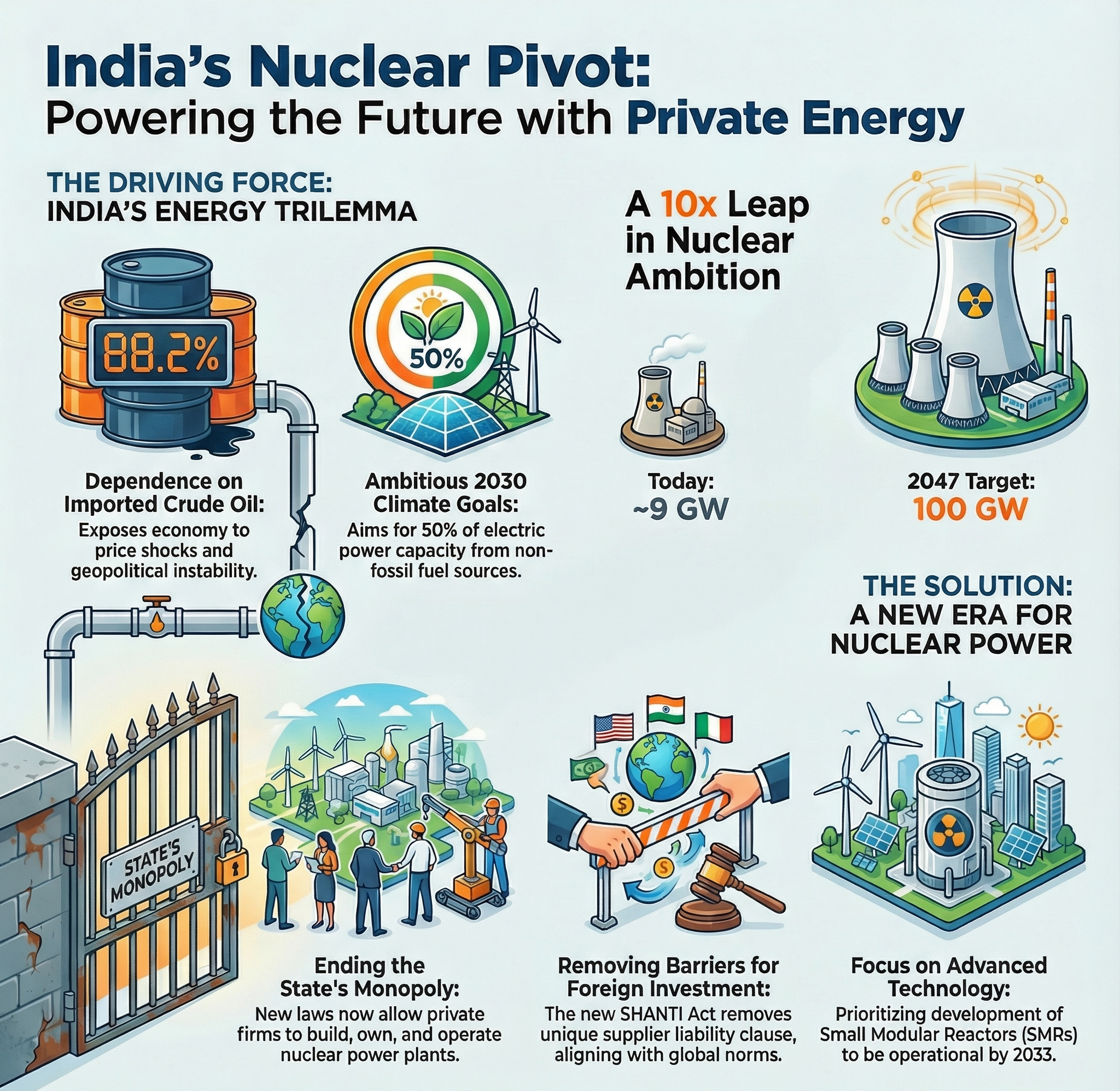
Nuclear power is currently the fifth-largest source of electricity in India.
As of late 2025, India operates 25 nuclear reactors across seven locations with a total installed capacity of 8,880 MW, contributing approximately 3% of the country's electricity generation. (Source: PIB)
Under the Nuclear Energy Mission launched in early 2025, the government has set an ambitious target to reach 100 GW of nuclear capacity by 2047.
Operational and Project Status
To achieve the 100 GW target, the parliament has passed the Sustainable Harnessing and Advancement of Nuclear Energy for Transforming India (SHANTI) Bill, 2025.
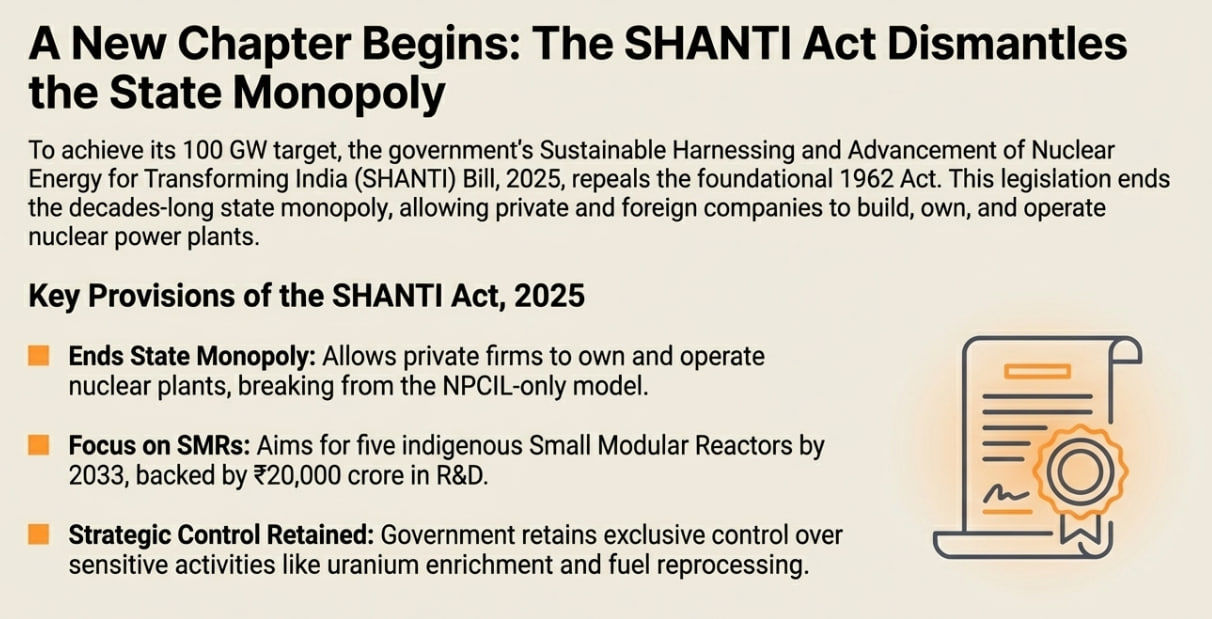 Restructuring Civil Nuclear Liability
A major hurdle for private and foreign investment has been supplier liability clauses. The SHANTI Act aligns India’s framework with international norms.
Strengthening the Regulatory Framework
 Global Nuclear Risks & India's Disarmament Policy
Rising global nuclear risks, driven by eroding arms control and geopolitical tensions, underline the significance of India's pragmatic model of balancing nuclear disarmament with its security requirements.
Factors Fuelling Rising Nuclear Risk
Geopolitical Tensions & Arms Race
Increasing strategic competition has led nuclear-armed states to modernize their arsenals. The number of operational nuclear warheads is increasing year-on-year, even as the total global inventory slowly declines due to the dismantling of retired weapons (Source: SIPRI).
Breakdown of Arms Control
The collapse or suspension of key treaties like the Intermediate-Range Nuclear Forces (INF) Treaty and the New START Treaty has removed critical checks, fueling instability.
Advanced Delivery Systems
The development of technologies like hypersonic missiles compresses decision-making time and increases the risk of miscalculation.
Militarization of New Domains
Competition is expanding into space and cyberspace, creating new pathways for conflict escalation involving nuclear command and control systems.
India's Approach to Nuclear Disarmament
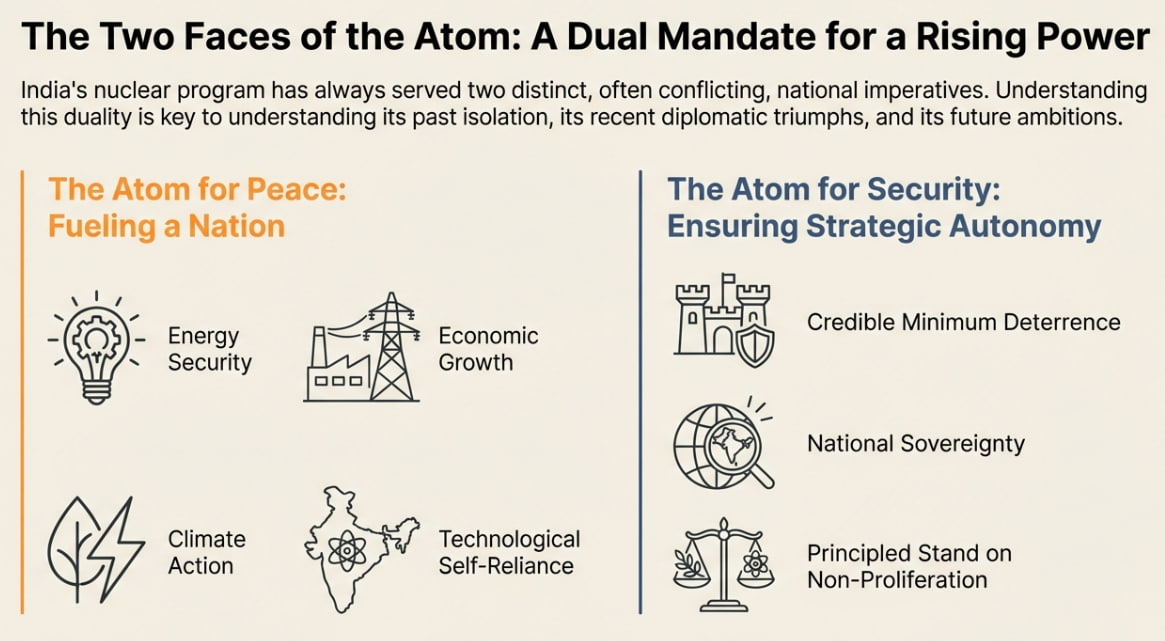
India’s nuclear policy is anchored in a commitment to global disarmament while addressing its regional security challenges. The doctrine rests on two pillars: "No First Use" and "Credible Minimum Deterrence."
 India's Stance on Key International Treaties
|
Treaty |
India's Position and Rationale |
|
Not a signatory. India views the NPT as discriminatory because it legitimizes the arsenals of the five permanent UN Security Council members while denying other states the same right. |
|
|
Not signed. While India observes a unilateral moratorium on nuclear testing, it maintains that the treaty does not provide a time-bound framework for the complete elimination of nuclear weapons. |
|
|
Not supported. India believes that any such treaty must be negotiated within the UN-mandated Conference on Disarmament (CD) and include all nuclear-armed states to be effective. |
 Conclusion
India is strategically using nuclear technology for clean energy, with legislative reforms opening the sector to achieve energy self-sufficiency and Net Zero goals, all while promoting responsible global nuclear security.
Source: INDIAN EXPRESS
|
PRACTICE QUESTION Q. How can the private sector participation in nuclear energy bridge the gap in India’s baseload power requirements? 150 words |
The primary purpose of the SHANTI Act, 2025, is to end the government's six-decade-long monopoly on nuclear power generation in India. It aims to accelerate the growth of nuclear energy by allowing private companies to invest in, build, and operate nuclear power plants.
The Act fundamentally changes the landscape by moving from a state-ownership model to a licence-based regulatory regime. This allows private entities to participate directly in nuclear power generation, which was previously restricted to government-owned corporations under the Atomic Energy Act, 1962.
The SHANTI Act aligns India's liability framework with international standards. It specifies that an operator can only seek recourse against a supplier if it's explicitly mentioned in a contract or if the damage was caused intentionally. This removes the major obstacle of unlimited liability that deterred foreign technology partners.
© 2026 iasgyan. All right reserved