The Advance Authorisation Scheme allows duty-free imports of essential inputs for export production. Recently, the government capped duty-free gold imports at 100 kg per licence to curb domestic diversion, implementing strict compliance checks, mandatory physical inspections, and prior export obligations.
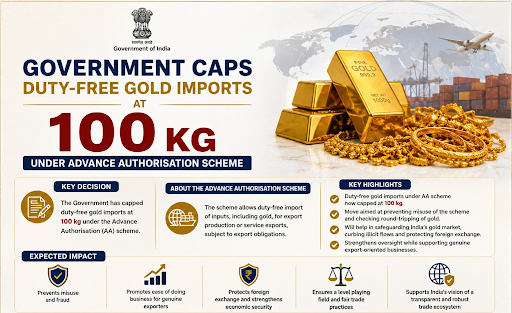
The Union Government caps duty-free gold imports at 100 kg under the Advance Authorisation scheme.
The Advance Authorisation Scheme was officially introduced under its current name on September 1, 2004, as part of India's Foreign Trade Policy (2004–2009).
Objective
It operates as a duty-exemption mechanism under the Foreign Trade Policy.
It allows exporters to import inputs duty-free, provided they incorporate these materials physically into the final export products.
It prevents upfront duty payments, preserves working capital, reduces production costs, and boosts export competitiveness globally.
Eligibility and Supply Categories
Manufacturer exporters or merchant exporters (who maintain formal tie-ups with supporting manufacturers) qualify to apply for the scheme.
The scheme covers various supply types: physical exports, intermediate supplies, deemed exports, and vessel stores.
Duties Exempted
The scheme exempts importers from paying Basic Customs Duty (BCD), Additional Customs Duty, Education Cess, Social Welfare Surcharge, Anti-dumping Duty (ADD), and Safeguard Duty.
The scheme conditionally exempts Integrated Goods and Services Tax (IGST) and Compensation Cess, subject to pre-import conditions upheld by the Supreme Court.
Value Addition (VA) and Export Obligation (EO)
Exporters must achieve a minimum Value Addition of 15% for most standard products.
The policy mandates specific exceptions, requiring a 50% Value Addition for tea and a 25% Value Addition for spices.
100 kg Cap: Duty-free gold imports are limited to a maximum of 100 kg per licence.
Mandatory Inspections: DGFT authorities will conduct physical inspections of manufacturing units for all first-time applicants.
50% Fulfilment Rule: Exporters must complete at least 50% of their previous export obligation before getting a new gold import authorisation.
Fortnightly Audits: Authorisation holders must submit performance reports every two weeks, certified by an independent Chartered Accountant.
Central Oversight: Regional DGFT authorities are required to send monthly consolidated reports to headquarters.
Source: NEWSONAIR
|
PRACTICE QUESTION Q. Consider the following statements about the Advance Authorisation Scheme (AAS):
Which of the statements given above is/are correct? A) 1 only B) 2 only C) Both 1 and 2 D) Neither 1 nor 2 Answer: C Explanation: Statement 1 is correct: Under India's Foreign Trade Policy, the minimum value addition required to be achieved under the Advance Authorisation Scheme (AAS) is 15%, whereas for the Duty-Free Import Authorisation (DFIA) scheme, it is 20%. Statement 2 is correct: To curb the misuse of price arbitrage following changes in import tariffs, the Directorate General of Foreign Trade (DGFT) imposed a maximum permissible quantity limit of 100 kg per licence for duty-free gold imports under the Advance Authorisation scheme. |
The AAS is a mechanism under India's Foreign Trade Policy that allows exporters to import raw materials, packaging, and consumables duty-free, provided these inputs are physically incorporated into final export products.
The DGFT implemented a 100 kg maximum permissible cap per licence for duty-free gold imports. It also mandated physical inspections of manufacturing units for first-time applicants to verify their operational status.
For most products, the minimum value addition is 15%. However, exceptions apply: tea exports require a 50% value addition, and spices require 25%.





© 2026 iasgyan. All right reserved