India and IFAD launched COSOP 2026–2033, an eight-year roadmap to strengthen the rural economy. It focuses on building climate resilience, empowering grassroots institutions like SHGs and FPOs, and sharing India's successful rural development models globally through South-South Cooperation.
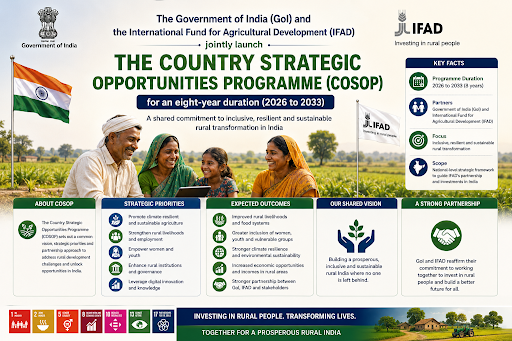
The Government of India launched the Country Strategic Opportunities Programme (COSOP).
The Government of India (GoI) and the International Fund for Agricultural Development (IFAD) jointly launch the Country Strategic Opportunities Programme (COSOP), for an eight-year duration (2026 to 2033).
IFAD is a specialized United Nations agency and international financial institution exclusively dedicated to eradicating rural poverty, hunger, and food insecurity in developing nations.
The strategy aligns with the vision of Viksit Bharat@2047 and shifts the focus from basic poverty alleviation to building a market-oriented, climate-resilient rural economy.
The program targets 3 million rural households, prioritizing the 10 poorest states, climate-vulnerable Himalayan regions, and 112 Aspirational Districts.
An initial IFAD financing of $160 million supports the roadmap, backed by a strategic partnership with NABARD to develop blended finance instruments for smallholders.
Enhance Resilience: Builds rural capacity to withstand climate and economic shocks using climate-smart agriculture and sustainable resource management.
Strengthen Grassroots Institutions: Empowers local bodies like Self-Help Groups (SHGs), Farmer Producer Organisations (FPOs), and cooperatives to connect farmers with finance, technology, and global markets.
Drive South-South and Triangular Cooperation (SSTC): Leverages the "Lighthouse Model" to export India's successful rural innovations—such as digital agriculture—to other developing nations
Key Interventions
Promote Market-Oriented Agriculture: Shifts subsistence farming to profitable rural enterprises through commercial farming and agro-processing.
Foster Deep Financial Inclusion: IFAD and NABARD partner to provide institutional credit to farmers and women, breaking the rural debt trap.
Empower Marginalized Demographics: Targets SCs, STs, youth, and women-headed households to bridge human development gaps in education and healthcare.
Integrate Artificial Intelligence (AI): Uses AI for precision farming, real-time weather forecasting, digital credit scoring, and market price discovery.
Strategic Significance
Economic Impact: Tackles disguised unemployment and fragmentation of landholdings by diversifying rural livelihoods and generating sustainable non-farm employment.
Social Impact: Promotes gender equality and decentralized governance by placing women at the forefront of the SHG movement.
Environmental Impact: Protects ecologically fragile rain-fed regions by introducing drought-resistant crops and micro-irrigation systems.
Strategic Impact: Enhances India's diplomatic soft power by positioning the country as a primary solution provider for global food insecurity and rural poverty under the SSTC framework.
Source: PIB
|
PRACTICE QUESTION Q. With reference to the Country Strategic Opportunities Programme (COSOP) 2026–2033, consider the following statements:
Which of the statements given above is/are correct? A) 1 and 2 only B) 2 and 3 only C) 1 and 3 only D) 1, 2 and 3 Answer: C Explanation: Statement 1 is correct: The Country Strategic Opportunities Programme (COSOP) 2026–2033 is an eight-year strategy launched by the Government of India in partnership with the International Fund for Agricultural Development (IFAD). Statement 2 is incorrect: COSOP focuses on rural development, poverty reduction, climate resilience, and sustainable livelihoods. Statement 3 is correct: One of its core strategic priorities is to position India as a global knowledge leader by scaling and sharing proven rural development models (like Self-Help Groups and digital agriculture) with other Global South nations. |
COSOP is a medium-to-long-term strategic framework jointly launched by the Government of India and the International Fund for Agricultural Development (IFAD) to strengthen India's rural economy and improve livelihoods.
The three core pillars are enhancing socio-economic and climate resilience, strengthening grassroots institutions (like SHGs and FPOs), and promoting South-South Cooperation.
It is an initiative to package and export India's successful rural development models—such as digital agricultural services and SHG federations—to other developing nations in the Global South.
FAD is providing an initial financing of approximately $160 million. It is also shifting its model to include blended finance and direct private sector investments in agri-startups, partnering with institutions like NABARD.
The programme places a strong emphasis on empowering Self-Help Groups (SHGs), Farmer Producer Organisations (FPOs), Panchayats, and cooperatives.
COSOP 2026-2033 is strategically aligned with the "Viksit Bharat@2047" vision by transforming the rural economy from subsistence farming to market-oriented, competitive, and sustainable growth



© 2026 iasgyan. All right reserved