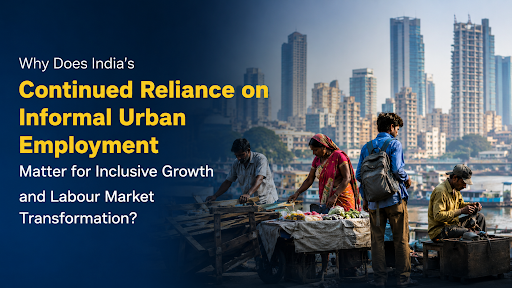
The PLFS April 2026 bulletin by MoSPI indicates a steady national unemployment rate of 5.2%. Urban joblessness marginally eased to 6.6%, while rural unemployment rose to 4.6%. The data provides vital insights into India’s shifting labour force participation dynamics.
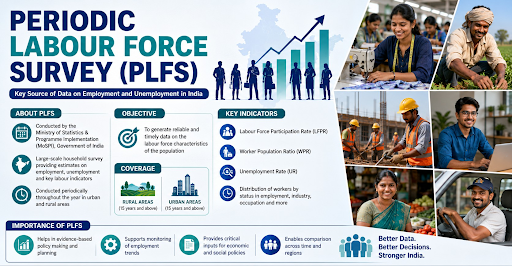
The Periodic Labour Force Survey (PLFS) Monthly Bulletin for April 2026 highlights broad stability in India's overall unemployment rate at 5.2%,
The National Statistical Office (NSO) under the Ministry of Statistics and Programme Implementation (MoSPI) conducts the Periodic Labour Force Survey (PLFS).
The government initiated this survey in April 2017 to establish an official framework for tracking employment and unemployment dynamics.
The survey generates monthly and quarterly estimates for both rural and urban areas to track short-term labor market fluctuations using the Current Weekly Status (CWS) approach.
The Current Weekly Status (CWS) considers a person employed if they work for at least one hour on any day during the seven days preceding the survey.
|
Key Indicator |
April 2026 Estimate |
Observation |
|
Overall Unemployment Rate (UR) |
5.2% |
The national joblessness rate remains broadly stable, matching previous records to mark a six-month high. |
|
Rural Unemployment Rate |
4.6% |
The rural sector registers a slight increase in joblessness compared to the previous month. |
|
Urban Unemployment Rate |
6.6% |
Urban joblessness shows a marginal decrease, highlighting a slight easing in city-based employment pressures. |
|
Youth Unemployment (15–29 Years) |
15.3% |
The data highlights bottlenecks in the school-to-work transition, necessitating a stronger focus on skill-based education and initiatives like the PM Internship Scheme. |
|
Urban Female Unemployment |
8.5% |
Urban female joblessness rate reaches its lowest level recorded since April 2025. |
|
Labour Force Participation Rate (LFPR) |
55.0% |
Overall workforce participation reflects a mild softening as fewer individuals actively seek work. |
|
Female LFPR |
33.9% |
Female participation rate records a marginal decline, signaling that challenges such as unpaid care work still hinder women's economic integration. |
|
Worker Population Ratio (WPR) |
52.2% |
The percentage of employed persons in the overall population displays a slight moderation. |
|
Urban WPR |
46.8% |
The urban worker ratio maintains complete stability, remaining unchanged from the previous month. |
Bridge the Gender Gap
Build affordable, high-quality community creches and elderly care centers to reduce the unpaid care burden on women and boost female labor force participation.
Promote Flexible Work
Adopt "Work from Home" and "Hybrid" models in the formal salaried sector to help women balance commitments without dropping out of the workforce.
Mandate Apprenticeship-Linked Education
Standardize university degrees to include mandatory, paid apprenticeships in the final year to reduce the high youth NEET (Not in Employment, Education, or Training) population.
Target Emerging Sectors
Direct hiring and training efforts toward "green jobs", municipal services, and the growing Manufacturing and Services sectors.
Align Vocational Training
Equip self-employed youth with digital marketing and financial management skills to transition them from subsistence work to genuine entrepreneurship.
Provide Formalization Incentives
Grant tax incentives to MSMEs that transition workers from casual contracts to regular salaried roles with social security (eg. Provident Fund).
Improve Ease of Doing Business
Remove regulatory hurdles and improve the business environment for labor-intensive industries like textiles and electronics assembly.
Drive Agro-Industrialization
Establish Integrated Agro-Processing Clusters to shift rural labor away from subsistence farming into high-value food processing, localizing sorting and packaging to stabilize rural incomes.
Ensure Regional Parity
Invest in local infrastructure, industrial clusters, and skill hubs to connect rural labor with new job opportunities and mitigate rural-urban disparities.
Launch Urban Livelihood Missions
Deploy targeted missions to tackle high urban unemployment and incentivize urban female labor participation.
Source: PIB
|
PRACTICE QUESTION Q. With reference to the Periodic Labour Force Survey (PLFS), consider the following statements:
Which of the statements given above is/are correct? (a) 1 only (b) 2 only (c) Both 1 and 2 (d) Neither 1 nor 2 Answer: (c) Explanation: Statement 1 is correct: The Current Weekly Status (CWS) approach determines a person's employment status based on a short reference period of the seven days preceding the date of the survey. Under this metric, a person is considered employed if they worked for at least one hour on any day during that week. Statement 2 is correct: The Periodic Labour Force Survey (PLFS) is officially designed and conducted by the National Statistical Office (NSO), which functions under the Ministry of Statistics and Programme Implementation (MoSPI). |
The overall unemployment rate for persons aged 15 years and above stood at a six-month high of 5.2% in April 2026, remaining broadly stable compared to 5.1% in March 2026.
The Periodic Labour Force Survey is released by the National Statistical Office (NSO) under the Ministry of Statistics and Programme Implementation (MoSPI).
LFPR is defined as the percentage of the working-age population (15 years and above) that is in the labour force, meaning they are either currently working or actively seeking/available for work.




© 2026 iasgyan. All right reserved