India’s fertilizer sector faces severe fiscal and geopolitical vulnerabilities due to massive LNG and urea import dependence. Reforming distorted urea pricing through Direct Benefit Transfers and scaling sustainable initiatives like PM-PRANAM is critical to ensuring long-term food and economic security.
Why in the news?
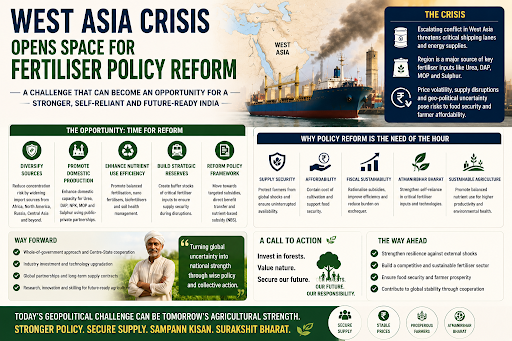
The West Asia crisis, by threatening fertilizer imports, offers a chance to reform subsidies, address nutrient imbalances, and shift to sustainable alternatives.
|
Read all about: WEST ASIA CRISIS IMPACT ON INDIAN ECONOMY l WEST ASIAN CRISIS IMPACT ON INDIA l FERTILISER SECTOR CRISIS & REFORMS l FERTILIZER CRISIS IN INDIA |
What are the major fertilizer subsidies in India?
Urea subsidy: Government sets a fixed Maximum Retail Price (MRP) for urea at ₹242 per 45-kg bag, making it one of the cheapest globally.
Nutrient Based Subsidy (NBS): Introduced in 2010, the government applies this scheme to Phosphatic and Potassic (P&K) fertilizers (like DAP and MOP).
How the West Asia Crisis Affects Fertilizer Prices?
Supply Chain Chokepoints: The conflict threatens the Strait of Hormuz, a critical transit route that handles over 60% of India's Liquefied Natural Gas (LNG) imports and 30% of global fertilizer trade.
Production Disruptions: India relies on imports for 68.6% of its fertilizer value chain, heavily depending on West Asia for the LNG required to manufacture domestic urea.
Supply shocks lower domestic factory output, creating fertilizer shortages.
Price Volatility and Surges: Geopolitical tensions cause spikes in global energy and fertilizer markets. For example, recent supply fears drove global urea prices up by 65% in just 40 days, jumping from $482 to $795 per tonne.
Fiscal Strain: Escaping import costs inflate the government's overall subsidy expenditure to shield farmers from the financial blow.
Major Problems in India’s Fertilizer Policy
Nutrient Imbalance: Price difference between cheap, controlled urea and expensive, decontrolled P&K fertilizers pushes farmers to overuse urea.
This skews the N:P:K (Nitrogen:Phosphorus:Potassium) application ratio to an alarming 10.9:4.4:1, far worse than the ideal 4:2:1 agronomic standard.
Soil Degradation and Health Risks: Excessive nitrogen use destroys soil organic carbon, limits crop yields, and triggers severe nitrate contamination in groundwater, posing massive risks to human and animal health.
Low Nutrient Use Efficiency (NUE): Crops absorb only 35-40% of the applied nitrogen, while the rest escapes into the atmosphere as nitrous oxide (a potent greenhouse gas) or leaches away.
Diversion and Black-Marketing: Flaws in the current Direct Benefit Transfer (DBT) verification system allow syndicates to divert 20-25% of subsidized urea toward industrial sectors (like plastics and resins) or smuggle it across borders.
Exclusion of Real Cultivators: The system targets landowners but excludes tenant farmers and landless laborers due to inadequate formal land records.
Way Forward
Direct Cash Transfers (DBT): Replace product-based subsidies with a direct per-acre cash transfer to farmers, eliminating industrial diversion and empowering farmers to buy balanced inputs.
Price Deregulation: Gradually free urea prices to align with import parity levels, allowing market forces to correct distorted consumption patterns.
Integrate Urea into the NBS Regime: Shift urea under the Nutrient-Based Subsidy scheme to penalize excessive nitrogen use and reward the application of balanced macronutrients.
Leverage Digital Triangulation: Use platforms like AgriStack and the PM-KISAN database to match fertilizer sales strictly with verified farm sizes, soil health data, and cropping patterns.
Promote Sustainable Alternatives: Scale up the PM-PRANAM scheme, Nano Urea, and bio-fertilizers to reduce chemical dependence and boost nutrient efficiency.
Diversify Import Sources: Reduce geopolitical vulnerability by acquiring overseas fertilizer assets and accelerating domestic natural gas exploration.
Conclusion
Transitioning fertilizer policy from product subsidies to direct income transfers and market pricing to build fiscal resilience, restores soil health, and secures agricultural sovereignty.
Source: INDIANEXPRESS
|
PRACTICE QUESTION Q. Critically examine India's high import dependence for its fertilizer value chain. How does geopolitical volatility in West Asia threaten India's agricultural security? 150 words |
The crisis disrupts the supply of Liquefied Natural Gas (LNG), the primary feedstock for urea, passing through maritime chokepoints, which directly inflates domestic manufacturing costs and creates supply shortages.
Introduced in 2010, the NBS scheme provides a fixed subsidy for phosphatic and potassic (P&K) fertilizers based on their specific nutrient content, allowing companies to set reasonable retail prices.
It is a government initiative that financially incentivizes states to reduce their chemical fertilizer consumption by promoting eco-friendly alternatives like organic manure, biofertilizers, and compost.




© 2026 iasgyan. All right reserved