

The West Asia crisis serves as a catalyst for India to transition from import-dependent vulnerability to proactive resource sovereignty through domestic energy and fertilizer alternatives.
|
Read all about: INDIA'S BALANCING ACT WEST ASIA l WEST ASIA CONFLICT DISRUPTED SUPPLY OF LPG TO INDIA l WEST ASIA TENSIONS: IMPACT ON INDIAN INDUSTRIAL SUPPLY CHAIN |
The Vulnerability Matrix breaks down India's structural exposure to the West Asia crisis across three critical dimensions: Energy Security, Agricultural Stability, and Trade Logistics.
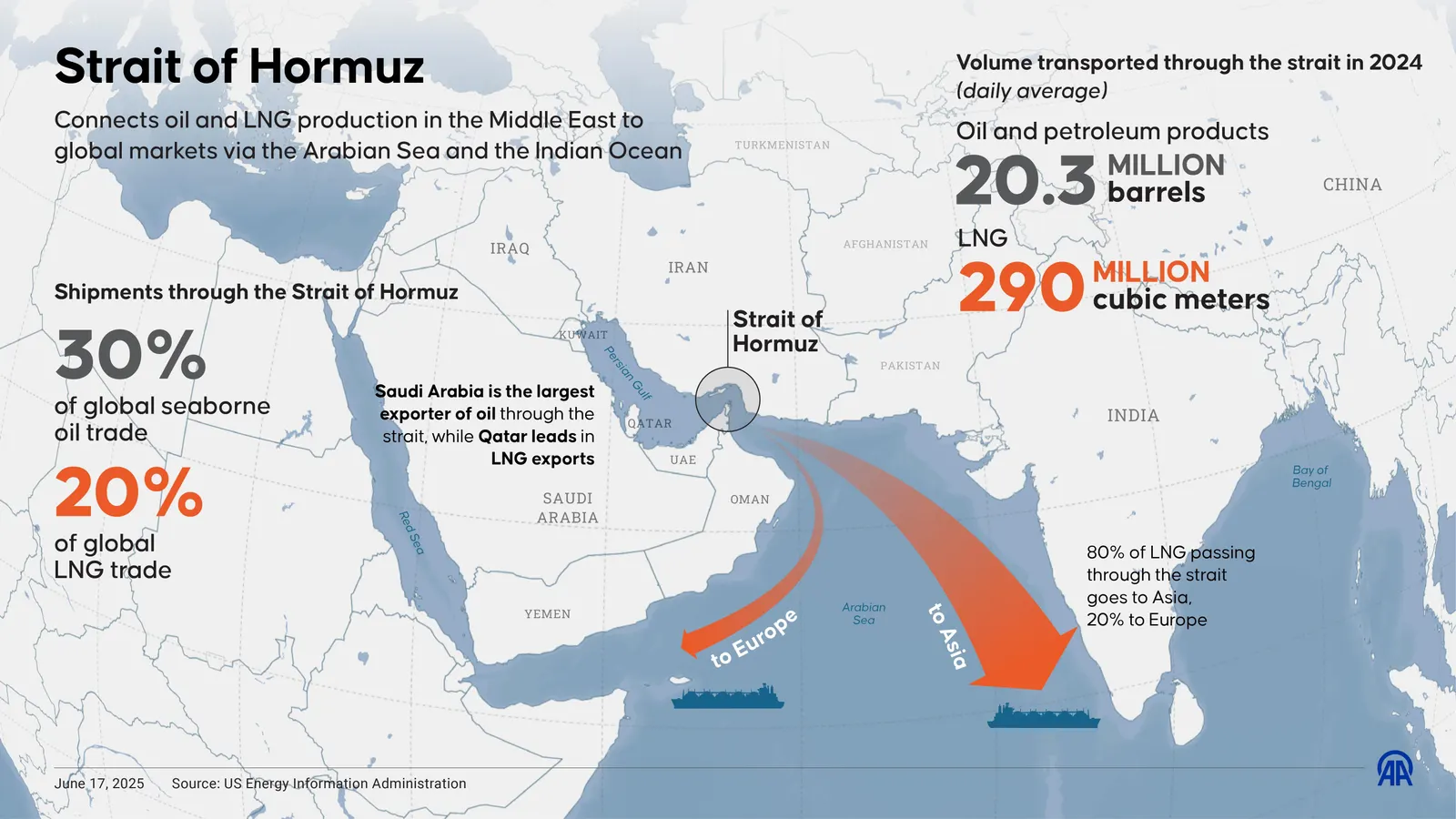
Energy Security: The "Hormuz Horror"
India’s energy architecture is heavily skewed toward West Asian supply lines. The Strait of Hormuz acts as a single point of failure for a vast portion of India’s energy needs.
Crude Oil Dependence: India imports over 85% of its total crude oil requirement.
LPG (Cooking Fuel): India is the world's second-largest importer of LPG, importing about 60% of the domestic requirement. (Source: PIB)
LNG (Industrial Feedstock): India imports roughly 50% of its natural gas as LNG.
 Agricultural Security: The "Fertilizer Trap"
Modern agriculture converts energy into food. Disruption in West Asia threatens this conversion because the region is a dominant supplier of fertilizers and their raw materials.
Import Dependency: India relies on imports for 25% of its Urea, 90% of Phosphates, and 100% of Potash. (Source: PIB)
The Gas-Fertilizer Link: Domestic urea production relies heavily on Natural Gas (LNG).
Trade Logistics: The Red Sea Crisis
The conflict has spilled over into the Red Sea, forcing ships to reroute around the Cape of Good Hope, bypassing the Suez Canal.
Cost & Time Escalation:
Sectoral Impact: This route handles roughly 30% of India’s total foreign trade. Key export sectors like textiles, engineering goods, and chemicals—which operate on thin margins—are becoming uncompetitive due to higher logistics costs.
 Efficient Use of Resources: The Immediate Shield
Industrial Energy Efficiency: The PAT Framework
The industrial sector is the largest consumer of commercial energy in India. Reducing its "Specific Energy Consumption" (SEC) directly cuts the need for imported LNG and coal.
The PAT Scheme: The Perform, Achieve, and Trade (PAT) scheme, under the National Mission for Enhanced Energy Efficiency (NMEEE), mandates energy savings for "Designated Consumers" in 13 energy-intensive sectors (e.g., Thermal Power, Iron & Steel, Cement, Fertilizers).
Impact: PAT Cycles have historically resulted in cumulative energy savings of over 26 Million Tonnes of Oil Equivalent (MTOE), which is roughly equivalent to avoiding 100 million tonnes of CO2 emission. (Source: Bureau of Energy Efficiency)
The Strategy: Strengthening the targets in the wake of the West Asia crisis can shave off peak demand for natural gas and imported coal.
Agricultural Rationalization: Breaking the Fertilizer Loop
India’s food security is currently "imported" via West Asian fertilizers. Efficiency here reduces the massive fiscal burden of the fertilizer subsidy.
Nano-Fertilizers: Accelerating the adoption of Nano-Urea and Nano-DAP is critical. These are liquid fertilizers with significantly higher nutrient use efficiency (NUE) compared to traditional granules.
Data: Field trials by the Indian Council of Agricultural Research (ICAR) indicate that one 500ml bottle of Nano-Urea can replace at least one 45kg bag of conventional urea, potentially reducing conventional urea consumption by up to 50%.
Precision Farming: Implementing Soil Health Cards to ensure farmers apply only the required amount of nutrients, preventing the "over-fertilization" that leads to wastage of imported stocks.
Logistics and Transport: Shifting the Load
The transport sector is the primary consumer of imported crude oil (Diesel and Petrol). Efficiency here requires a modal shift.
Rail vs Road: Shifting freight from road to rail is a strategic need. Moving freight by rail is approximately 6 times more energy-efficient than by road and results in 80% lower particulate matter emissions.
PM Gati Shakti: Integrating logistics through the PM Gati Shakti National Master Plan aims to reduce logistics costs from 14% of GDP to 8%, primarily by eliminating inefficiencies and "empty runs" in the supply chain.
Demand-Side Management (DSM) in Urban Centers
Following best practices for crisis response can yield immediate fuel savings.
The IEA 10-Point Plan: During global supply shocks, the International Energy Agency (IEA) recommends measures such as reducing highway speed limits by 10 km/h, encouraging "Work from Home" three days a week, and incentivizing public transport use.
LED Transition: The UJALA (Unnat Jyoti by Affordable LEDs for All) scheme has already saved billions of kWh of electricity annually, reducing the baseload power requirement that often relies on imported gas or coal.
Circular Economy: Mineral Recovery
With supply chains for sulphur and limestone at risk, India must focus on recycling.
Sulphur Recovery: Instead of importing sulphur (crucial for chemicals/fertilizers), refineries can maximize recovery from domestic crude processing using Sulphur Recovery Units (SRU).
West Asia supplies nearly 66% of India’s sulphur imports; domestic recovery is the only viable alternative during a blockade.
Geographical Diversification: The "Gulf Plus One" Strategy
India is reducing its reliance on the Strait of Hormuz by widening its supplier base across the Atlantic and Eurasia.
Russia: Currently accounts for roughly 36% of India’s crude oil imports, up from less than 2% in 2021.
The Americas & Africa: India is tapping into "Atlantic Basin" crude to avoid the Hormuz chokepoint. Imports from the USA, Brazil, and Guyana have surged, providing a vital alternative for high-quality crude.
LPG & LNG Alternatives: To de-risk cooking fuel and industrial gas, India is seeking long-term contracts outside the Gulf. Increasing gas imports from USA, Australia, and Qatar (via long-term contracts) to ensure price stability.
Technological Substitution: The Energy Transition
The ultimate alternative to importing energy is generating it domestically through technology.
National Green Hydrogen Mission: To produce 5 Million Metric Tonnes (MMT) of Green Hydrogen by 2030. Replacing "Grey Hydrogen" (made from imported gas) in refineries and fertilizer plants with Green Hydrogen can reduce fossil fuel imports by over ₹1 lakh crore.
Ethanol Blending (E20): Utilizing domestic agricultural surplus to replace petrol. India has achieved 20% (E20). This saves approximately ₹50,000 crore in foreign exchange annually.
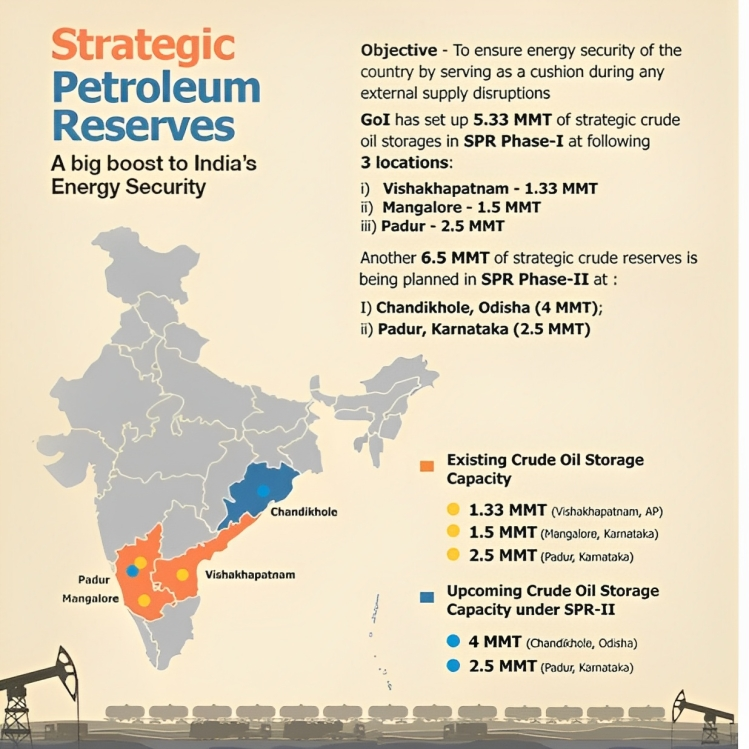
Strategic Petroleum Reserves (SPR): The National Insurance
When markets fail, physical stockpiles are the only alternative.
Current Infrastructure: India has underground rock caverns in Visakhapatnam, Mangaluru, and Padur. Current capacity holds 5.33 MMT, covering roughly 9.5 days of national consumption.
Expansion (Phase II): The government has approved two additional commercial-cum-strategic facilities at Chandikhol (Odisha) and Padur (Karnataka). Adding 6.5 MMT to bring the total strategic cover closer to the IEA-mandated 90-day net import requirement.
 Connectivity Alternatives: Bypassing Chokepoints
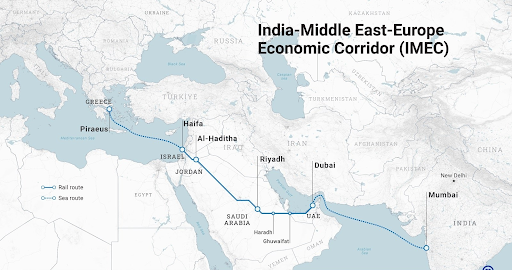
India is investing in multi-modal corridors that do not rely on the volatile Suez-Red Sea axis.
International North-South Transport Corridor (INSTC): Connecting Mumbai to Moscow via Iran (Chabahar Port) and the Caspian Sea.
India-Middle East-Europe Economic Corridor (IMEC): While currently paused due to conflict, it remains a long-term alternative to link India with Europe via a ship-to-rail network.
 Fertilizers: Diversifying Nutrient Sources
To break the "Fertilizer Trap," India is seeking mineral-rich partners in Africa and North America.
Joint Ventures: India is investing in phosphate mines in Morocco, Jordan, and Senegal to secure long-term supply at fixed prices.
Coal Gasification: Utilizing India's domestic coal reserves to produce Urea (Talcher Fertilizer Plant), reducing the need for imported natural gas.
Conclusion
The West Asia crisis serves as a reminder that Interdependence is a liability when the partner is in a conflict zone. For India, "Atmanirbharata" in energy is no longer a choice but a survival necessity. By combining Efficiency (lower demand) with Diversification (wider supply) and Substitution (renewables/hydrogen), India can insulate the economy from the tremors of the Middle East.
Source: INDIAN EXPRESS
|
PRACTICE QUESTION Q. The West Asia crisis highlights the fragility of global supply chains. Discuss how India can leverage this crisis to structurally reform its energy consumption and agricultural practices." 250 words |
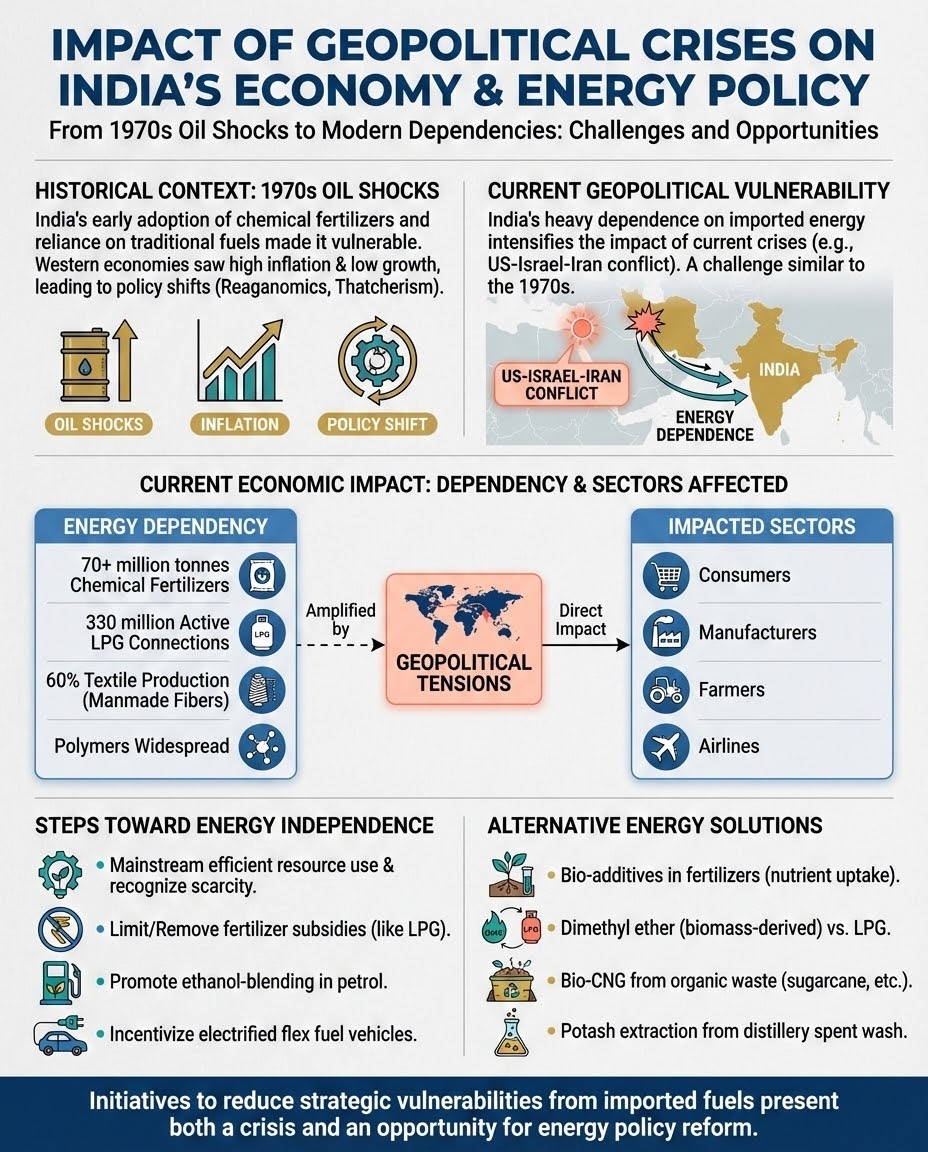
The 1970s global oil embargo triggered stagflation in the West, forcing massive economic restructuring. Similarly, the current West Asia crisis exposes India's extreme vulnerability to global oil shocks, demanding a radical structural shift from imported fossil fuels to domestic, renewable alternatives.
PM PRANAM aims to reduce the reliance on chemical fertilizers by incentivizing states to promote alternative, bio-based fertilizers. This helps in improving soil health, reducing the fiscal drain caused by fertilizer subsidies (like urea and DAP), and cutting down import dependency.
Brazil's 'Proálcool' model successfully replaced imported gasoline with sugarcane-derived ethanol by offering tax incentives for automakers and building dispensing infrastructure. India can adopt this by diversifying its feedstock (using surplus grains and agricultural residue) and mandating the production of electrified flex-fuel vehicles.
© 2026 iasgyan. All right reserved