Recent tensions in the Strait of Hormuz highlight India’s LPG vulnerability. While PMUY expanded access to over 10 crore households, import dependence reached 60–67%. With LPG storage for under 22 days, experts urge strategic reserves, including salt cavern storage in Rajasthan, and a national gas reserve policy.
Copyright infringement not intended
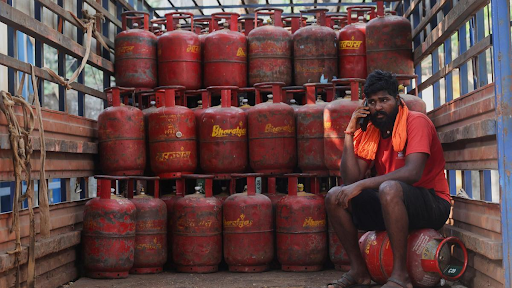
Picture Courtesy: THEHINDU
Context
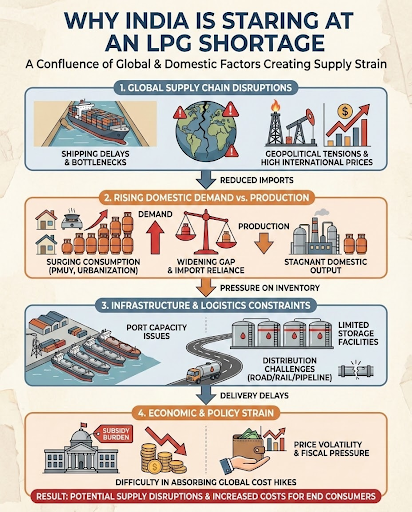
India is facing a Liquefied Petroleum Gas (LPG) supply crisis triggered by escalating military conflict in West Asia involving the U.S., Israel, and Iran.
What are the key drivers behind India's surging LPG consumption?
India's status as the world's second-largest LPG consumer is the result of a targeted government policy to promote clean cooking fuel, primarily through the Pradhan Mantri Ujjwala Yojana (PMUY).
Pradhan Mantri Ujjwala Yojana (PMUY): Launched in 2016, this scheme provides deposit-free LPG connections to women from low-income families.
Increased Affordability: A targeted subsidy of ₹300 per cylinder for PMUY beneficiaries (for up to 9 refills a year) has boosted consumption. (Source: PIB)
Rising Consumption Rates: Per-capita consumption among PMUY users rose from about 3 refills in 2019-20 to 4.85 refills in FY 2025-26. (Source: Ministry of Petroleum)
Overall Growth: India’s total LPG consumption grew over 44%, from 21.6 million metric tonnes (MMT) in FY 2017 to 31.3 MMT in FY 2025. (Source: CRISIL))
India's LPG Vulnerability
Extreme Import Dependency
India imports about 60% of LPG requirements, 90% of which comes through the Strait of Hormuz, making the supply chain vulnerable to regional conflicts. (Source: PIB)
Inadequate Strategic Storage
India's LPG infrastructure is designed for a "just-in-time" operational flow, not long-term storage. The country's total LPG storage capacity can cover only about 21.5 days of national supply. (Source: S&P Global Energy)
Strategic storage is limited to two underground rock caverns with a combined capacity of just 1.4 lakh tonnes—equivalent to less than two days of national consumption.
What are the Challenges in Building Strategic LPG Reserves?
Large-scale underground storage faces geological and technical challenges. India has three potential geological zones for this.
|
Geological Zone |
Feasibility |
Key Points |
|
Peninsular Shield (Hard Rock) |
It comprises ancient granite and gneiss rock. Technology is proven, as seen in the existing caverns at Visakhapatnam and Mangaluru. |
|
|
Deccan Traps (Basaltic Rock) |
A vast basaltic plateau in western and central India. Presents significant engineering challenges for cavern construction. |
|
|
Salt Formations (Salt Caverns) |
Salt deposits in Rajasthan's Bikaner-Barmer belt offer a highly promising alternative. Created by leaching salt with water (solution mining). |
|
Way Forward
Diversify Import Sources
Reduce over-reliance on the Persian Gulf by securing long-term contracts with diverse suppliers like the U.S.
Invest in Strategic Storage
Prioritize and fast-track the development of salt cavern-based strategic reserves in Rajasthan, leveraging international technology partnerships.
Formulate a National Gas Reserve Policy
Establish a clear policy framework for LPG and LNG, similar to the Strategic Petroleum Reserve program, with defined storage targets (e.g., 30-60 days of consumption) and crisis-release protocols.
Integrate Storage into Planning
Ensure that all future energy infrastructure projects, such as pipelines and terminals, incorporate strategic storage components.
Learn Lessons from Global Best Practices
|
Country/Region |
Strategy |
Key Features |
|
European Union (EU) |
Mandatory Storage Filling |
Member states must fill gas storage to 90% capacity before winter. The EU can store about 25% of its annual gas consumption. (Source: IEA) |
|
Japan |
Strategic Buffer LNG (SBL) |
The government directs private firms to hold additional LNG cargoes that can be released during a supply crisis. |
Conclusion
The recent supply disruption is a wake-up call for India to transition from a vulnerable "just-in-time" supply model to a resilient, reserves-based energy security framework for LPG.
Source: THEHINDU
|
PRACTICE QUESTION Q. With reference to Liquefied Petroleum Gas (LPG) and Natural Gas (CNG/PNG), consider the following statements:
Which of the statements given above are correct? (a) 1 and 2 only (b) 2 and 3 only (c) 1 and 3 only (d) 1, 2, and 3 Explanation: b Statement 1 is incorrect: The compositions are swapped. Natural Gas consists primarily of methane and ethane (roughly 85–95% methane). LPG is primarily a mixture of propane and butane. Statement 2 is correct: LPG (Liquefied Petroleum Gas) is heavier than air because it consists of heavier hydrocarbons like propane and butane. Natural Gas (CNG/PNG), being primarily methane, is lighter than air and disperses quickly if leaked. Statement 3 is correct: Both LPG and Natural Gas are naturally odorless. An odorant, typically ethyl mercaptan (also known as ethanethiol), is added to them to provide a distinctive "rotten egg" smell for leak detection. |
India is vulnerable to an LPG shortage due to a combination of high import dependency (around 60-67% of needs are imported) and geopolitical tensions in West Asia disrupting shipping through the Strait of Hormuz, a route used by over 85% of India's LPG imports.
Launched in 2016, PMUY is a government scheme aimed at providing deposit-free LPG connections to women from low-income households to promote the use of clean cooking fuel. The scheme has been highly successful, expanding its beneficiary base to over 10 crore households.
Salt caverns are large underground storage spaces created by dissolving salt deposits through a process called solution mining. They are considered a promising option for strategic LPG storage because they are cheaper and faster to construct than hard rock caverns, are naturally impermeable to gas, and allow for rapid filling and withdrawal.



© 2026 iasgyan. All right reserved