

The Supreme Court upheld the Election Commission of India's (ECI) power to conduct the Special Intensive Revision (SIR) of electoral rolls to ensure free and fair elections.
|
Read all about: SUPREME COURT ON SIR: CONSTITUTIONAL POWERS OF THE ELECTION COMMISSION l SPECIAL INTENSIVE REVISION (SIR) |
The Election Commission of India (ECI) prepares the electoral roll, which functions as the official, general register of eligible voters for every territorial constituency.
Article 325 of the Constitution mandates the creation of one general electoral roll per constituency, while Article 324 vests the ECI with the power of superintendence, direction, and control over its preparation.
Establishes Voter Eligibility: Section 19 of the Representation of the People Act (RPA), 1950 entitles every person who reaches 18 years of age and acts as an ordinarily resident in a constituency to register in the roll.
Enforces Statutory Disqualifications: Section 16 of the RPA disqualifies individuals from the electoral roll if they lack Indian citizenship, possess an unsound mind, or face disqualification due to corrupt electoral practices.
Creates a Legal Presumption: Entering a name onto the electoral roll establishes a rebuttable presumption of citizenship, which places the burden of proof on the state or objector to prove an individual's ineligibility.
Universal Adult Suffrage
Article 326 guarantees voting rights to all eligible adult citizens, establishing the core framework for India's representative democracy and ensuring political equality.
Sustains Democratic Legitimacy
The Supreme Court declares democracy and free and fair elections as "inseparable twins" that form the basic structure of the Constitution.
Relies on Accurate Data
Free and fair elections depend on the integrity, accuracy, and credibility of inclusive electoral rolls rather than just the mechanics of polling.
Prevents Constitutional Failures
Retaining an ineligible voter creates an administrative flaw, but excluding a legitimate citizen (a false negative) triggers a fundamental constitutional failure.
Protects Marginalized Communities
True electoral inclusion defends vulnerable populations—such as seasonal migrants, the poor, women, and minorities—who often lack formal paper trails and face disproportionate risks of algorithmic or bureaucratic disenfranchisement.
Checks State Overreach
Robust inclusion policies prevent the state from using database "purification" exercises (like the Special Intensive Revision) as a backdoor mechanism for citizenship screening or mass exclusion without due process.
Upholds Fundamental Equality
Electoral inclusion operationalizes the great constitutional promise of "one person, one vote," ensuring that the most helpless and impoverished citizens retain their fundamental power to participate in the political process.
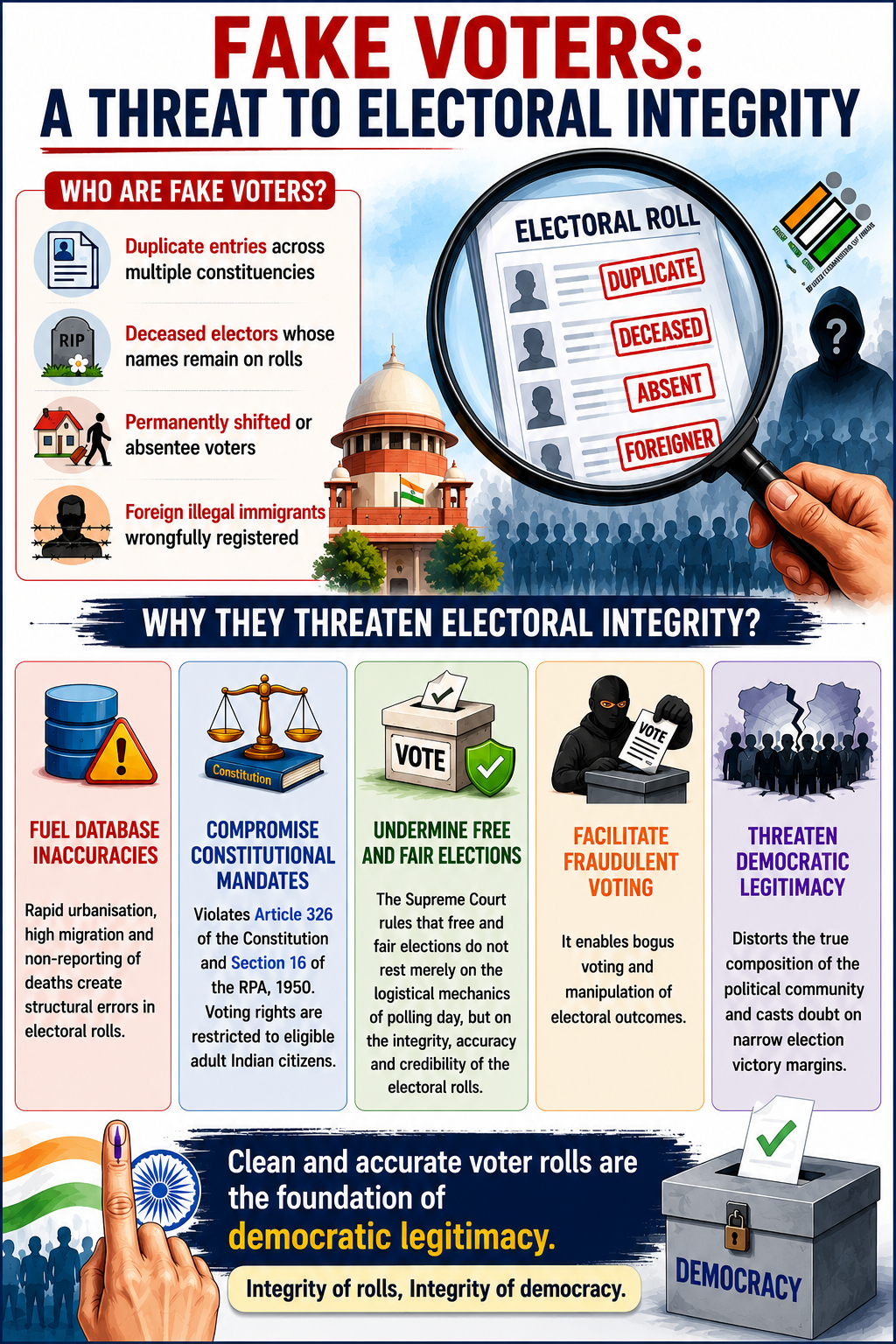 What Measures India Adopted to Prevent Electoral Fraud?
Executes Special Intensive Revisions (SIR)
The Election Commission of India (ECI) invokes its plenary powers under Article 324 of the Constitution and Section 21(3) of the RPA, 1950 to conduct the nationwide Special Intensive Revision (SIR) to comprehensively verify and purify electoral rolls.
Mandates House-to-House Enumeration
The ECI deploys Booth Level Officers (BLOs) to conduct physical, door-to-door field verification, distribute pre-filled enumeration forms, and collect fresh data from existing and newly eligible electors.
Imposes Strict Documentary Verification
The state requires voters to submit hierarchical proof of eligibility from an approved list of 11 to 12 documents (such as Birth Certificates, Passports, or Forest Rights Certificates) to verify age, residency, and citizenship.
Deploys Algorithmic Deduplication and Mapping
The ECI utilizes centralized software (like ERONET) to digitise historical voter lists (e.g., 2002-2004 rolls) and automatically flag logical discrepancies—such as abnormal family sizes, impossible parent-child age gaps, and phonetic spelling mismatches—to detect suspect or fraudulent entries.
Facilitates Aadhaar-Voter ID Linkage
The government enacted the Election Laws (Amendment) Act, 2021 to allow the voluntary linking of Aadhaar numbers with Elector Photo Identity Cards (EPIC) to weed out duplicate registrations and authenticate voters biometrically.
Establishes Grievance Redressal Mechanisms
The ECI publishes draft electoral rolls to invite public scrutiny and allows citizens to file claims and objections. It also sets up a two-tier appellate mechanism involving District Magistrates and Chief Electoral Officers to resolve disputes fairly before final publication.
Integrates Booth Level Agents (BLAs)
The ECI invites recognized political parties to appoint Booth Level Agents to monitor the revision process, verify forms locally, and resolve discrepancies at the preparation stage to enhance overall transparency
Simplify Documentation Requirements
The State must establish simple and accessible documentation rules by accepting widely held, common proofs of identity—such as the Aadhaar Card, Elector Photo Identity Card (EPIC), and Ration Cards—to prevent the disenfranchisement of marginalized and undocumented groups.
Regulate Algorithmic Tools
The ECI must stop relying on opaque, untested software algorithms to detect "logical discrepancies," as automated translations and rigid parameters erroneously flag millions of legitimate voters as suspicious.
Prioritize Physical Verification
Election authorities must align any automated database checks with robust, door-to-door physical field verification by Booth Level Officers, as physical enumeration remains the most effective method for updating rolls accurately.
Prevent Burden Shifting
The electoral system must ensure the burden of proof does not unfairly shift entirely onto the citizen, treating non-inclusion as a substantive constitutional injury rather than a routine administrative error.
Build Administrative Capacity
The State must develop sufficient administrative capacity by equipping local officers, adequately staffing appellate tribunals, and ensuring disputes resolve swiftly before election days.
Ensure Data Privacy and Security
The government must enact a robust data protection law to safeguard citizens against the misuse of integrated biometric databases (like Aadhaar-Voter ID linking), thereby preventing voter profiling, data leaks, and political microtargeting.
Maintain Institutional Neutrality
The ECI must act with absolute neutrality and transparency, publishing clear written protocols for local officers and openly disclosing the names and reasons for all draft voter deletions.
The integrity of Indian democracy depends on an electoral system that effectively purges fraudulent entries while proactively safeguarding every eligible citizen's right to vote.
Source: INDIAN EXPRESS
|
PRACTICE QUESTION Q. With reference to the Special Intensive Revision (SIR) of electoral rolls, consider the following statements: 1. The power to conduct SIR is derived exclusively from the Representation of the People Act, 1951. 2. Article 324 of the Constitution serves as the foundational source of the ECI's authority over the preparation of electoral rolls. 3. Deletion of a name from the electoral roll on the ground of doubtful citizenship constitutes a legal declaration of non-citizenship. Which of the statements given above is/are correct? (a) 1 and 2 only (b) 2 only (c) 2 and 3 only (d) 1, 2, and 3 Answer: (b) Explanation: Statement 1 is incorrect: The statutory power to conduct a Special Intensive Revision (SIR) of electoral rolls is derived from Section 21(3) of the Representation of the People Act, 1950 (which governs the preparation and revision of electoral rolls), not the Representation of the People Act, 1951 (which primary deals with the actual conduct of elections). Statement 2 is correct: Under Article 324 of the Constitution of India, the Election Commission of India (ECI) is explicitly vested with the foundational plenary power of superintendence, direction, and control of the preparation of electoral rolls. Statement 3 is incorrect: In its landmark judgment, the Supreme Court of India clarified that deleting a person's name from the voter list on citizenship grounds simply means the ECI was "unable to be satisfied" of their eligibility for electoral purposes. It does not constitute a legal or final adjudication of non-citizenship. Final determination of citizenship falls exclusively under the domain of competent authorities via the Ministry of Home Affairs and the Citizenship Act. |
SIR is a comprehensive voter list verification process involving house-to-house visits by Booth Level Officers (BLOs) to identify eligible citizens, remove duplicate entries, and eliminate names of deceased or shifted voters to ensure a "clean" electoral roll.
The ECI has clarified that Aadhaar is optional. No voter can be denied registration or deleted from the roll solely for failing to provide an Aadhaar number, as alternative documents are accepted.
Aggrieved persons can file a 1st Appeal before the District Magistrate (DM) and a 2nd Appeal before the Chief Electoral Officer (CEO). They may also seek judicial review through High Courts.
© 2026 iasgyan. All right reserved